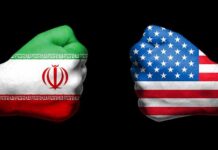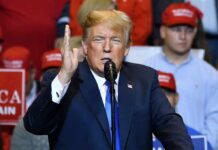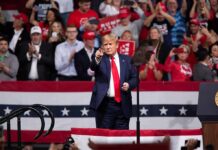
Trump’s warning to Israel that fresh Lebanon strikes could “blow” an Iran deal exposes how fast war and diplomacy can collide—and how easily Washington can lose the thread.
Story Snapshot
- Trump urged Israel to halt new strikes, linking calm to a near-term Iran deal timeline [6].
- Mixed messages surfaced as Trump also praised earlier Israeli strikes as “excellent” [1].
- Reports described an unfinalized, fragile U.S.-Iran understanding under heavy fire [7].
- Israeli actions were framed as responses in a long escalation cycle, not random shots [10].
Trump’s Message: Stop Now Or Risk The Deal
President Donald Trump told Prime Minister Benjamin Netanyahu to pause further military action, according to reporting that said he placed two calls in 24 hours urging no new retaliation. Those accounts linked his push for restraint to the final stretch of a possible agreement with Iran, described as days away if fighting eased [6]. Trump’s warning matched a familiar pattern: make space for talks by cooling the battlefield, then try to lock in text before another flare-up wrecks the runway.
Trump also told both sides to stop shooting after new exchanges, signaling that the White House viewed any extra strike as a direct risk to diplomacy [8]. That stance followed public claims that a signing could come soon, even as officials argued over terms in public and in the press [7]. This is the tightrope of war-time bargaining. Each day without a strike can build trust. Each new blast can shake it. The gap between “almost done” and “dead” is often one missile away.
Mixed Signals: Praise For Strikes And A Push For Restraint
Trump publicly praised earlier Israeli strikes on Iran as “excellent,” while also warning that more could push Tehran toward a deal—or push it away if the violence spread [1]. Israeli media and commentators reported Israeli anger over reported deal contours, reflecting fear that Washington might accept terms short of Israel’s stated war aims [3]. These split-screen messages are not new in U.S.-Israel crisis management. Leaders often talk tough for deterrence while working the phones to slow the next punch.
Confusion over the actual state of the deal deepened the noise. Coverage highlighted clashing statements from Washington and Tehran about how close things were and what each side had agreed in principle [7]. Without a public draft, claims became political tools. Supporters argued urgency. Critics warned of concessions. In that fog, every headline about a strike in Beirut or near the Strait of Hormuz risked changing the price of entry for both capitals, or handing leverage to hardliners on each side.
Israel’s Security Case And The Escalation Cycle
Israel argued it was striking to blunt threats from Iran and its partners, not to spoil talks. Reporting showed an escalation that had run for months, with both sides trading blows and threatening more as Trump pressed for calm [10]. From Israel’s view, security needs do not pause for talks that are not final. From Washington’s view, every new strike invites a counterstrike that can erase weeks of shuttle work. Both claims can be true at once—and that is the problem.
Foreign news outlets said a new Israeli strike on Beirut could undercut the talks by showing that Washington could not restrain its ally or chose not to do so [9]. That allegation underscores a broader reality: if the White House cannot enforce a pause with friends, it is even harder to demand restraint from foes. Trump’s prior history of calling off U.S. strikes in tense moments shows he knows how fast a military response can outrun the political plan [5].
Why This Matters For Americans
Energy prices, shipping lanes, and the risk of a wider war all hinge on whether guns fall silent long enough to finish a text everyone can live with. Families already squeezed by inflation and high energy costs feel every shock at the pump. Veterans and military families hear talk of “limited strikes” and remember how limits fade. Both conservatives and liberals see a familiar pattern: leaders promise peace, yet secret talks and sudden hits keep resetting the clock without real accountability.
Trump drawing another hard line on Israel/Lebanon/Hezbollah while the Iran deal keeps getting teased? It’s starting to feel like the same cycle on repeat: headline, hope rally, escalation, reset. Markets have been whipsawed on this loop for weeks now.
— USstocks-Sally (@PrettyFlocko_A1) June 14, 2026
Many Americans also see the “deep state” concern here. Power brokers trade leaks and shape headlines while the public gets fragments. One day a deal is “close.” The next day it is “not agreed.” The facts we can verify are simple: Trump urged a pause to protect a fragile track [6][8]; he also praised prior Israeli action [1]; media in Israel and abroad flagged anger over terms and doubt over U.S. leverage [3][9][7]. Until leaders publish terms, treat every grand claim with care.
Sources:
[1] Web – ‘Let’s Not Blow It!’: Trump Warns Israel’s Lebanon Strikes Could …
[3] YouTube – Trump warns Israel not to “blow it” by attacking Iran before nuclear …
[5] YouTube – Iran, Israel pause strikes as Trump warns both to stop
[6] Web – Trump Says He Canceled Strikes On Iran, Hours After Making Threat
[7] YouTube – US & Iran trade blows, say different things about a deal & …
[8] YouTube – US-Iran Deal Confusion Deepens As Trump, Tehran Trade Claims …
[9] YouTube – Trump demands Israel and Iran to ‘STOP SHOOTING’ as …
[10] Web – Iran war latest: New Israeli strike on Beirut could undermine talks …