
The United States has locked in a 99‑year deal to build a permanent embassy in Jerusalem on land Palestinians say was taken from their families.
Story Snapshot
- Israel approved a long-term U.S. Embassy site at Jerusalem’s Allenby Complex, cementing Trump’s 2018 recognition of the city as Israel’s capital.
- The land comes from a 1989 Israel–U.S. lease, but Palestinian researchers say most of the plot is confiscated refugee property once owned by 76 Palestinian families.
- Supporters call the project a symbol of strong U.S.–Israel ties and a stand against Iran; critics see it as proof that powerful governments can override private land rights.
- The embassy move fits a wider pattern in the region where land disputes and diplomatic symbolism often outweigh clear, transparent property records.
Israel and the U.S. Seal a Long-Term Embassy Site
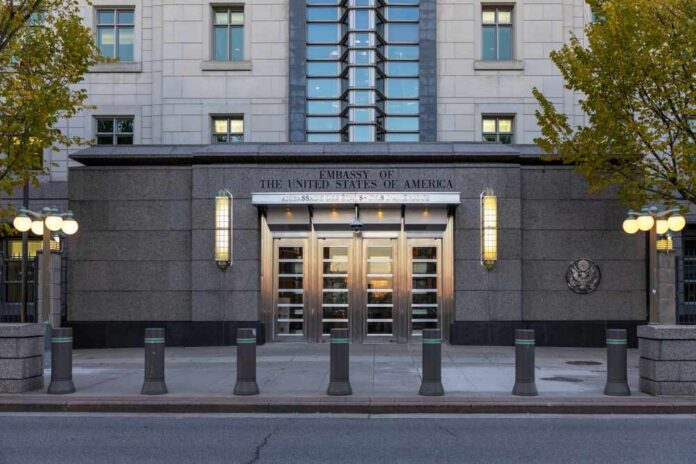
The Government of Israel approved a plan to allocate land at the Allenby Complex in Jerusalem for a permanent United States Embassy, backed by Prime Minister Benjamin Netanyahu, Foreign Minister Gideon Sa’ar, and Construction and Housing Minister Haim Katz. Officials say this “completes a major diplomatic move” that began when President Donald Trump recognized Jerusalem as Israel’s capital and moved the embassy there in 2018. The new compound would replace the current embassy in the Arnona area and stand as a lasting symbol of Washington’s support for Jerusalem as Israel’s seat of government.
The Allenby site traces back to a 1989 land lease between Israel and the United States for a former British military area known as Allenby Barracks in West Jerusalem. Under that deal, Israel leased about 7.8 acres for “diplomatic facilities” to the U.S. for 99 years at a token rent of one dollar per year, under the condition that the land be free of any third-party claims. Supporters point to this agreement to argue the project rests on long-standing, legal arrangements, not a sudden land grab, and they frame the new embassy as one more step in a decades-long alliance that now includes joint efforts against Iran.
Palestinian Families Say the Embassy Plot Is Their Confiscated Land
Palestinian researchers, lawyers, and families strongly dispute the idea that the Allenby site is neutral state land, saying most of it is private property taken from refugees after 1948. A detailed study using records from United Nations bodies, British archives, and Israeli land registries concludes that at least 70.52 percent of the planned embassy plot is confiscated refugee land and that more than a third is part of an Islamic trust, or waqf. The research identifies 76 Palestinian owners on the eve of Israel’s independence, and families such as those of historian Rashid Khalidi have produced rental contracts and other documents to show that their relatives leased the land to the British Mandate authorities before 1948.
Palestinian rights groups and U.S. citizens of Palestinian descent have submitted these records to Israeli officials, arguing that building the embassy on this land would turn an old injustice into a permanent fact on the ground. One Palestinian legal group says it found proof in Israeli archives that the land’s condition in the 1989 lease—that it be free of claims—does not match reality, and that Israel misled the United States about its status. Critics warn that if the project moves ahead without a transparent review of ownership, it will signal to ordinary people across the region that powerful governments can ignore written deeds and refugee rights when big political goals are at stake.
Symbolism, Power, and Why This Story Resonates in America
For many Israelis and American conservatives, a large embassy in Jerusalem feels like a win for national strength, clear borders, and an “America First” foreign policy that backs close allies and stands firm against enemies like Iran. They see Trump’s 2018 move and this permanent site as long overdue recognition of a reality on the ground: that Israel’s government sits in Jerusalem and has done so for decades. From this angle, the embassy plan looks like decisive leadership at a time when global bodies like the United Nations often seem slow, biased, or ineffective.
For many Palestinians and human-rights advocates, the same project tells a very different story—one where refugee families lose their homes, and then watch world powers turn those homes into official compounds. They point out that international law debates still treat parts of Jerusalem as occupied or contested land, and that calling the new plot “indisputably Israeli sovereign territory” brushes aside those concerns. For Americans on both the right and the left who already feel the federal government listens more to lobbyists and foreign policy insiders than to regular citizens, this fight over a symbolic piece of land can look like another example of elites cutting quiet deals while property rights, transparency, and fairness come second.
Why This Embassy Deal Fits a Bigger Regional Pattern
Conflict over the Allenby site fits a pattern seen across the Middle East, where states pick “strategic” plots for embassies or bases in cities with tangled ownership histories. Researchers tracking these cases say that in most disputes, governments win out over private title deeds, especially when the land sits in a capital city or carries strong national symbolism. In Jerusalem, earlier projects have already raised similar complaints, including claims that parts of the existing U.S. Embassy compound extend into areas once treated as no-man’s land or occupied territory under international rules.
I bet @POTUS is proud of the real estate deal I made for USA today-acquired multi million $$ property for new US Embassy in Jerusalem for 1 American dollar! My friend @IsraelMFA Gideon Sa’ar gets the dollar. pic.twitter.com/CLIynVvYHc
— Ambassador Mike Huckabee (@GovMikeHuckabee) July 1, 2026
On the surface, this new deal is about concrete, security walls, and visa lines for the roughly hundreds of thousands of Americans living in or visiting Israel. Beneath that, it echoes many frustrations back home in the United States. People who worry about unaccountable “deep state” power, unequal treatment, or a government too quick to make permanent decisions without public debate will see this story as one more warning sign. Until there is a clear, independent review of who owns the Allenby land and how the 1989 lease fits that record, the embassy may stand less as a house of diplomacy and more as a monument to how political goals can override ordinary people’s rights.
Sources:
insiderpaper.com, embassies.gov.il, palestine-studies.org, atlantajewishtimes.com, facebook.com, everycrsreport.com, jerusalemstory.com, jpost.com, thenationalnews.com, nytimes.com, instagram.com, acleddata.com