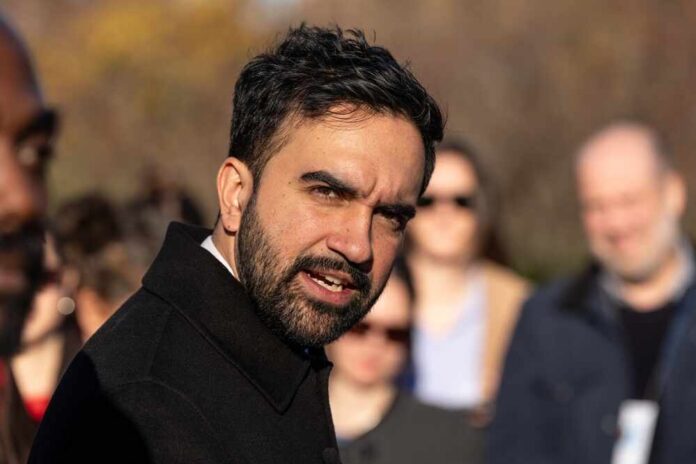
When a Florida governor says a New York mayor’s agenda looks like “communism,” it forces a deeper look at whether bold city experiments are fixing the system—or speeding up its collapse.
Story Snapshot
- Ron DeSantis is using Zohran Mamdani’s New York City agenda as a warning sign for the whole country.
- Mamdani backs city-supported grocery stores and a new community safety department, while rejecting calls to abolish police.
- DeSantis says these ideas echo failed socialist promises and will drive taxpayers south, but offers little hard proof.
- The clash highlights a bigger problem both left and right see: government spending more, delivering less, and ducking accountability.
DeSantis’s Core Questions: Who Pays, Who Leaves, Who Decides?
Florida Governor Ron DeSantis has turned New York City Mayor Zohran Mamdani into a symbol of what he calls runaway “socialist” city policy. In a Gainesville press conference, he stressed that New York City’s budget, serving about eight million people, is now larger than the entire State of Florida’s budget for over twenty million residents. He asked why a smaller city needs more money than a larger state, and what taxpayers actually get in return. That taps into a common fear: government keeps growing while basic services still feel broken.
DeSantis pushes the point further with migration numbers, warning that high taxes and heavy spending will drive New Yorkers to Florida and push Palm Beach property values higher. He has also cited earlier data showing hundreds of thousands leaving neighboring New Jersey, tying those exits to similar left-leaning policies. But none of this data is directly tied to Mamdani’s short time in office or his specific plans. That raises a fair question: are people fleeing a mayor, or a bigger pattern of long-term mismanagement and rising costs?
Mamdani’s Agenda: City-Supported Groceries and “Community Safety”
Zohran Mamdani ran and won on a sweeping list of promises: rent freezes for millions of tenants, free public transit, free childcare, and higher wages funded by new taxes on corporations and high earners. One of the most controversial ideas is a network of city-backed grocery stores aimed at lowering prices in underserved neighborhoods. DeSantis calls these **government-run grocery stores** and argues they will end in waste and shortages, comparing the pitch to old socialist experiments that never worked.
But Mamdani’s plan is narrower and more structured than DeSantis suggests. He is talking about a pilot of about five stores with roughly sixty to seventy million dollars in public support, not a takeover of the entire food market. A key early site, La Marqueta, is set up so the city helps with rent and construction but brings in a private operator to actually run the store day to day. That hybrid model still puts taxpayers on the hook, but it is not the pure state-run supermarket DeSantis describes, which complicates claims that it will automatically fail like past one-party economies.
Policing, Community Safety, and the “Abolish NYPD” Charge
DeSantis tells audiences that Mamdani wants to “abolish the New York Police Department” and replace officers with social workers in dangerous areas. For many conservatives and liberals alike, that hits a nerve. They already feel unsafe and doubt that city leaders take crime seriously. Yet Mamdani has said in debate that he does not support defunding or abolishing the police. He argues instead for reform and for a broader Department of Community Safety that includes outreach workers and violence prevention programs alongside traditional policing.
That gap between what Mamdani says and how DeSantis describes it matters. Researchers who studied hundreds of cities over thirty years found that switching from a Republican mayor to a Democratic mayor did not cause clear changes in crime rates or arrest levels. In other words, the party label often hides a more mixed reality on the ground. Mamdani’s push to add mental health outreach and hate violence prevention does raise questions about overlap, cost, and results. But calling that “abolition” or proof that he “hates the police” stretches beyond the available facts and feeds the sense that national leaders spin fear more than they share data.
Budgets, Groceries, and a Shared Distrust of the “Elites”
DeSantis’s strongest point is not a slogan; it is a number. He notes that New York City’s budget has grown so large that it now outstrips Florida’s, even as many New Yorkers say roads, transit, and basic quality of life are not improving in step. That mismatch speaks to conservatives angry about overspending and liberals angry about inequality. Both sides see a system where taxes go up, programs multiply, and yet working families still feel squeezed by housing, food, and energy costs.
Mamdani, for his part, is targeting some of the same elites that many Americans blame. He has backed a tax on luxury “pied-à-terre” apartments worth more than five million dollars, arguing that ultra-wealthy absentee owners should help fund services for residents who actually live in the city. DeSantis warns that this will drive more capital and people out of New York. Mamdani counters that without asking more from the top, the city cannot pay for rent relief, child care, or fair wages. Both men frame themselves as defenders of ordinary people, yet neither has offered a full, independent audit that proves their path will truly lower costs rather than feeding another cycle of big promises and bigger bureaucracies.
What This Fight Reveals About America’s Broken System
This clash between a conservative governor and a progressive mayor fits a long-running pattern in the United States. Studies of mayors across the country show that Democratic city leaders in conservative states often feel blocked and undercut by state governments that hold the purse strings and set many rules. That tension invites dramatic rhetoric on both sides. It also distracts from deeper questions: why do so many budgets keep growing while basic services lag, and why do so few leaders submit their big ideas to tough, independent review before rolling them out?
For many Americans over forty, whether conservative or liberal, this story confirms a bigger worry—that the political class and their allies in business and media are playing power games while the cost of living and fear of disorder climb. DeSantis is right to ask what massive city spending and new departments will deliver for ordinary people. Mamdani is right to challenge a status quo that left many neighborhoods as food deserts and many workers stuck. What is missing so far is hard, transparent evidence, not just sound bites, showing that either man’s approach will finally break the pattern of government promising the American Dream while pushing it further out of reach.
Sources:
twitchy.com, nypost.com, gnvinfo.com, miamiherald.com, floridapolitics.com, reddit.com, youtube.com, maciverinstitute.com, facebook.com