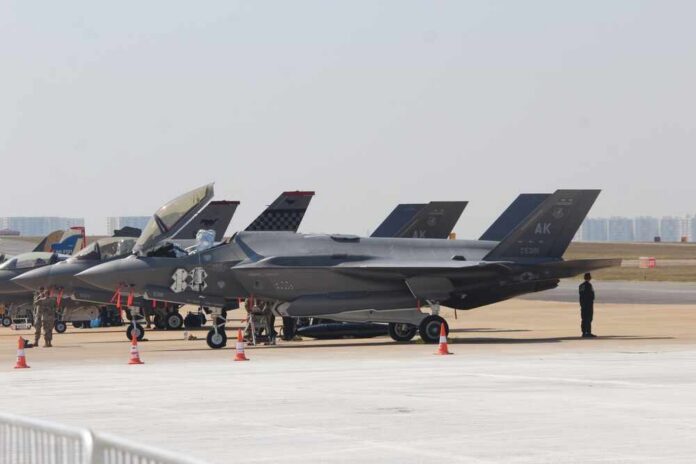
As Washington weighs selling its most advanced F‑35 stealth jets to Turkey, Israel’s prime minister is warning that America could be arming a NATO ally whose Russian missiles might spy on U.S. technology and erase Israel’s edge in the skies.
Story Snapshot
- Israeli Prime Minister Benjamin Netanyahu is pressing U.S. leaders not to approve F-35 sales to Turkey, arguing the move would endanger Israel and upset the regional balance of power.
- Netanyahu’s lobbying comes as President Trump signals he may lift sanctions and consider new jet deals with Turkey if Ankara’s Russian S-400 missile system is somehow neutralized.
- Turkey was kicked out of the F-35 program in 2019 for buying the Russian S-400 system, and U.S. law now bars F-35 transfers while that system remains in Turkish hands.
- Behind the jet drama is a bigger fight over who sets U.S. policy: elected leaders accountable to voters, or a small circle of foreign and domestic security insiders guarding secret weapons deals.
Netanyahu’s Quiet Push to Stop the F‑35 Sale
Israeli Prime Minister Benjamin Netanyahu has been working behind the scenes to stop any U.S. plan to sell F-35 fighter jets to Turkey. According to multiple reports, he raised the issue several times this spring with U.S. Secretary of State Marco Rubio, pushing him to block the sale because of Turkey’s growing military role in Syria and its tense relationship with Israel. Netanyahu fears that if Turkey flies the same advanced jets Israel uses, Israel will lose the clear air power advantage it has relied on for years to deter threats and strike enemies first.
Netanyahu’s warnings are not just private phone calls. Israeli media and regional outlets say he has also vowed publicly to raise the issue directly with President Trump and has framed the possible sale as a direct risk to Israel’s security. Israeli diplomats have echoed this line, arguing Turkey’s “hostile” behavior in the region means it should not receive the most advanced American jets at this time. Members of the U.S. Congress have joined in, with several lawmakers pushing letters and statements urging the White House to keep F-35s out of Turkish hands because of both Israeli security and the risk of Russian intelligence gaining access.
Why Turkey Was Kicked Out and What Has Changed
Turkey was once a core partner in the F-35 program. It helped build parts for the jet and planned to buy over 100 aircraft. That changed in 2019 when Ankara bought Russia’s S-400 air defense system, ignoring repeated U.S. warnings that mixing Russian radar with American stealth technology could expose valuable secrets. In response, Washington removed Turkey from the F-35 consortium, cut off related contracts, and imposed sanctions under the Countering America’s Adversaries Through Sanctions Act, locking Turkey out of new U.S. fighter deals.
Since then, Congress has written strict rules into law. Section 1245 of the 2020 defense bill says the United States cannot send F-35 jets, parts, or technical data to Turkey unless the Secretary of State and the Secretary of Defense certify that Turkey no longer possesses the S-400 system and promises not to buy similar Russian gear again. Turkey has kept the S-400 in storage and has not fully deployed it, but that is not enough under U.S. law. Legal experts and former officials say any jet transfer now would clearly break the statute, which was designed to keep advanced American weapons away from Russian sensors.
Trump’s Signals and the Bigger Power Struggle
Despite these legal barriers and Israeli pressure, President Trump has sent mixed signals about his plans for Turkey. Reports say he is considering lifting some sanctions and moving forward with other jet engine sales to help Turkey’s domestic fighter program, and has even stated he is “thinking very seriously” about an eventual F-35 deal if both sides can agree on a way to neutralize the S-400. That could mean mothballing the Russian system, handing it over to U.S. control, or some other workaround that keeps it away from American aircraft.
Netanyahu urges US not to sell F-35 fighter jets to Turkey https://t.co/dEGmESUgi0
— Turkish Minute (@TurkishMinuteTM) July 6, 2026
For many Americans, this saga fits a familiar pattern. A complex arms deal is shaped not by open debate in Congress, but by quiet talks between presidents, defense contractors, foreign leaders, and security bureaucrats who never face voters directly. Israel, a close ally with its own powerful defense lobby, has long pushed Washington to protect its “qualitative military edge” and to delay or condition new jet sales to Arab states and Turkey. At the same time, companies and officials see big money and leverage in expanding F-35 exports, even to governments whose values and actions often clash with American principles.
Shared Concerns Across America’s Political Divide
Netanyahu’s push against the F-35 sale taps into fears on both the left and the right in the United States. Conservative voters worry that giving cutting-edge jets to unstable or authoritarian leaders could drag America into new wars, waste taxpayer money, and strengthen foreign militaries while U.S. forces struggle with budget fights and aging equipment. Liberal voters see another example of weapons deals driving policy, with little regard for human rights, civilian lives, or long-term peace. They point to how advanced jets, including Israel’s own F-35 fleet, have been used in heavy bombing campaigns that raise serious moral questions.
Many ordinary Americans, regardless of party, also see a deeper problem. The same “deep state” they blame for endless wars and bloated budgets now appears ready to bend complex laws and ignore allies’ concerns to keep a troubled partner like Turkey inside the U.S. orbit. Netanyahu warns that an F-35 sale would upset the regional balance and endanger Israel; critics warn it would once again prove that the most important voices in Washington belong not to citizens, but to those who build, sell, and trade in weapons—far above the reach of most voters’ control.
Sources:
insiderpaper.com, middleeasteye.net, ynetnews.com, youtube.com, x.com, thehill.com, facebook.com, turkishminute.com, timesofisrael.com, reddit.com, fddaction.org, behindthefront.substack.com, jinsa.org, reuters.com, globalr2p.org, warontherocks.com