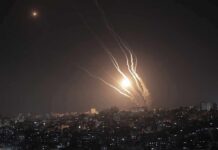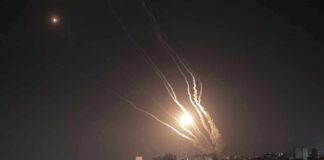
After Iran’s missile-and-drone barrage lit up the region, Britain, France, and Germany signaled they may join strikes aimed at destroying launch capabilities “at their source”—a major escalation with direct consequences for U.S. forces and allies.
Story Snapshot
- Britain, France, and Germany issued a joint statement saying they could enable “necessary and proportionate defensive action” against Iran’s missile and drone capabilities.
- The European leaders condemned Iran’s “indiscriminate” retaliation across the region while stressing they did not participate in the initial U.S.-Israeli strikes.
- U.S. strikes reportedly hit Iranian ballistic missile facilities, and three U.S. service members were reported killed as the conflict widened.
- Iran’s leadership is in flux after the reported killing of Supreme Leader Ayatollah Ali Khamenei, with Tehran saying a successor would be chosen within days.
Europe’s “Defensive Action” Language Signals a Wider War Footprint
Britain, France, and Germany—often called the “E3”—said on March 1, 2026, they are prepared to take steps to defend their interests and regional allies, including “necessary and proportionate defensive action” against Iran’s ability to fire missiles and drones. The statement frames the potential action as defensive and targeted at launch capabilities, not as open-ended regime change. Even so, European participation would widen the conflict beyond the U.S.-Israel front.
The E3 also drew a bright line around the opening phase of the conflict, stating they did not participate in the initial strikes that preceded Iran’s retaliation. That distinction matters diplomatically, but it doesn’t change the operational reality: if Europe begins enabling strikes, Iran could treat European assets, bases, and personnel as part of the battlefield. The E3 messaging attempts to balance deterrence with restraint while keeping credibility for future talks.
What Triggered the Crisis: U.S.-Israel Strikes and Iran’s Regional Retaliation
The U.S. and Israel launched strikes on February 28, 2026, killing Iran’s Supreme Leader Ayatollah Ali Khamenei and other senior leaders—an extraordinary move that immediately raised the odds of rapid escalation. Iran responded the next day with “large-scale” missile and drone attacks aimed at Israel, U.S. military installations, and Gulf Arab states. At least nine people were reported killed in Beit Shemesh, Israel, underscoring the civilian stakes.
U.S. operations reportedly included B-2 stealth bombers striking Iranian ballistic missile facilities with 2,000-pound bombs, as Washington sought to reduce Tehran’s capacity to continue launching attacks. President Trump also claimed major damage to Iranian naval assets, though some battlefield claims can be hard to independently verify in real time. Separately, reports said three U.S. service members were killed, marking known American casualties and putting added pressure on decision-makers to protect deployed forces.
Iran’s Leadership Vacuum Adds Uncertainty to Deterrence and Diplomacy
Iran’s internal situation is now a major variable. Iranian President Masoud Pezeshkian said a new leadership council has begun operating and that a new supreme leader would be chosen within “one or two days.” Leadership transitions in authoritarian systems can be stabilizing or explosive, depending on who consolidates power and whether hardliners interpret outside pressure as a reason to expand the fight. Public reporting noted deserted streets and heightened internal security measures in Tehran.
Iran’s foreign minister, Abbas Araghchi, said Tehran is prepared to defend itself “by any means necessary,” language that signals a willingness to keep striking if leadership believes deterrence requires it. For American families watching yet another Middle East crisis unfold, the key facts are these: the U.S. already has casualties, Iran has shown it can target a wide geography, and European powers are positioning themselves to help suppress Iran’s missile-and-drone threat if attacks continue.
The Narrow Diplomatic Off-Ramp: Talks Amid Escalation
Despite the military trajectory, multiple parties have left a door open to negotiations. The E3 statement paired condemnation of Iran’s attacks with calls for resuming negotiations, reflecting Europe’s preference for diplomatic containment alongside credible defensive capacity. President Trump also said he would speak with Iran’s new leadership, suggesting Washington is looking for a route to halt the exchange while protecting U.S. interests and regional allies. No timeline or format for talks has been publicly detailed.
Britain, France and Germany Say They Could Join Attacks on Iran Through ‘Necessary and Proportionate Defensive Action’ https://t.co/jpoi4r77mj #gatewaypundit via @gatewaypundit
— Thomas Register (@Gregister) March 2, 2026
The strongest confirmed takeaway is that the E3 is trying to deter further Iranian strikes while avoiding responsibility for starting the conflict. The least certain pieces involve casualty totals and the exact scale of damage claimed by governments during fast-moving combat. What is clear is that missile-and-drone warfare is driving policy decisions, and any broader coalition activity will hinge on whether Iran continues targeting U.S. positions and partner states across the region.
Sources:
France, Germany, UK ready to take defensive action against Iran
Joint statement by the leaders of France, Germany and the United Kingdom on Iran (Feb. 28, 2026)
Britain, France, Germany ready to work with US to stop Iran’s retaliatory attacks
UK, France, Germany vow defensive action against Iran’s missile, drone capabilities
Joint E3 leaders statement on Iran: 28 February 2026