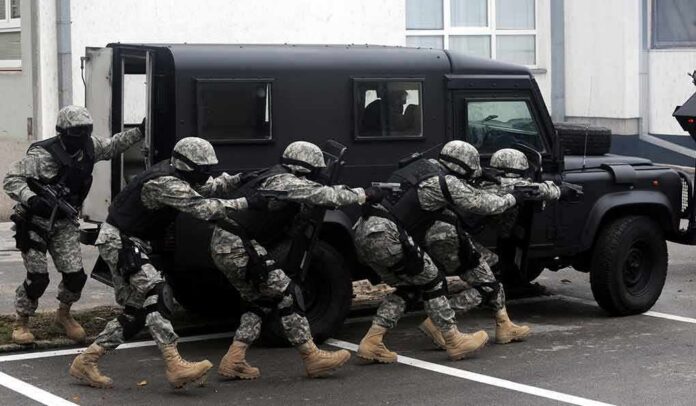
A lethal ambush in eastern Congo reportedly left about 20 dead or wounded and spotlighted how private contractors are now on the front line of a shadow war.
Story Snapshot
- Sources said Rwandan forces carried out the ambush on a Vectus Global team supporting Congo’s army.
- Former UFC fighter and U.S. Green Beret Tim Kennedy was wounded; a New Zealand veteran was reportedly killed.
- The attack showed military-style planning during movement between locations, according to sources.
- Congo’s conflict with the M23 movement and alleged Rwandan backing formed the backdrop.
What Happened In South Kivu
Reuters-based reports said a Vectus Global team moving between locations in South Kivu was ambushed on September 17. Sources with direct knowledge attributed the attack to Rwandan military forces, citing the operation’s sophistication and timing. The strike reportedly caused about 20 casualties among Congolese personnel and foreign contractors. Former UFC fighter and U.S. Green Beret Tim Kennedy was wounded by three shots to the leg. A New Zealand special forces veteran, identified in local reporting as Justin Conaglen, was reportedly killed.
A Congolese government source said Rwandan forces aligned with the M23 movement may have tracked a surveillance drone to locate the team. That account described a surprise attack timed to movement, which is a vulnerable phase in most patrols. Vectus Global declined to comment in initial reporting. Rwanda has broadly denied backing M23 in the past, but the available articles did not include a specific Rwandan response to this incident. The casualty pattern suggested a planned, coordinated action rather than a brief skirmish.
Who Was Targeted And Why It Matters
The team reportedly supported the Armed Forces of the Democratic Republic of the Congo under a Vectus Global contract linked in coverage to Erik Prince. United Nations expert reporting described the contract as including border security, aircraft support, and strategic advice, with recruitment of former foreign military personnel. Such work can make contractors targets in a war shaped by states, proxies, and militias. The attack came as Congo’s forces fight the M23 movement across eastern provinces rich in minerals and contested routes.
United Nations expert findings and major outlets have described Rwandan support to M23 over recent years, which Congo and some partners say changed the battlefield. Legal and policy studies note that proxy warfare often blurs the line of responsibility. When states aid or advise a proxy, outside observers can link actions to the sponsor even without open command ties. That pattern fits eastern Congo, where groups overlap, uniforms vary, and control can shift from road to road.
How This Fits A Wider Trend
Eastern Congo shows how modern wars mix national armies, rebel groups, and private contractors. Research on proxy conflict finds that labeling an attack as “by a proxy” can reduce how much the public blames the sponsor government, which can encourage deniable action. Cybersecurity scholarship describes how investigators piece together likely culprits from technical and circumstantial clues, rather than one smoking gun. The South Kivu ambush echoes that reality: contested space, layered actors, and hard choices about risk.
INTELLIGENCE BRIEF
Subject: Reported Ambush of Vectus Global/FSG Personnel — Eastern DRC
Date: 10 October 2026
Classification: Open-Source Assessment📌 SUMMARY
In mid‑September 2026, personnel linked to entities Vectus Global and FSG — both associated with Erik Prince,… pic.twitter.com/n3xJwOSfeU
— INTELLIGENCE FRONT⚡️ (@IntelFrontUnit) October 10, 2026
For Americans, the story raises pocketbook and principle concerns. Private contractors now fly, train, and advise in places where great powers compete. That can protect interests, but it also exposes U.S. veterans working abroad to sudden danger. Conservatives see another risky fight far from home. Liberals see a widening role for private force. Both sides see a system where powerful players strike deals while regular people pay the price in blood and taxes.
What To Watch Next
Officials in Congo could release an incident review that clarifies how the ambush unfolded and who ordered it. Any technical readout from the surveillance drone, if recovered, could show tracking or jamming attempts. International bodies, including United Nations experts, may add findings on armed group support networks. Families and units will seek accountability. Meanwhile, eastern Congo’s war will keep grinding on, and with it the hard question of who really pulls the strings in the shadows.
Sources:
mediaite.com, usnews.com, yahoo.com, athlonsports.com, thebrief.news, nypost.com, x.com