
Tesla showed the world a car that can launch off a ramp, spin in the air, and land on its wheels — and rival flying-car maker Alef Aeronautics immediately said, “welcome to the club.”
Story Snapshot
- Tesla unveiled a Roadster prototype at SpaceX’s Texas facility that briefly flew off a ramp and landed on its wheels.
- Elon Musk said the car uses compressed-air thrusters built with SpaceX technology and claimed 0-to-60 mph in 0.81 seconds.
- Alef Aeronautics publicly welcomed Tesla to the “flying car race,” noting it has worked on the idea for eleven years.
- Tesla has not announced a price or release date, and the flying version is not approved for public roads.
- Flying cars have been promised for nearly a century without ever reaching mass-market production.
Tesla Stages a Flight Demo in Texas
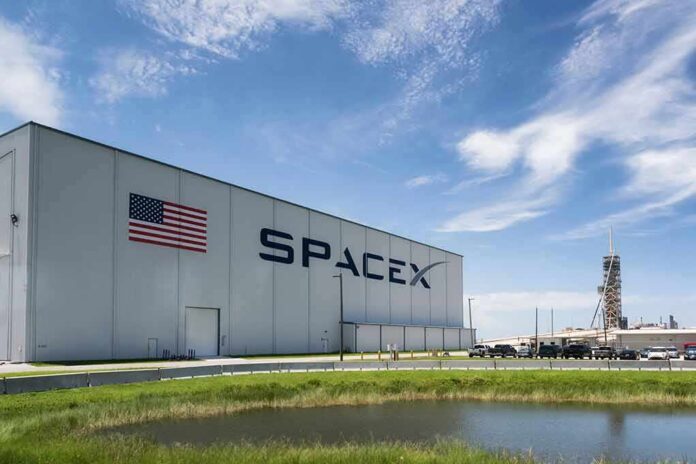
Tesla held a livestream event on October 15, 2026, at SpaceX’s McGregor, Texas facility. The company showed off a new Roadster prototype launching from a curved ramp, rotating in midair, and landing back on its wheels. Reporters at the event described the maneuver as brief but real, giving the public its first look at a Tesla vehicle leaving the ground.
Musk framed the project as a joint effort between Tesla and SpaceX. Coverage of the unveiling described SpaceX-derived compressed-air, or cold-gas, thruster technology built into the car. That link between Musk’s car company and his rocket company turned the event into more than a typical product reveal.
Musk’s Numbers and the Road Ahead
Musk did not just show a concept. He gave specific numbers, including a production target of 2028 and a claimed 0-to-60 mph time of 0.81 seconds. He said the vehicle relies on ultra-high-pressure air tanks and multiple thruster nozzles to get airborne, details that moved the pitch beyond a simple stunt and into a stated engineering plan.
Those numbers have not been independently tested. The 2028 production date, the acceleration claim, and the thruster performance all come from Tesla’s own staged demonstration. NBC News reported that Tesla has not announced a price or a release date for the vehicle, and CNN noted that an aviation expert described the move as closer to a hop than true flight.
A Rival Welcomes the Competition
Alef Aeronautics, a company that has been building flying cars for over a decade, responded the next day. On October 16, 2026, Alef posted on social media: “Welcome @Tesla and @elonmusk to the flying car race! We’ve been here for ELEVEN YEARS!”. The message framed Tesla’s splashy debut against Alef’s longer, lower-profile track record in the same space.
That exchange highlights a gap between attention and track record. Tesla’s reveal drew massive coverage and views within a day. Alef has spent years working on certified flying vehicles with far less media buzz, raising the question of whether Tesla is entering a real product category or simply generating headlines before a rival that has already logged more development time.
Regulatory and Historical Hurdles Remain
Tesla’s own website reportedly states that the flying version of the Roadster is not approved for use on public roads. Combining high-speed driving with pressurized air propulsion creates overlapping safety and legal questions for regulators who oversee cars and aircraft separately, and no timeline for approval has been announced.
History offers a reason for caution. Only two flying car designs, the Fulton Airphibian and the Taylor Aerocar, ever received full government certification, and neither reached mass production. The Aerocar needed 500 firm orders to move forward and never got them. Decades of prototypes, from Moller’s Skycar to Terrafugia’s Transition, followed the same pattern: impressive demos, no mass-market vehicle.
Musk also carries a history of missed deadlines on past promises, a pattern CNN pointed out directly in its coverage of the event. That track record does not undo what the Roadster demonstrated in Texas, but it does mean the 2028 production target will likely draw close watching rather than automatic trust, regardless of how the prototype performed on camera.
Sources:
cbsnews.com, us.cnn.com, nbcnews.com, en.wikipedia.org, thedailybeast.com, planeandpilotmag.com, thevintagenews.com