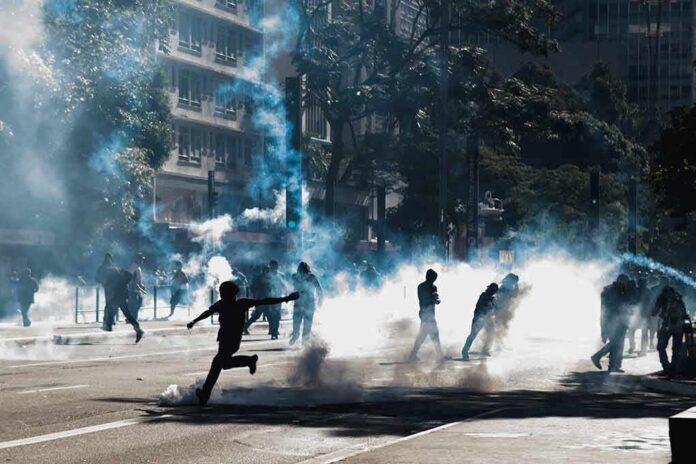
More than 256,000 people marched across France over school funding, and before the day ended, police were firing tear gas, cars were burning, and a government minister was calling parts of it a riot.
Story Snapshot
- The Interior Ministry counted 256,000 protesters nationwide, including 56,000 in Paris, in marches over education funding.
- Police used tear gas in Paris and other cities and fired water cannon in Rennes after a barricade was set on fire in Lyon.
- More than 6,100 people were arrested or stopped by police, with one report putting the figure near 6,547 since late September.
- Interior Minister Laurent Nuñez said the protests had “at times turned into riots” requiring police action.
- A 14-year-old boy suffered a broken jaw, and nearly 50 officers were injured in a single day of unrest.
Hundreds of Thousands Take to the Streets
France’s Interior Ministry reported 256,000 people joined nationwide demonstrations over school funding, with 56,000 marching in Paris alone. The ministry described the bulk of the march as peaceful before trouble broke out at a city square. The numbers mark one of the largest single-day protest turnouts France has seen in years, placing new pressure on a government already managing a tense budget season.
Crowd estimates shifted sharply depending on the day and the outlet reporting them. Some accounts put a later demonstration near 550,000 participants, while another day’s count sat closer to 71,500. The swings reflect how fast-moving and spread out across French cities the protest movement became over several weeks.
Tear Gas and Fires Spread Through Major Cities
Police response escalated alongside the protests themselves. Officers fired tear gas in Paris and other cities, deployed water cannon against crowds in Rennes, and confronted demonstrators in Lyon after a barricade was set ablaze. Near Paris’s Place de la République, a car and a newspaper kiosk caught fire. Reports also linked fires and damage to protests at schools in multiple cities.
Interior Minister Laurent Nuñez said police used proportionate force in “almost all cases” but acknowledged that some gatherings “at times turned into riots, requiring police intervention.” His comments framed the unrest for the government as a public order problem layered on top of the original education funding dispute.
Arrests and Injuries Climb Through the Unrest
The Interior Ministry reported more than 6,100 arrests tied to the protest wave, while another count put arrests or police stops at 6,547 since demonstrations began on September 28. A later report described more than 6,500 arrests total, including nearly 500 detentions on a single Tuesday. The figures mark one of the largest arrest tallies linked to French civil unrest in recent memory.
Injuries piled up on both sides of the clashes. A 14-year-old boy suffered a double jaw fracture after reportedly being struck by a tear-gas grenade, and an officer was later charged in connection with the incident. Separately, 48 officers were hurt in a single day of confrontations, pointing to the intensity of some flashpoints even as most of the marching stayed calm.
A Pattern France Has Seen Before
France has a long history of large, mostly peaceful protests that produce violent flashpoints involving smaller groups or police units. The Yellow Vest movement that began in 2018 was described by researchers as largely peaceful and unarmed, yet it also included vandalism and repeated clashes with police over more than a year. The 2023 pension protests followed a similar shape, drawing millions of peaceful demonstrators alongside documented confrontations.
That history matters for reading the current wave accurately. Reports describe unions, political groups, and students joining the education funding marches, while some participants not aligned with the movement’s goals were blamed for stirring trouble. The pattern suggests France’s current unrest fits a recurring national dynamic rather than a single, uniform riot.
Election Stakes Raise the Pressure
The protests are unfolding as France heads into an early presidential campaign season, raising the political stakes for how the unrest gets defined. A government emphasizing riots and arrests sends one message about law and order. A movement emphasizing school funding and largely peaceful marches sends another. Both are supported by the same set of events, which is part of why the story is drawing international attention.
This is fucking madness and it's infuriating how this barely gets any attention. France protests almost certainly turn into riots. https://t.co/tthNpyFYJH
— Manas Gaddam (@GaddamManas) October 18, 2026
For now, the documented facts stand on their own: a massive turnout, real clashes, significant arrests, and genuine injuries on both sides. How French officials and political candidates choose to frame those facts in the weeks ahead will shape public perception of the unrest far more than any single night of tear gas or fire.
Sources:
youtube.com, apnews.com, pbs.org, abcnews.com, bbc.com, cnn.com, cbc.ca