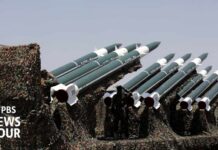
North Korea’s Kim Jong Un has ordered a 2.5-fold increase in missile production while his sister flatly rejected any path to denuclearization — a one-two punch that signals Pyongyang has no interest in negotiating away its nuclear arsenal, no matter who is asking.
Story Snapshot
- Kim Jong Un personally inspected a newly operational weapons factory and ordered missile production capacity expanded by 2.5 times.
- North Korea’s state media claims weapons-grade nuclear material output has more than doubled over the past five years.
- Kim’s sister, Kim Yo Jong, publicly rejected U.S. calls for denuclearization, calling North Korea’s nuclear status irreversible.
- Kim warned that North Korea has “no intention of avoiding a war” and accused South Korea of provoking an arms buildup.
Kim’s Factory Tour Sends a Deliberate Message
North Korean leader Kim Jong Un toured a newly operational weapons production facility and directed factory workers to dramatically scale up output, according to reports from Korean Central News Agency as relayed by multiple international outlets. Kim called for a 2.5-fold increase in existing missile production capacity and urged workers to “produce more weapons,” emphasizing their strategic value to the nation. This marks at least the third time North Korea has publicly disclosed a uranium enrichment or weapons production site, suggesting a deliberate pattern of signaling rather than accidental disclosure. [3][6]
The facility, described by state media as a “newly operational nuclear material production factory” and a “major milestone,” featured dense rows of metallic tubes and piping that outside analysts said appeared consistent with centrifuge-based uranium enrichment infrastructure. The exact location was not disclosed, though reporting suggests it may be near the known Yongbyon nuclear complex. Because North Korea controls all direct access, independent verification of the facility’s type, scale, and actual output remains impossible from publicly available sources. [6][3]
Kim Yo Jong Slams the Door on Denuclearization
While her brother toured the factory floor, Kim Yo Jong — widely considered the second most powerful figure in Pyongyang — issued a formal statement rejecting U.S. calls for denuclearization. She characterized North Korea’s nuclear weapons status as permanent and non-negotiable, reinforcing the regime’s long-standing position of “no negotiations, no rollback, no surrender of its arsenal.” The statement was framed not as a response to a specific diplomatic proposal but as a declaration of irreversible policy. [1][2]
The dual messaging — factory tour paired with a policy statement — fits a pattern analysts have observed for years: Pyongyang uses high-profile leader inspections and official declarations simultaneously to signal both military capability and political resolve. Whether this represents a genuine escalation in capability or a calculated propaganda effort designed to strengthen Kim’s domestic standing and his hand in any future negotiations remains an open question. The regime’s claims of more-than-doubled nuclear material output over five years come entirely from state media, with no independent audit or inspection record to confirm the figures. [1][6]
What This Means for Regional Security and U.S. Policy
Kim’s factory visit coincided with North Korea firing ballistic missiles, a combination that drew immediate attention from South Korea and its allies. Kim used the moment to accuse Seoul of inciting confrontation and an arms buildup, while declaring North Korea had “no intention of avoiding a war.” The rhetoric, whether intended as deterrence or coercion, lands in a region already on edge, with South Korea, Japan, and the United States all watching Pyongyang’s weapons programs with growing alarm. [1][2]
For the Trump administration, North Korea presents a familiar and unresolved problem. Despite high-profile diplomatic engagement during Trump’s first term, including direct summits with Kim, no lasting agreement was reached. The latest signals from Pyongyang — expanded production orders, public rejection of denuclearization, and continued missile testing — suggest the regime has concluded that building up its arsenal serves its interests better than any deal currently on the table. Whether Washington responds with renewed diplomatic outreach, tighter sanctions, or a different approach entirely remains to be seen. [2][3]
A Warning About What We Actually Know
It is worth being clear about the limits of what can be verified here. Every central claim — the production increase, the facility’s function, the output figures, Kim’s exact words — flows through Korean Central News Agency, a state-controlled propaganda organ, before reaching international audiences through secondary reporting. No independent inspector, journalist, or technical analyst has accessed the site. Phrases like “exponential growth” and “more than doubled” are assertions from a regime with every incentive to project strength. That does not make them false, but it does mean the public is being asked to assess a security threat based almost entirely on information the threat’s source chose to release. [1][3][6]
🇰🇵North Korean state media released a report showing Kim Jong Un inspecting a domestic defense factory and reviewing the country’s ballistic missile production targets for the first half of 2026.
The report highlighted that production of Hwasong-11 ballistic missiles is… pic.twitter.com/kh4l1QRouq
— News.Az (@news_az) June 7, 2026
Sources:
[1] YouTube – North Korean leader Kim tours missile factory as his sister says no to …
[2] Web – Kim Jong Un tours weapons factory as North Korea fires ballistic …
[3] Web – Kim Jong-un tours weapons factories amid global condemnation …
[6] Web – North Korean leader Kim tours weapons factories and vows to boost …