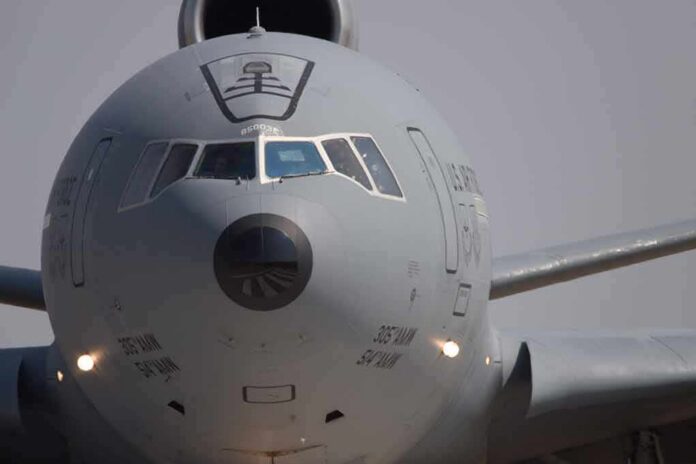
The Air Force’s decision to more than double its F-15EX Eagle II fleet is less about choosing a “better” fighter than the F-35 and more about buying time and capacity in a force that cannot get enough stealth jets, fast enough, to meet its own operational demands.
Key Points
- The planned F-15EX fleet has jumped from 129 to 267 aircraft, with 24 jets and $3 billion requested in the FY27 budget alone.
- The F-15EX offers exceptional payload, range, radar and service life, but it is not stealthy and will not replace the F-35 in high-threat penetration missions.
- Unit cost has climbed toward F-35 territory, eroding the original “cheap complement” rationale, even as operating cost per hour remains lower.
- This surge follows a familiar pattern: legacy platforms expanded to cover capacity shortfalls created by delays and constraints in next‑generation programs like the F-35 and NGAD.
A doubled F-15EX fleet and what it really signals
In the Air Force’s fiscal 2027 budget request, the F-15EX Eagle II went from a modest stopgap to a core pillar of the fighter force. The service now aims to buy 267 F-15EXs, more than double the previous plan for 129 aircraft and far beyond the low-water mark of 98 jets floated just a few years earlier. The FY27 request alone includes 24 aircraft at a cost of roughly $3 billion, a unit price on the order of $125 million for that year’s lot. This is not a small adjustment; it is a structural bet that a heavily updated fourth-generation airframe will carry a large share of the combat load for the next two decades.
At the same time, official acquisition documents show lower unit prices in earlier multi-year contracts—around $90–97 million per jet in lots 2 and 3, and roughly $94 million in lot 4—illustrating how the effective “sticker price” varies by batch and accounting method. Regardless of which figure one prefers, the direction is clear: the F-15EX is no longer the bargain-bin alternative to the F-35 that some early advocates suggested. It is a premium platform bought for specific strengths, not simply because it is cheaper.
Why the Air Force wants a heavy, non-stealth fighter in quantity
To understand why 267 F-15EXs make sense to Air Force planners, you need to look at missions, not labels. The Eagle II is optimized for roles where payload, range, and persistence matter more than signature reduction: homeland air defense, defensive counter‑air in relatively permissive environments, long‑range escort and “missile truck” duties supporting stealth formations, and high‑volume cruise missile and drone defense. In these scenarios, the aircraft’s ability to carry up to about 29,500 pounds of ordnance on 23 stations—more than any other U.S. fighter—becomes decisive.
With new racks like AMBER, the F-15EX can reportedly mount up to 22 air‑to‑air missiles, including large numbers of AIM‑120 AMRAAMs, dramatically increasing the number of weapons a single sortie can put into the fight. Paired with the AN/APG‑82(V)1 active electronically scanned array radar, tuned for detecting low‑flying cruise missiles and small unmanned systems, this turns the jet into a high-capacity shooter that can sanitize wide swaths of airspace, particularly over U.S. territory and maritime approaches. That function is difficult to replicate with stealth aircraft that carry fewer missiles internally and are optimized for penetrating dense integrated air defense systems rather than loitering over friendly territory.
Service life is another lever. The F-15EX is designed for roughly 20,000 flight hours—a figure far higher than the 6,000–8,000 hours typical of legacy fighters and well above older F-15 variants. For a force facing a long-term demand for air sovereignty and defensive counter‑air, fewer airframes retiring early reduces pressure on future budgets and training pipelines. That longevity is one reason the jet is earmarked as the premier replacement for aging F-15C/Ds in Air National Guard units in Florida, Oregon, California, and Louisiana, where domestic air defense and quick‑reaction alert missions dominate.
The capacity crisis behind the surge
The F-15EX expansion does not occur in a vacuum; it is a direct response to a fighter capacity shortfall. A 2025 Air Force study mandated by Congress concluded the service needs 1,558 combat‑coded fighters, nearly 300 more than it had available. At the same time, F-35 production and integration have been slower and more troubled than originally forecast, with Block 4 software delays and performance issues constraining how quickly new Lightning IIs can be fielded at full combat capability.
In testimony and interviews, senior officials have been explicit. Lt. Gen. David Tabor, the Air Force’s deputy chief of staff for plans and programs, described the F-15EX as the “fastest way to close” the fighter gap created by F-35 setbacks, pointing to Boeing’s ability to ramp production at its St. Louis line and the relative ease of transitioning Guard units already flying F-15s. Articles in Air & Space Forces and Breaking Defense echo this framing, casting the Eagle II as a capacity‑driven choice: the service cannot buy and absorb enough F-35s quickly, so it is leaning on a mature design to stabilize fighter numbers.
This logic follows a familiar pattern in U.S. defense acquisition. When next-generation programs slip, legacy platforms are extended or expanded to cover the gap. In the 2010s, F-16s and F-15C/Ds were flown well past their intended lives rather than being replaced on schedule, largely because the F-35 program was not delivering aircraft fast enough. When F-22 production was capped at 187 jets, the resulting “stealth gap” in air superiority forced the Air Force to lean harder on upgraded fourth‑generation fighters. The F-15EX surge is the latest manifestation of this: a short‑to‑medium‑term bulwark against fleet hollowing while NGAD and mature F‑35 capacity remain over the horizon.
Cost, affordability, and the erosion of the “cheap complement” narrative
Because the F-15EX shares many systems with existing Eagles and leverages a long‑running production line, early proponents pitched it as an affordable complement to stealth fighters. That story has become much harder to sustain. Public budget figures for FY27—$3 billion for 24 jets—imply a unit cost around $125 million for that year’s batch, which is broadly in the same neighborhood as current F-35A prices. Analysts at 19FortyFive are blunt: the Eagle II “is no longer especially affordable” and “costs more than the stealth fighter” on a per-aircraft basis, at least in some procurement lots.
Other data points complicate the picture. Selected Acquisition Reports and contract disclosures have cited F-15EX unit costs near $94 million when averaged over specific lots, and estimates from the Secretary of the Air Force’s financial office have put earlier figures closer to $87–90 million. The spread reflects different accounting treatments—development, military construction, and support all change the apparent unit price—as well as the effect of smaller, premium lots. However one slices the numbers, the simple claim that the Eagle II is a “cheap fighter” compared to the F-35 no longer holds. It is a sophisticated, expensive aircraft bought for distinct advantages.
Operating cost tells a different story. The best available estimates put F-15EX cost per flight hour in the $29,000–$30,000 range, compared with roughly $34,000–$42,000 for the F-35A. That gap matters once aircraft leave the acquisition spreadsheet and enter daily operations; over thousands of hours, lower maintenance and sustainment costs can offset a higher sticker price. Notably, critics who focus on unit cost parity have not yet produced primary-source data refuting the Air Force’s operating cost figures, leaving that advantage largely uncontested.
Stealth, survivability, and the limits of the Eagle II
No matter how capable its radar or payload, the F-15EX remains a non‑stealth, large radar cross-section fighter. That reality sets hard boundaries around what missions it can perform against peer adversaries. Defense outlets such as The War Zone and Defense News are clear that the Eagle II is not intended for “contested penetration” into the most heavily defended sections of Chinese or Russian airspace; those jobs belong to stealth aircraft like the F-35, F-22, and, in the future, NGAD.
Instead, the F-15EX is expected to operate at standoff distances and in less saturated environments, acting as a high-capacity shooter cued by stealthy sensors, offboard ISR platforms, and collaborative combat aircraft. That concept—sometimes described as the “missile truck” model—raises an unresolved question: how often, in realistic Indo-Pacific scenarios, will conditions permit non‑stealth fighters to operate close enough to employ their vast weapons loads without unacceptable risk? Neither proponents nor critics have yet produced detailed scenario analyses in the public domain that quantify the frequency and character of these missions, leaving a gap in the evidence for just how central the Eagle II will be in a high‑end fight.
Another area where rhetoric outruns proof is hypersonic integration. Boeing and Air Force advocates frequently tout the F-15EX’s capacity to carry future hypersonic weapons, notably the AGM‑183 ARRW, thanks to its payload and strong wing structure. Yet as of the latest reporting, there is no public operational test report confirming that such weapons have been fully integrated, tested, and fielded on the Eagle II. Coverage in The War Zone and other outlets notes the absence of verified live capability, underscoring that this remains more a design aspiration than a current operational asset.
Industrial base, politics, and the long view
The surge to 267 jets also reflects industrial and political calculus. The St. Louis production line is one of the few remaining U.S. facilities capable of building large, twin‑engine fighters. Keeping it healthy preserves options for NGAD derivatives, foreign sales, and future upgrades, and mitigates the risk of over‑reliance on a single stealth production line. After a 2025 strike at the plant raised questions about delivery timelines, locking in a multi‑year Eagle II buy may be seen as a way to stabilize that workforce and supply chain.
At the same time, congressional and think‑tank pressure to prioritize NGAD and the F-35 over fourth-generation platforms has not disappeared. The current plan for 267 F-15EXs relies on future appropriations; there is no immutable guarantee that every aircraft envisioned today will be funded tomorrow. If budget constraints tighten or NGAD accelerates, later tranches of the Eagle II buy could be trimmed. In that sense, the F-15EX is both a hedge and a bet: a hedge against near‑term capacity shortfalls and industrial fragility, and a bet that there will be enough mission space in the 2030s and 2040s for a large fleet of sophisticated, non‑stealth fighters to remain relevant.
What this means for the future fighter mix
When one steps back from the procurement details, the doubling of the F-15EX fleet reveals a deeper truth about modern airpower: stealth alone does not solve the whole problem. The Air Force’s own behavior—first calling the Eagle II a stopgap, then embracing 267 aircraft—amounts to an admission that high‑end stealth jets cannot simultaneously provide mass, coverage, and cost-effective day‑to‑day operations. Instead, the future force will be a layered mix: stealth platforms for penetrating and surviving in the hardest airspace; heavy “missile trucks” like the F-15EX for volume and persistence; and collaborative unmanned systems to extend all of the above.
Whether the current Eagle II buy proves strategically optimal is an open question that will be answered by future conflicts and budgets, not by procurement rhetoric. What the evidence does show today is that the F-15EX is being purchased not because it is stealthy or cheap, but because it is available, proven, and uniquely capable of carrying a great deal of ordnance for a very long service life at a lower operating cost. In a fighter force struggling to reconcile ambition with capacity, that combination is powerful enough to justify a 267‑jet bet.
The 142nd Wing has dropped bombs for the first time in its history! Members of the Operations and Maintenance Groups traveled to Idaho with the F-15EX multi-role fighter to prove a new capability of the novel jet as the wing paves the way for the USAF. https://t.co/tXf5FZJEiV
— 142nd Wing (@142ndWG) July 17, 2026
Sources:
19fortyfive.com, aeronauticsmagazine.com, defensenews.com, migflug.com, twz.com, youtube.com, facebook.com, militarywatchmagazine.com, breakingdefense.com, airandspaceforces.com