A missile strike on a commercial grain ship leaving Ukraine has killed four Indian crew members, turning a distant war into a deadly risk for ordinary workers just trying to earn a living.
Story Snapshot
- Four Indian nationals were killed and one critically injured when the MV Golden Leo was hit near Ukraine’s Odesa port.
- India condemned the strike as a deplorable attack on commercial shipping and innocent civilian crew.
- Ukraine says Russian cruise missiles hit the Guinea-Bissau-flagged, Turkish-owned corn carrier, killing a total of ten people.
- The attack highlights how global conflicts now reach civilian trade routes, endangering workers far from any front line.
Missile strike on MV Golden Leo kills Indian crew
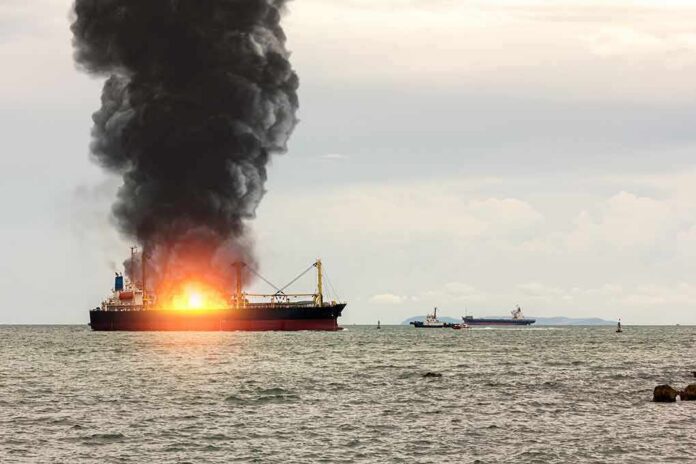
On July 19, a commercial cargo ship named MV Golden Leo was leaving Ukraine’s southern port of Odesa when it came under a deadly missile attack. The vessel was a bulk carrier flying the flag of Guinea-Bissau and carrying corn loaded in Ukraine for global markets. India’s Ministry of External Affairs said there were 17 crew members on board, including five Indian nationals, when the strike happened. Four Indians were killed and the fifth was left in critical condition in a local hospital.
Ukrainian port officials reported that the ship also carried crew from Syria and a Ukrainian maritime pilot who was guiding the vessel out of Odesa. They said the strike killed ten people in total, including nine foreign crew members and the 66-year-old pilot, while eight sailors were rescued and hospitalized. The ship’s owner later confirmed that nine crew members died in the attack and eight survived. These numbers show how fast one hit on a “civilian” ship can turn into a mass casualty event.
India’s condemnation and growing anger over civilian risks
India’s government moved quickly to condemn the attack once the deaths were confirmed. In its statement, the Ministry of External Affairs said “targeting commercial shipping and endangering innocent civilian crew members or otherwise impeding freedom of navigation and commerce is deplorable and should be avoided.” The ministry stressed that its embassy in Ukraine is helping the injured Indian sailor and working with local authorities to support the families of those who died. New Delhi also summoned a senior Russian diplomat to formally protest the killings.
This reaction reflects rising anger in India over how distant wars keep putting ordinary citizens in danger. Thousands of Indian seafarers work on foreign-flag ships in hot spots like the Black Sea, the Red Sea, and the Persian Gulf. They sign up to move goods, not to fight. Yet they now face missiles, drones, and mines as part of their daily job. For many families, especially in poorer states, these shipping jobs look like a path to a better life. The Golden Leo strike shows that path can suddenly end in a blast far from home.
Russia-Ukraine war spills into civilian trade routes
Ukrainian authorities blamed Russia for the attack, saying Russian forces fired three cruise missiles that slammed into the Golden Leo shortly after it left Odesa. They said the missiles hit the ship’s superstructure, started a major fire, and forced a night-long search and rescue effort. Russia has claimed it targets military-related logistics, but Ukraine called this a deliberate strike on an unarmed civilian vessel and described it as a violation of humanitarian law. Independent media also reported the strike as a Russian attack on a corn ship manned by crews from India and Syria.
This pattern fits what many security experts have warned about in the Black Sea since the war began. Civilian shipping has become a “gray zone” target, exposed to missiles, drones, and mines as both sides try to choke off each other’s trade and supply lines. Ships that carry grain or other goods are now caught between military aims and legal protections. Sailors and pilots who do not make policy end up paying the price. People watching from the United States can see here how global power games quickly reach regular workers who only want safe jobs and steady pay.
Shared worries about elites, rules, and who gets protected
This story also taps into wider fears that many Americans, both conservative and liberal, already share. On one level, it looks like another case where rules on “freedom of navigation” and civilian safety exist on paper but collapse when big powers decide their goals matter more. On another level, it shows how ordinary workers become expendable in wars they did not choose, while elites argue over blame from safe offices. The Indian sailors on the Golden Leo were not politicians or generals. They were people trying to support families, much like truckers, oil workers, or factory hands in the United States.
As conflicts continue across Ukraine, the Middle East, and the Red Sea, one group that rarely makes headlines is paying an increasingly heavy price, Indian merchant seafarers.
The latest tragedy occurred near Odesa, where the merchant vessel MV Golden Leo was reportedly struck… pic.twitter.com/ewOeqdRra4
— Srijan Pal Singh (@srijanpalsingh) July 22, 2026
For readers frustrated with the “deep state” and global elites, this attack reinforces a familiar concern. International rules and promises about safe trade routes sound good, but enforcement often fails when it counts most. Governments talk about protecting citizens yet keep sending them into danger zones because the global economy depends on cheap labor and constant movement of goods. Whether you worry about open borders, globalism, or corporate greed, the Golden Leo strike is one more sign that the system rarely puts regular people first.
Sources:
insiderpaper.com, republicworld.com, timesofindia.indiatimes.com, youtube.com, eurasiantimes.com, newsonair.gov.in, openthemagazine.com