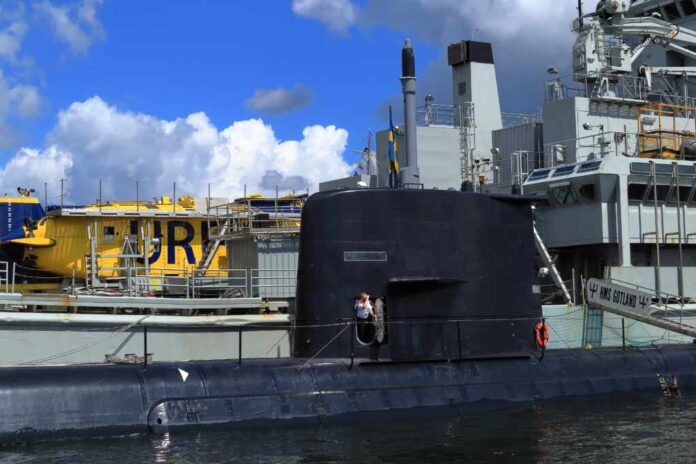
A stealthy underdog, Sweden’s AIP submarine, ‘sank’ a U.S. aircraft carrier, questioning the invulnerability of American naval might.
Story Highlights
- In 2005 war games, Sweden’s Gotland submarine evaded U.S. defenses, ‘sinking’ the USS Ronald Reagan.
- HSwMS Gotland’s Stirling AIP engine enabled near-silent, extended underwater operations.
- The exercise underscored vulnerabilities in U.S. carrier defenses, prompting tactical overhauls.
- Gotland’s success highlighted cost-effective threats to expensive naval assets.
Swedish Submarine Challenges U.S. Naval Superiority
In a striking military exercise off the U.S. coast in 2005, the Swedish diesel-electric submarine HSwMS Gotland demonstrated a groundbreaking upset. Equipped with advanced Stirling Air-Independent Propulsion (AIP), the vessel managed to evade detection by the USS Ronald Reagan carrier strike group. This included dodging destroyers, helicopters, and nuclear submarines, delivering simulated torpedo strikes that effectively ‘sank’ the $6.2 billion aircraft carrier.
The exercise, repeated over two years, caught the attention of military strategists worldwide, emphasizing Gotland’s quiet and stealthy nature.The Gotland’s success was a wake-up call for the U.S. Navy, revealing significant gaps in carrier defense strategies against non-nuclear threats.
In 2005, a single Swedish sub, HMS Gotland, sneaked up on the carrier USS Ronald Reagan and ' sank ' it with several virtual torpedo hits during joint maneuvers in the Pacific. It then managed to get away undetected.
Just saying what we Swedes can do….. pic.twitter.com/2bcDIuKjFt— Tim Hermansson 🇸🇪🇺🇦 (@TimHermansson) March 15, 2025
Revolutionizing Anti-Submarine Warfare
The Gotland-class submarines, launched in 1996, were designed by the Swedish Kockums shipyard to counter Soviet threats. The AIP technology allowed these submarines to remain submerged for weeks without surfacing, a capability that traditional diesel submarines lacked. This technology leveraged a closed-cycle Stirling engine that burned diesel to generate electricity, eliminating the need for snorkeling and allowing stealthy operations.
The success of the Gotland in U.S. war games led to significant changes in U.S. anti-submarine warfare tactics. The U.S. Navy had previously retired its last diesel submarine in 1990, which left a gap in diesel-submarine detection capabilities. The lease of the Gotland marked a turning point, prompting a tactical overhaul.
Long-Term Implications for Naval Strategy
The exercise highlighted the economic and strategic implications of using cost-effective AIP submarines against high-value naval assets like aircraft carriers. The Gotland’s ability to outmaneuver a task force demonstrated that a $100 million submarine could pose a credible threat to a $6 billion carrier. This realization has prompted navies around the world to reconsider their fleet compositions and strategies, emphasizing the need for advanced anti-submarine warfare capabilities.
In the long run, the incident reinforced the concept that low-cost, stealthy submarines can challenge traditional naval dominance, especially in littoral waters. This has led to increased interest in AIP technology among global navies, including nations like India, Israel, and Japan, looking to bolster their coastal defenses.
Sources:
An AIP Submarine Quieter Than Ambient Ocean Noise ‘Sunk’ A U.S. Navy Aircraft Carrier
War Games: Swedish Stealth Submarine Sank A U.S. Aircraft Carrier
HMS Gotland vs. USS Ronald Reagan Aircraft Carrier
Gotland-class Submarine