One Democrat just handed President Trump a rare bipartisan moment on Iran—while Washington braces for a high-stakes fight over war powers, oil prices, and what “constitutional oversight” really means.
Quick Take
- Sen. John Fetterman (D-PA) publicly backed President Trump’s Iran strikes, breaking with many Democrats and ridiculing party critics.
- Reports say the operation killed Iran’s Supreme Leader Ayatollah Ali Khamenei and dozens of senior Iranian leaders, but the administration has not publicly released evidence of an “imminent threat.”
- Congress is preparing for classified briefings and near-term votes on war powers resolutions that would limit the president’s authority.
- Energy prices and broader inflation worries are resurfacing as lawmakers warn about oil-market blowback and economic spillover.
Fetterman breaks ranks as Trump’s Iran operation reshapes the political map
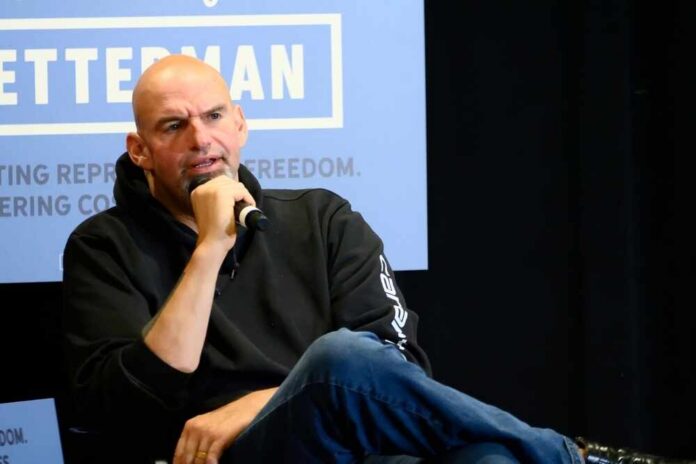
Sen. John Fetterman’s decision to defend President Trump’s military action against Iran has become the clearest sign yet that the usual party lines on foreign policy are cracking. Fetterman has argued the strikes were justified to counter Iran’s nuclear ambitions and regime aggression, positioning himself closer to the administration than to Democratic leaders demanding restraint. That split matters because it changes the congressional math and the public messaging at a moment when national security and deterrence are back at center stage.
Public reporting describes the strikes as hitting Iranian leadership targets, including Ayatollah Ali Khamenei, and killing a total of 49 leaders ahead of schedule. At the same time, multiple accounts stress a key limitation: the administration has not publicly presented evidence that Iran was about to carry out an imminent attack. That gap is now shaping the debate, because the White House is asking lawmakers and voters to accept the necessity of the operation while reserving most justification for classified settings.
Congress moves toward briefings and war-powers votes as both parties maneuver
Congressional leadership has scheduled a sequence of briefings and votes that will test the balance between Article I oversight and the president’s role as commander in chief. Administration officials, including Secretary of State Marco Rubio, Defense Secretary Pete Hegseth, and CIA Director John Ratcliffe, are expected to brief lawmakers, with a wider congressional session following. Senate and House votes on war powers measures are also imminent, with expectations in reporting that such limits are likely to fail.
Democratic leaders have framed their push in constitutional terms, arguing the strikes require clearer authorization and stronger evidence. Sen. Tim Kaine has been among the most forceful critics, describing the move as reckless and calling for a return to diplomacy. Fetterman has taken the opposite approach, promising a “hard no” on curbing Trump through war-powers restrictions and dismissing intra-party opposition in blunt language. The result is a public clash not just over policy, but over who speaks for “responsible” governance.
Iran’s internal unrest and nuclear defiance form the backdrop to Washington’s debate
The operation unfolded against a volatile Iranian backdrop, including protests that erupted in late December 2025 amid economic collapse. One report cites at least 544 killed and 10,681 arrested, figures attributed to the Human Rights Activists News Agency, underscoring both the scale of unrest and the difficulty of verifying information in closed societies. U.S. deliberations over military options reportedly intensified as Iran continued nuclear defiance, with Trump briefed on options and warning of retaliation if provoked.
The administration’s broader posture has included more than airstrikes. Reporting describes Trump keeping “all options on the table,” ranging from military action to economic pressure—such as tariffs aimed at countries trading with Iran—and indirect talks via intermediaries like Switzerland. For conservatives wary of globalist entanglements, this mix is politically significant: it signals an attempt to combine deterrence and leverage without immediately defaulting to open-ended nation-building. Still, the current operation is described as potentially multi-week, keeping escalation risks alive.
Oil, inflation, and constitutional limits collide in the next phase
Economic spillover is now part of the war-powers argument. It links the strikes to renewed concern about oil prices and cost-of-living pressure—an especially raw issue after years of inflation that many voters blame on fiscal mismanagement and Washington’s habit of treating families’ budgets as an afterthought. Democrats have highlighted price risks while pressing for limits on Trump, and congressional leaders have simultaneously pivoted to other economic issues, a sign that lawmakers fear foreign-policy shocks can quickly land at the gas pump.
Fetterman Chooses Country Over Party After Iran Operationhttps://t.co/cWE7LiRFd5
— PJ Media (@PJMedia_com) March 4, 2026
What remains unresolved is the central question Congress will press in briefings: the precise justification for the strikes, and whether the administration can establish urgency without revealing sources and methods. Until more evidence is declassified, the debate will continue to hinge on trust, party alignment, and each side’s reading of the Constitution. Fetterman’s posture—backing the operation while attacking his party’s skeptics—doesn’t settle that question, but it ensures the political fight won’t fit neatly into red-versus-blue.
Sources:
Iran protests, Senate, Fetterman, intervention, federal government
Fetterman needles Democrats over Iran strikes opposition
Fetterman blasts Iran strike critics: ‘Ayatollah’s apologists’ — ‘let’s see who grieves’ ‘garbage’