Norway’s prime minister says a drone nearly struck President Zelenskyy’s plane in Moldova, and officials confirm the airspace was closed after a drone incursion.
Story Highlights
- Norway’s leader said Zelenskyy’s plane was “almost hit” by a drone during takeoff in Moldova.
- Moldova closed its airspace due to a drone incursion, delaying Zelenskyy’s flight.
- Moldovan police reported a Russian drone crashed in the country the same day.
- A Ukrainian presidency source called the near-hit claim “exaggerated”.
What Officials Say Happened in Moldova
Norwegian Prime Minister Jonas Gahr Støre told a public broadcaster that a drone almost hit the aircraft carrying Ukrainian President Volodymyr Zelenskyy as it took off from Moldova. Multiple outlets repeated his on-the-record quote the same day. The Moldovan government said it closed its airspace to protect aircraft, which delayed some departures, including Zelenskyy’s. These statements place a drone threat and an airspace shutdown in the same window as the planned flight.
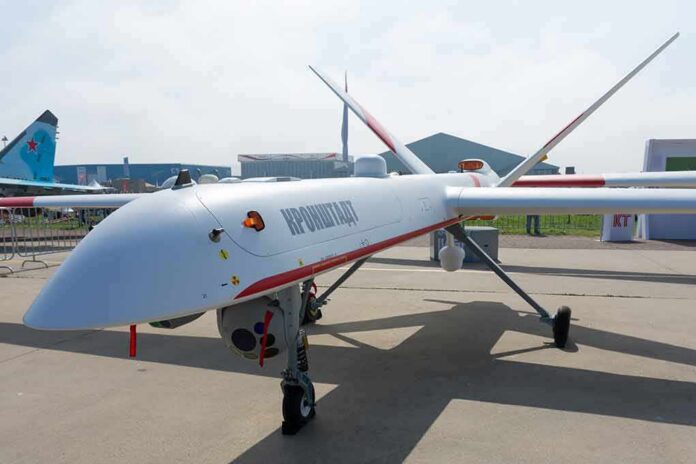
Moldovan police later said a Russian drone crashed in Moldova that day, sparking fires in a field and prompting safety steps. Authorities lifted restrictions after they assessed the situation. The sequence described by officials is clear: drone incursion, airspace closure, flight delays, then clearance. That chain supports a real aviation hazard in Moldova’s skies during Zelenskyy’s travel window, even if the exact distance between drone and aircraft was not released.
Claims, Caveats, and What We Do Not Know Yet
One Ukrainian presidency source disputed the “near-hit” framing and told reporters the danger claim was exaggerated. That source said the episode was an air alert triggered by a Russian drone entering Moldovan and Romanian airspace, not a close call with the plane itself. So far, no public radar data, pilot report, or incident file confirms how close the drone came to the aircraft. The gap leaves room for competing descriptions of risk.
The record still supports several facts. Moldova shut its airspace. Zelenskyy’s departure was delayed. A Russian drone entered Moldovan airspace and a drone crashed in the country that day. Those points are backed by named officials and major outlets. What is not proven is the proximity needed to call it a “near collision.” Without logs from air traffic control or flight telemetry, the exact hazard level to the plane remains unclear.
Why This Matters Beyond One Flight
Repeated drone intrusions over Moldova have raised steady concerns for civil aviation. Reports over the last year describe drones crossing borders and forcing safety actions, including temporary airspace closures. This pattern blurs lines between war zones and civilian routes and puts pilots and passengers in a risk environment they cannot control. When skies close with little notice, families, business owners, and aid groups all pay the cost in time and money.
Norwegian Prime Minister Jonas Gahr Støre said that a drone "almost hit" the plane carrying Volodymyr Zelenskyy and his wife, Olena Zelenska, as they were departing for Norway to attend the funeral of King Harald V.
💬 "His plane was nearly struck by a drone during takeoff from… pic.twitter.com/DcotGVFMjL
— Belsat in English (@Belsat_Eng) September 10, 2026
Americans who feel the system is failing will see a familiar problem here. Governments confirm a real threat, but they offer few details. Leaders deliver strong claims, but the public rarely gets the data to verify them. That gap breeds doubt on both left and right. People want honest facts, fast accountability, and safer skies. Releasing basic incident records—timelines, radar tracks, and a brief safety review—would help rebuild trust without risking security.
What to Watch Next
Watch for Moldova’s civil aviation authority to release an incident summary. Look for Norway or Ukraine to clarify with a written report from the flight crew or security detail. If none appears, expect the debate to continue: one side stressing a near-hit, the other calling it an alert and delay. Meanwhile, each new cross-border drone incursion will keep pressure on governments to improve detection, share facts, and protect civilian flights over crowded air corridors.
Sources:
foxnews.com, aljazeera.com, abc17news.com, unn.ua, newsukraine.rbc.ua, reuters.com, theguardian.com, pravda.com.ua