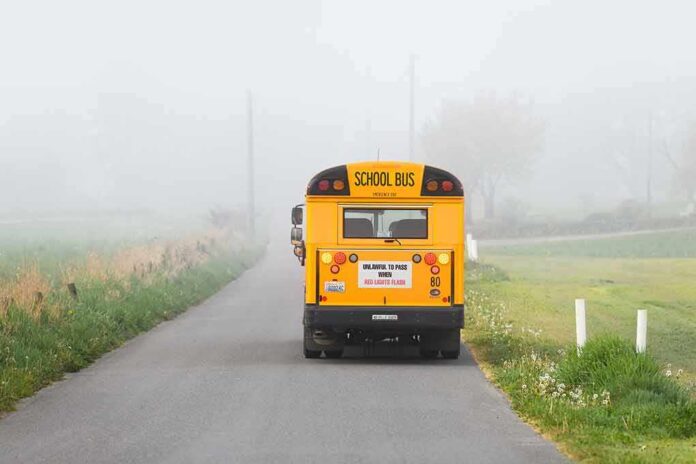
Six nonverbal special education students were driven around Brooklyn for more than four hours and reached school at 1:25 p.m., long after staff lost track of the bus.
Story Snapshot
- Investigators say the bus missed P.S. 289 by hours and arrived at 1:25 p.m.
- The driver went to the wrong schools before dispatch gave the correct location
- A parent’s tracking tags showed two children still moving near midday
- The driver and matron were removed from student contact after the probe
What Investigators Found About the Route
City investigators reported that the bus missed its morning schedule by more than four hours. The students were due at P.S. 289 between about 8:20 and 9:00 a.m., but did not arrive until 1:25 p.m.. Reports say the driver went to two wrong schools before dispatch told him the right destination. The Special Commissioner of Investigation reviewed the events and shared findings with school officials, who then took staffing actions based on those results.
Department of Education global positioning system data reportedly contradicted the driver’s timeline. The driver said all students were picked up by 10:00 a.m., but location data placed the bus outside one student’s home at 10:59 a.m.. A parent had placed tracking tags in two children’s backpacks. Those tags showed the kids were still on the move near midday, not at school as expected. These data points helped investigators map the bus’s path across the late morning hours.
How Adults on the Bus and at School Responded
Reports say the bus matron, who had years of experience, told investigators she did not speak with the driver during the morning ride and did not call for help from the school or the depot. School officials and the contractor could not locate the bus for hours, which raised concern for the students’ safety. When the bus arrived, staff found one child had urinated, removed clothing, and was lying on a seat or the floor in wet garments, underscoring the long delay’s impact on care needs.
The transportation vendor placed the driver and matron on administrative leave after the incident. The company said they are barred from its buses and from contact with students while proceedings continue. Investigators also recommended codes that prevent the employees from supervising Department of Education students or working with contractors tied to the school system. Those steps show how city agencies and vendors use employment controls to address immediate safety risks while any further actions are considered.
Why This Happened Within a Troubled System
This breakdown took place in a system already under strain. In the 2023 to 2024 school year, the New York City Office of Pupil Transportation received more than 150,000 complaints, including thousands about late arrivals and no pickups. City audits say the Department of Education lacks strong tools to find root causes, enforce contract rules, and hold companies to account for bad service. That context helps explain how an extreme delay could continue for hours before officials regained control.
SCHOOL BUS SCARE: Six nonverbal students spent more than four hours on a school bus before arriving at their Brooklyn school, according to a city investigation.#News12 #Brooklyn #SchoolBusScare https://t.co/h6kx4P5vy7
— News12BK (@News12BK) October 17, 2026
Families on the left and right share a basic worry here: government services promised to the most vulnerable often fail when it counts. Parents expect clear routes, working global positioning systems, and fast action when a bus goes off course. Taxpayers expect contract oversight that prevents repeat problems. This incident highlights simple fixes with large payoffs: real-time tracking at schools, direct parent alerts, clear escalation rules, and fast vendor discipline when safety steps break down.
Sources:
nypost.com, us.headtopics.com, hoodline.com, politico.com, worldjournal.com, pix11.com, wlox.com, local12.com