
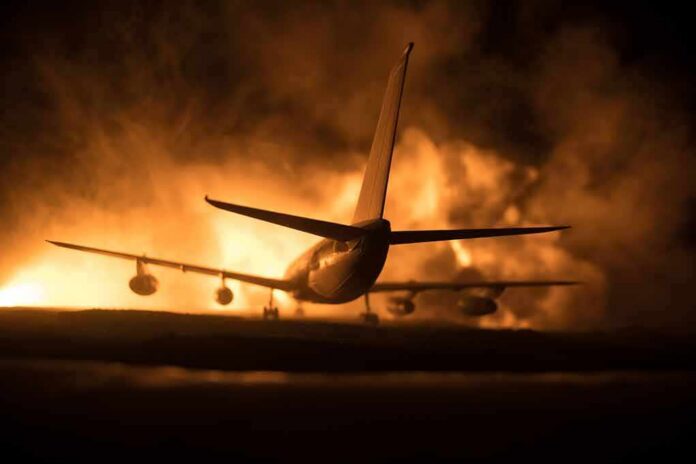
Missiles that killed civilians at Riyadh’s main airport forced flight diversions and triggered global aviation warnings, showing how a distant war now endangers everyday travelers.
Story Highlights
- Houthis warned airlines and passengers to avoid Saudi airports and airspace, excluding Mecca and Medina.
- Saudi authorities reported deaths, injuries, and flight disruptions at King Khalid International Airport.
- The European Union Aviation Safety Agency expanded its warning for Saudi airspace after the strikes.
- Riyadh’s airport later resumed operations, but several airlines kept flights suspended.
What The Houthis Said And Why It Matters
Yemen’s Houthi movement told airlines, airport workers, and travelers to avoid all Saudi airports and airspace, except for Mecca and Medina. The group said these sites are now military targets. A senior spokesman also claimed strikes on Riyadh and Najran airports using ballistic and cruise missiles, and said the attacks disrupted flights. The warning mixes two things at once: a real safety alert and a bid for pressure in a wider war. That blend raises the stakes for everyone who flies over the kingdom.
Saudi Arabia’s General Authority of Civil Aviation said two strikes hit King Khalid International Airport in Riyadh and a Saudia aircraft. The agency reported deaths and injuries. Reuters described three Saudi nationals killed and damage to a passenger plane. Airport operations were suspended as officials checked safety and damage. Flights were diverted or canceled, and passengers faced long delays during the shutdown. These are not theoretical risks; the blast effects touched a major civilian hub.
How Regulators And Airlines Responded
The European Union Aviation Safety Agency widened its conflict-zone bulletin for Saudi airspace after the Riyadh attacks. The agency urged airlines to avoid operations in the affected areas and to not use Saudi airports as alternates. The update cited growing risk from missiles, drones, and active air defenses. Major carriers, including some in Europe and Asia, suspended or canceled flights linked to Riyadh. These moves show independent actors treated the threat as a live safety hazard.
Air traffic in Riyadh later resumed. Saudi media said passenger flow was smooth and services had returned to normal. Flight tracking also showed a gradual return by some Middle Eastern airlines. At the same time, other carriers kept suspensions in place while reviewing risks. This split response reflects a hard truth of conflict flying: one state’s “normal” does not erase another airline’s duty to avoid elevated danger to crews and passengers.
Competing Claims And The Known Limits
The Houthis claimed successful hits on airport targets. The Saudi-led coalition said its air defenses intercepted incoming missiles. The Associated Press noted the group offered no proof for some damage claims, and the public record does not settle which missiles got through or where debris fell. What is confirmed is more basic: civilians died, an aircraft was damaged, and airport operations were disrupted at least for several hours. That is enough to change aviation risk calculations.
The Houthi warning did not link itself to the deadliest attack day, even as the group claimed other strikes. That gap leaves open questions about authorship of the specific blast that killed the most people. United Nations Secretary-General António Guterres condemned attacks on civilians and civilian infrastructure and called for them to stop. He said such strikes violate international law. Those statements reflect broad, cross-border concern about the direction of this fight.
Why This Matters Beyond The Region
Missiles, drones, and air-defense systems around airports raise dangers beyond a direct hit. Debris can fall on runways. Crews can face sudden alerts and diversions. A plane can be misidentified in the fog of conflict. The European Union Aviation Safety Agency flagged all these hazards for Saudi airspace after the escalation. For travelers, that means longer routes, higher costs, and new anxiety about basic safety when boarding a flight through or near the Gulf.
12 dead on Saturday. A projectile on Sunday. Riyadh is no longer behind the front lines.
The Saudi Civil Aviation Authority reported 12 dead and 309 injured in Saturday's strike on King Khalid Airport. The casualties included four Saudis, two Bangladeshis, and one person each… pic.twitter.com/I6fakO6KEr
— Dumitrescu Octavian Nicolae (@tavitag203) October 12, 2026
Americans watching this may feel a familiar frustration. Leaders argue while ordinary people carry the risk and the bill. Airlines cancel, then restart, then cancel again. Governments condemn, but the missiles keep flying. Whether you lean right or left, the pattern looks the same: complex wars, unclear lines, and civilian systems strained. Clear facts here help cut the noise. Civilians died at a major airport. Aviation regulators raised alarms. Some airlines are still staying away. That is the ground truth.
Sources:
youtube.com, bbc.com, reuters.com, usnews.com, bbc.co.uk, aa.com.tr, thenationalnews.com