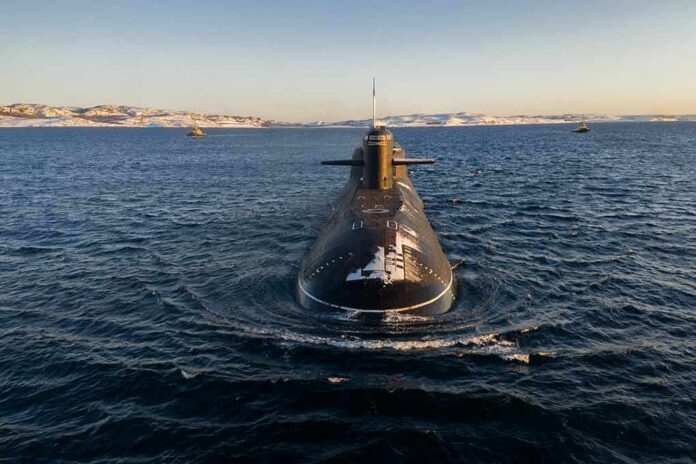
Two nuclear-armed submarines from allied nations quietly bumped into each other under the Atlantic, and both governments admitted it.
Story Snapshot
- British and French nuclear missile submarines made low-speed contact while submerged; no injuries were reported.
- United Kingdom officials said nuclear safety was not compromised, and both boats returned to port with damage.
- France first blamed an “immersed object,” then acknowledged contact with the British submarine days later.
- Released briefings say weapons and reactors stayed safe, but detailed technical findings remain classified.
What Both Governments Confirmed Happened
United Kingdom and French officials confirmed a low-speed underwater contact between the United Kingdom’s HMS Vanguard and France’s Le Triomphant during February 2009 patrols in the Atlantic. Leaders in London and Paris reported no injuries to crews, and both vessels reached port with damage to outer structures. The First Sea Lord at the time said the contact happened at very low speed. French officials used similar language. Both statements stressed that the incident did not trigger a nuclear emergency.
United Kingdom parliamentary records later stated that HMS Vanguard was moving at very low speed at the moment of contact and that nuclear safety was not compromised. The statement confirmed damage but affirmed that the deterrent mission continued. These details, entered into the official House of Commons record, provided the most authoritative account from the United Kingdom side. The Ministry of Defence also handled questions about safety, operations, and how the crew responded after impact.
Damage, Safety, and What Stayed Off-Limits
Press reports at the time described damage to both submarines but no injuries, no reactor breach, and no release of radioactive material. Outlets across Europe and the United States carried similar accounts, noting that both boats sailed home under their own power. The French boat reportedly had damage near its sonar dome, and the British boat had outer casing damage. The main point was clear: the hulls suffered, but the crews and the nuclear systems remained safe.
Freedom of Information releases in the United Kingdom later added that there was no damage to nuclear weapons or to the propulsion plant on Vanguard and that the round-the-clock deterrent posture remained in effect. A follow-up briefing said a comprehensive analysis concluded nuclear propulsion and weapon safety were not compromised. These documents answered core safety questions yet left out exact sensor logs, damage photos, and full timelines due to classification and national security limits.
Why The Early Story Shifted
France first told the public that Le Triomphant had struck a submerged object, possibly a container. Days later, both nations acknowledged that the “object” was the British submarine. This turn created confusion about the opening account. Officials did not provide a detailed chronology of who knew what and when, likely because patrol routes and detection methods are secret. The later joint acknowledgment aligned the two sides on the core facts of a low-speed submarine-to-submarine contact.
United Kingdom statements and the later released briefings addressed the most pressing public concern: nuclear risk. They did not describe the exact angle of approach, the relative depth, or what the sonar teams saw and heard in the moments before impact. That level of detail is standardly withheld for ballistic missile submarines. Such limits can frustrate people across the political spectrum who want transparency, but they also reflect how allied navies guard deterrent operations from rivals.
Why This Matters Beyond One Mishap
This event shows how even advanced submarines can miss each other when both are designed to be quiet and are running silent. Analysts have long noted that modern covert submarines can be hard to detect until they are very close, depending on ocean conditions and tactics. That reality explains how two allied boats on separate patrols could touch at low speed without seeing each other first. It is rare, embarrassing, and still consistent with the physics of underwater stealth.
For readers worried about government honesty and elite protection, two threads stand out. First, the safety news is firm: officials and later briefings say reactors and warheads remained safe, and the crews were fine. Second, secrecy remains heavy: the full technical record is still sealed. That mix—reassurance on safety, silence on methods—tracks with how democratic allies handle nuclear forces. It is not satisfying, but it is how these institutions balance public trust with national defense.
Sources:
19fortyfive.com, aljazeera.com, nytimes.com