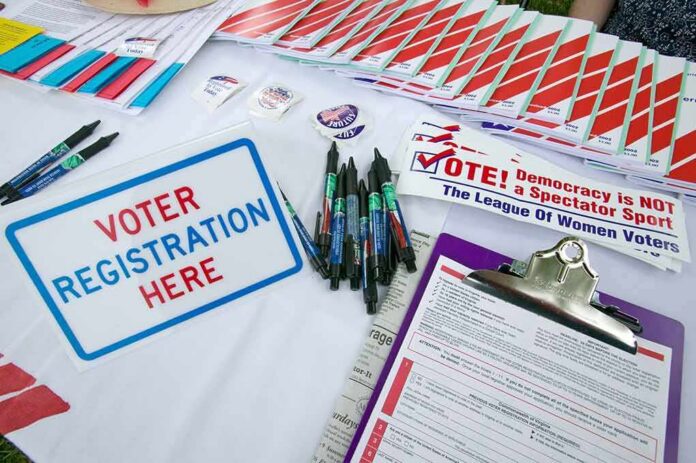
Republicans now hold their strongest midterm voter-registration position in decades across key states, but Democrats have clawed back part of the gap, keeping the map unsettled.
Story Highlights
- Republicans gained registration ground in Arizona, Nevada, North Carolina, and Pennsylvania versus past cycles.
- North Carolina showed a historic Republican registration lead, while Pennsylvania saw large GOP gains late 2024–2025.
- Democrats recovered some registration losses in several battlegrounds during 2025–2026.
- Registration shifts do not guarantee votes; national polling shows mixed signals.
What changed in voter rolls across key battlegrounds
Cable and network analyses said Republicans improved their registration standing since the 2024 election in several swing states. Reports cited gains of four points in Arizona, five in Nevada, seven in Pennsylvania, and eight in North Carolina, placing the party in its best midterm registration spot in at least twenty years. A Republican campaign memo echoed that trend, claiming about a five-point margin shift across the House battleground compared with the last midterm cycle. These gains fueled talk of a red registration edge.
North Carolina stood out. News outlets described a first-ever Republican lead in party registration there, with a net gain of nearly one hundred thousand registrants from late 2024 to late 2025. Pennsylvania also posted large Republican movement in that window, with more than one hundred ten thousand in margin improvement for the GOP, according to the same reporting stream. Local data snapshots in Pennsylvania districts showed Republicans holding sizable advantages, hinting at strong rural and exurban growth.
How Democrats narrowed parts of the gap
Democrats pushed back in 2026. An analysis from a major network reported that from late 2025 through mid-2026, Democrats added more registrants than Republicans in Arizona, Maine, Nevada, New Jersey, and Pennsylvania, recovering some ground without fully erasing earlier GOP gains. Pennsylvania Democrats said they increased their statewide registration edge month after month this year, signaling a live battle for the rolls ahead of the midterms. That rebound trimmed the headline Republican advantage in several places.
Other recaps emphasized a mixed map. A roundup noted sturdy Republican leads in states like Kansas and Nebraska, but smaller, shifting margins in closer battlegrounds such as North Carolina and New Hampshire. State-level snapshots showed the risks of cherry-picking time frames and regions, since late 2024 to late 2025 trends can look different than September 2026 totals. This apples-to-oranges problem makes it easy for partisans to claim a sweeping tilt that the underlying data do not fully prove.
Why registration momentum is not the same as votes
Registration numbers show who signs up, not who shows up. A national survey from Marist found registered voters favor Democrats for Congress by double digits, which complicates a simple “registration decides the race” story. That poll does not cancel the GOP’s gains, but it reminds us that turnout, persuasion, and drop-off matter. Put plainly, a registration edge can fade if new registrants are low-propensity voters or if the other side out-organizes in early vote and on Election Day.
Both sides see what they want in the same spreadsheets. Republicans argue the right is building a broader coalition in the Sun Belt and parts of the Rust Belt. Democrats counter that new sign-ups since late 2025 show energy returning in key states, including Pennsylvania’s steady monthly gains. Voters across the spectrum also see a familiar pattern: leaders chase headlines about momentum while core issues—prices, wages, immigration, schools, and energy bills—remain stuck. That gap feeds distrust in a political class that talks more than it fixes.
What to watch in the final month
Watch the final official registration updates and early-vote files in North Carolina and Pennsylvania. Look for whether Democratic recoveries hold and whether Republican net gains include frequent voters or mostly new, untested voters. Check if either party expands its edge in suburban counties that decide close races. Track any late rules or deadlines that might change mail ballot use or in-person turnout. These practical signals will tell us more than any viral chart about who will actually cast a ballot.
Sources:
pjmedia.com, crbcnews.com, thetimes-tribune.com, newsmax.com, nbcnews.com, maristpoll.marist.edu, thegatewaypundit.com, nrcc.org