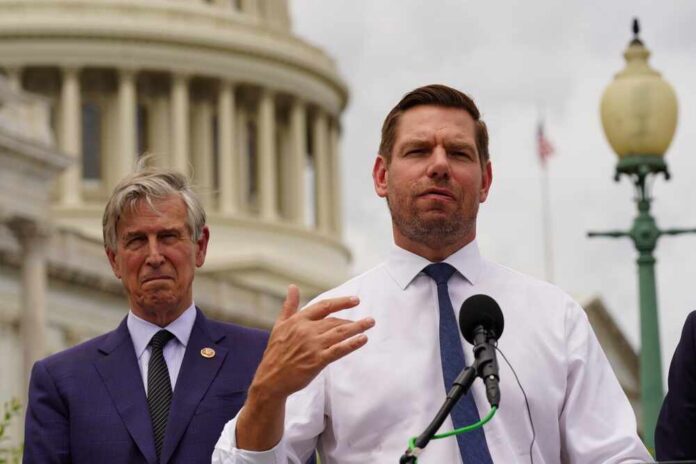
Just days before sexual assault allegations blew up his campaign, Eric Swalwell’s lawyers tried to legally muscle Tom Steyer’s team into silence over a residency fight, raising fresh questions about how powerful politicians use the law to protect themselves.
Story Snapshot
- Swalwell’s attorney sent a cease-and-desist letter to Tom Steyer’s campaign over claims he was only a “paper” California resident.
- Within days, a former staffer’s sexual assault allegations surfaced, and multiple women came forward with misconduct claims.
- Swalwell denied the allegations, insisted he has lived in California since 2006, and offered sworn declarations to defend his residency.
- The clash shows how legal threats and defamation claims now shape campaigns, while many voters feel both parties’ elites dodge real accountability.
How a residency dispute turned into a legal showdown
Tom Steyer’s campaign first went after Eric Swalwell’s right to run for California governor by questioning whether he truly lived in the state. Steyer’s attorney, Ryan Hughes, argued in a letter that Swalwell bought a house in Washington, D.C., and was registered to vote at a Livermore address he did not own, calling him a resident “on paper only.” The Steyer team asked the California secretary of state to enforce a long-dormant five-year residency rule, even though that rule has been treated as unconstitutional and unenforceable for years.
Swalwell’s lawyers hit back hard. In a court filing, Swalwell submitted a sworn declaration saying he has been a California resident since 2006. They also filed a declaration from Kristina Mrzywka, who said Swalwell and his wife have rented a Livermore property from her since 2017, paying monthly rent and keeping “significant belongings there at all times.” A campaign lawyer accused Steyer of echoing talking points from filmmaker Joel Gilbert, known for sensational, false claims about public figures, suggesting the residency attack was a political smear rather than a serious legal argument.
The legal threat that tried to shut down Steyer’s narrative
As the residency fight escalated, Swalwell’s attorney Elias Dabaie sent a cease-and-desist letter aimed at shutting down Steyer’s line of attack. The letter warned that continuing to say Swalwell was not truly a California resident could be defamatory, especially in light of his sworn statements and the Livermore rental records. A prominent election lawyer, Fredric Woocher, said he saw “not much substance” to the legal basis for Steyer’s residency challenge, noting courts and the secretary of state have long treated strict residency rules as constitutionally suspect. That view suggested the legal threat was less about winning a court case and more about stopping damaging headlines.
This kind of legal counterpunch fits a growing pattern in modern campaigns. Recent work on defamation and elections shows more politicians using cease-and-desist letters and defamation claims as tools to manage reputation when the facts are still disputed. These tactics can sometimes deter outright lies, but they can also intimidate critics and chill debate when voters are trying to sort truth from spin. For many Americans who already distrust “deep state” elites, seeing powerful figures deploy lawyers so quickly feeds the sense that rules work differently for the politically connected.
Sexual assault allegations erupt and overwhelm the residency fight
Just as the residency battle reached the courts, a more serious crisis hit. The San Francisco Chronicle reported that a former staffer accused Swalwell of sexually assaulting her twice, once in 2019 while she worked for him and again at a 2024 charity gala. She said she was too drunk to consent, and her account was backed by medical records and by people she spoke with after the later incident. CNN and other outlets followed with stories about four women accusing Swalwell of sexual misconduct, and an online influencer claimed he sent unsolicited explicit photos.
Swalwell called the allegations “flat false” and said they “have never happened,” framing them as political attacks timed to stop the frontrunner in a governor’s race. His attorney sent another cease-and-desist letter, this time to the accuser, arguing her years of friendly contact with Swalwell after the alleged incidents undermined her credibility. Her lawyer, Gerald Singleton, rejected the threat and said her statements were “100% factually accurate” and would not be withdrawn. Meanwhile, the Manhattan District Attorney’s Office in New York opened an investigation into the alleged 2024 incident, adding official scrutiny beyond campaign spin.
Collapse of a campaign and what it says about power and accountability
Once the assault claims went public, political pressure built fast. Fifty-five former staffers signed a letter backing the accuser and urging Swalwell to leave the governor’s race and resign from Congress, saying “no one is above the law.” Major Democratic groups, including teachers and nurses unions, lined up behind Tom Steyer instead, and one union rescinded its endorsement of Swalwell. Within days, Swalwell suspended his campaign, apologized to his family and supporters for “mistakes in judgment,” but again called the allegations “serious, false.” He later resigned from Congress while still denying any criminal wrongdoing.
For many voters, especially older conservatives and liberals who feel both parties have failed them, this saga looks familiar and discouraging. A powerful figure faces grave claims, lawyers fire off letters, and party insiders quickly shift to a new favorite, all while key facts remain under investigation. The residency dispute and the assault allegations show how legal tools, media framing, and party machinery can be used to protect or destroy a candidate without clear answers for the public. It reinforces a broad fear across the political spectrum: that America’s elites fight hardest not to fix the country’s problems, but to guard their own power and careers.
Sources:
nypost.com, politico.com, sacbee.com, sfchronicle.com, instagram.com, static.foxnews.com, facebook.com, eastbayinsiders.substack.com