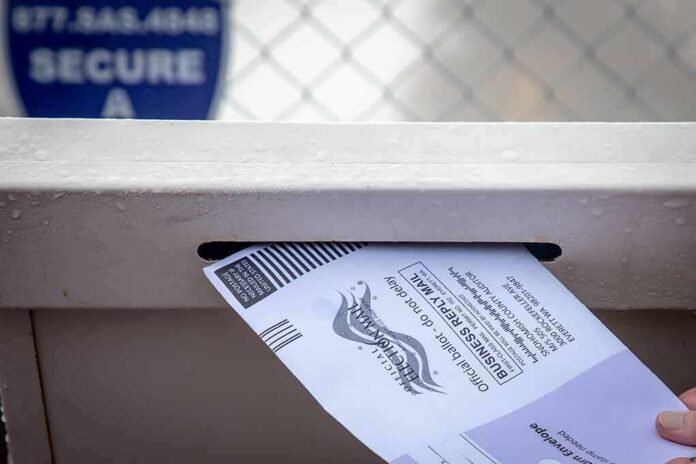
Twelve Republican-led states have asked the Supreme Court to let President Trump block mail ballots that arrive after Election Day, even though the same court ruled against that idea just weeks earlier.
Story Snapshot
- Missouri and eleven other GOP-led states filed an emergency Supreme Court request backing Trump’s executive order on mail voting.
- A federal appeals court had already blocked the order in 23 Democrat-led states and Washington, D.C.
- The move comes about 99 days before the November midterm elections, which will decide control of Congress.
- In June, the same Supreme Court ruled 5-4 against a similar GOP-backed push to cut off late-arriving mail ballots.
States Line Up Behind the Executive Order
Missouri led a group of a dozen states asking the Supreme Court to let the Trump administration fully carry out an executive order restricting mail-in voting. Alabama, Florida, Indiana, Kansas, Louisiana, Montana, Nebraska, Oklahoma, South Carolina and South Dakota joined the filing, according to Democracy Docket. The states argue federal law demands one uniform Election Day, and that grace periods for late-arriving mail ballots break that rule.
The Justice Department made a parallel request on the same day, asking the justices to step in after a federal appeals court sided against the White House. Reuters reported the Trump administration wants the order enforced nationwide before ballots go out for the midterms. The Justice Department frames this as a matter of election security, arguing that Postal Service mail should follow one clear national standard.
Appeals Court Ruling Sparked the Fight
A federal appeals court blocked Trump’s mail-voting order in 23 Democrat-led states plus Washington, D.C., ruling the directive likely violates the Constitution’s limits on federal power over state-run elections. That ruling forced the administration and its allied states to go straight to the Supreme Court on an emergency basis rather than wait for a full appeal, according to NPR. The clock is ticking, since ballots for many states start printing and mailing well before Election Day itself.
Republican National Committee attorneys have made this same argument before. They contend federal election-day statutes set one single day for casting ballots, and that state grace periods for military, overseas and domestic mail voters break that federal standard. Democracy Docket notes the current filing tracks nearly word-for-word with earlier Republican National Committee arguments the court already reviewed once this year.
A Recent Ruling Cuts the Other Way
The Supreme Court already weighed in on this exact question in June. By a 5-4 vote in Watson v. Republican National Committee, the justices upheld a Mississippi law letting mail ballots count if postmarked by Election Day and received within five days. The American Civil Liberties Union called it a win for “voters’ rights” and said the ruling protects state authority over ballot deadlines. That decision directly undercuts the legal theory behind the new emergency request.
Reporting from The Guardian confirms the June ruling sided against both the Republican National Committee and the Trump administration, upholding similar laws in more than a dozen states. Whether the justices treat this new dozen-state push differently, given it targets an executive order rather than a state statute, remains the open legal question. No ruling had been issued as of this writing.
What This Means for Voters
More than a dozen states, plus Washington, D.C. and U.S. territories, currently allow mail ballots to count if they arrive after Election Day, as long as they were mailed on time. A Supreme Court order siding with Trump and the states could force those jurisdictions to change their rules just weeks before millions of Americans vote in the midterms. Election officials in several states have already begun preparing contingency plans in case the court moves quickly.
This fight lands squarely inside a broader argument over who controls how Americans vote: the federal government or the states. Both sides in this case say they’re protecting election integrity, and both accuse the other of trying to tilt the midterms. For voters already skeptical of Washington, the spectacle of dueling emergency court filings over ballot deadlines, just months before an election, adds to a sense that the rules keep shifting under their feet.
SCOTUS ELECTION BREAKING: Key Deadline Set in High-Stakes Mail-In Voting Fight
The U.S. Supreme Court has officially set a crucial deadline in the Department of Justice’s emergency appeal (Trump v. California, No. 26A124).
Here is what you need to know about where things…
— Unite4Freedom (@Unite4Freedom) July 30, 2026
Sources:
zerohedge.com, courthousenews.com, democracydocket.com, scotusblog.com, cnbc.com, npr.org, nbcnews.com, abcnews.com, abc7news.com, pbs.org, washingtonpost.com