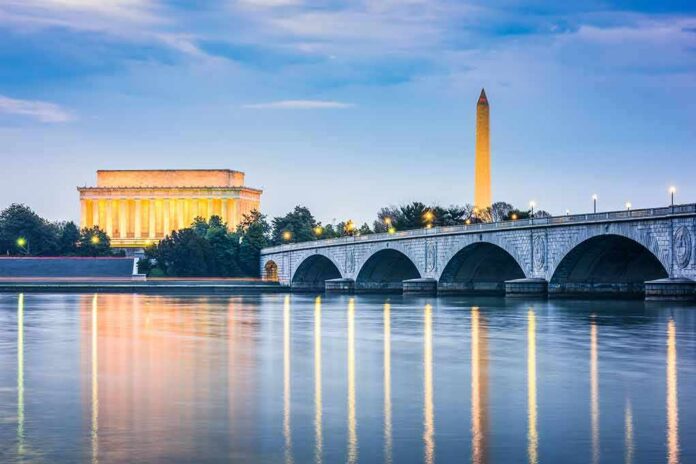
When a president publicly scolds his own top prosecutor over a dropped vandalism case at the Lincoln Memorial, it raises hard questions about whether justice in Washington still belongs to regular Americans or to the people in power.
Story Snapshot
- President Trump says Reflecting Pool damage was “pure vandalism,” blasting U.S. Attorney Jeanine Pirro for dropping the case against former Olympian David Hearn.
- Pirro’s court filing says new Interior Department records show a botched contractor installation, not criminal damage, undermining the original felony indictment.
- The dispute exposes how political appointees, agencies, and contractors can shift blame while everyday citizens see another elite fight over a broken national symbol.
- Both sides now use the Reflecting Pool to push bigger stories about government failure, mismanagement, and trust in the justice system.
What Trump Says Happened At The Reflecting Pool
President Trump is firmly telling Americans that the Lincoln Memorial Reflecting Pool was wrecked by vandals, not by sloppy government work. In a social media post, he said the case against former Olympic canoeist David Hearn was “a pure case of vandalism” and insisted he “disagrees 100%” with U.S. Attorney Jeanine Pirro for dropping the charge. He also pointed to other damage at the site, including grass marked with “86 47,” tying the pool problems to a larger pattern of disrespect and destruction.
Trump’s anger is not only about one pool. He launched the renovation ahead of the nation’s 250th birthday, as a symbol of American pride. From his view, calling the damage a contractor problem feels like letting vandals and weak officials off the hook. For many conservatives who already feel the system excuses bad behavior, Trump’s stance taps into fear that lawbreakers win while historic sites crumble and leaders blame “process” instead of people.
Why Pirro Dropped The Felony Case Against David Hearn
Jeanine Pirro, the U.S. Attorney for the District of Columbia and a longtime Trump ally, first pushed hard for a felony case. She told reporters that a grand jury had indicted Hearn for “felony destruction of property” and said the evidence would prove he “willfully destroyed” more than $1,000 in sealant at the bottom of the pool in a “deliberate act.” That framing treated Hearn as a clear vandal, and it matched Trump’s tough talk about fully prosecuting anyone who damaged the Reflecting Pool.
But weeks later, Pirro’s office changed course after seeing more records from the Interior Department. In a 20-page filing, she wrote that “additional documents” showed the damage was the result of a “flawed installation by the contractor” and a rushed job to finish before July 4 events. She admitted this new information “significantly undermine[d] the evidentiary basis for the indictment” and said it was now “difficult to attribute the widespread damage to the Reflecting Pool to vandalism, let alone to establish that fact beyond a reasonable doubt.” That is why she asked the judge to dismiss the case.
How A Broken Pool Became A Fight Over Government Credibility
This clash between Trump and Pirro hits a nerve because it is not just about a liner peeling off a famous pool. It is about whether the federal government can tell the truth, manage major projects, and treat regular people fairly when something goes wrong. First, officials blamed a citizen and called him a felon. Then, after new paperwork surfaced, they blamed a contractor hired under the same government that pushed the case. To many Americans, that looks like the system protecting itself.
For people on the right, Pirro’s reversal can feel like another retreat from law and order, feeding the idea that elites bend the rules when it suits them while everyday Americans face harsh penalties. For people on the left, Trump’s push to keep calling it “vandalism” even after the filing admits contractor faults fits a pattern where powerful figures resist facts that expose mismanagement. Both sides see something familiar: agencies slow to share records, political appointees under pressure, and public narratives hardening before all the evidence is out.
What This Dispute Reveals About Justice In Washington
The Reflecting Pool case also shows how quickly a criminal charge can become a political weapon. Pirro was confirmed with promises to crack down on crime in Washington. She stood at a podium, warned that vandals “will be fully prosecuted,” and used tough language about someone “intent on doing incredible damage” to a national monument. That message sounded strong to many viewers who are tired of chaos and feel the capital is out of control.
President Donald Trump faulted Jeanine Pirro, his handpicked federal prosecutor for Washington, D.C., for dropping a criminal charge against a former Olympian accused of damaging the Lincoln Memorial Reflecting Pool. Federal prosecutors had… https://t.co/PtVpgXFh50
— Hartford Courant (@hartfordcourant) August 1, 2026
Then came the reversal, with blame shifted to a contractor the government chose and to its rush to finish a patriotic project. Now, critics say the Justice Department moved too fast to indict a citizen and too slow to admit its own role. Supporters of Trump argue the dismissal sends the wrong signal to would-be vandals. Supporters of Pirro argue she followed the law once new facts appeared. Both claims rest on partial records, because the full complaint, engineering reports, and contractor files are not widely public yet. That gap leaves millions of Americans staring at a damaged pool and wondering whose story to trust.
Sources:
nypost.com, newsweek.com, en.wikipedia.org, abcnews.com