New reports show President Trump personally driving record-breaking donations from big corporations and wealthy backers, turning his own fundraising hustle into fuel for his America First agenda.
Story Snapshot
- President Trump directly reviews which companies and donors have paid, then pushes for much larger checks.
- Major corporate donors are tying big contributions to hopes of better access and friendlier policy decisions.
- New Freedom 250 and ballroom projects use tiered perks like VIP seating and presidential access for million‑dollar gifts.
- Democrats and watchdogs attack the strategy as “pay‑to‑play,” while Trump uses it to power his second‑term agenda.
Trump’s Hands-On Fundraising Style
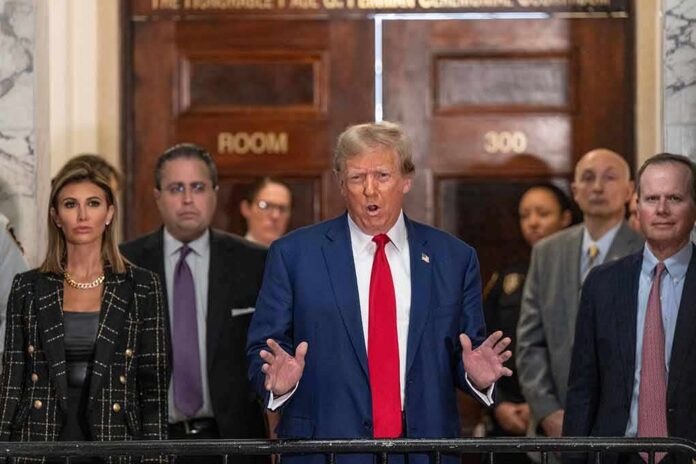
Almost every night at the White House, President Trump calls his lead fundraiser Meredith O’Rourke to go line by line through the donor list, asking which companies have written checks, which have not, and how much each has paid. People familiar with those calls say he often orders bigger asks than staff planned, with some donors pressed for sums from $5 million up to $50 million. O’Rourke tells prospects that “the boss wants this money,” signaling Trump’s direct interest in every dollar.
Trump’s approach fits his long pattern of aggressive fundraising, mixing small online donors with high‑dollar corporate money and access‑oriented events. Unlike many politicians who leave big asks to finance staff, Trump treats fundraising like a core part of his own job. He has bragged that by calling Wall Street and energy executives, he could instantly out‑raise Democrats and become “the greatest fundraiser in history,” a claim he made while contrasting his style with Joe Biden’s. For frustrated conservatives, that drive looks like using the left’s own tactics to defeat them.
Ballroom, Freedom 250, and Corporate Donor Perks
One major focus of Trump’s current money push is the new White House ballroom project, reported to be in the hundreds of millions of dollars and aimed at creating a lasting venue for national celebrations and America First events. Senatorial Democrats complain that Trump fundraiser Meredith O’Rourke is working with lobbyists to solicit huge checks from technology giants, defense contractors, and telecom companies that have business before the administration, but that criticism itself confirms how central this project has become. Public lists show donors including Apple, Amazon, Meta, Microsoft, Google, Lockheed Martin, and Comcast.
Freedom 250, a fundraising brand tied to America’s 250th anniversary, takes that model further with clear sponsorship tiers. Reports on Freedom 250 materials say donors who give at least $500,000 receive VIP access and preferred seating at events, while those who give $1 million are invited to private receptions and photo opportunities with President Trump. A congressional letter alleges that United States ambassadors in places like Japan have urged foreign companies to back Freedom 250, with promises of preferred access and speaking roles tied to official activities if they cross the million‑dollar mark. That shows how Trump’s team is using America’s birthday year to rally huge corporate donations for patriotic programming.
Access, Policy, and Pay-to-Play Attacks
Executives quoted in reporting admit they view multimillion‑dollar donations as a way to gain better access if their company’s issues reach the Oval Office, expecting Trump will want to know “how much the company had contributed” before weighing in. One chairman described companies as being “checked on a list, or crossed off a list” based on whether they gave or not. Watchdog groups and liberal critics brand this as a “pay‑to‑play” culture, arguing that seven‑figure checks can help donors win friendlier policy positions or ease federal investigations.
Democrats point to Trump’s private talks with oil and gas executives, where he reportedly said that if they raised $1 billion for his campaign, he would slash Biden‑era environmental rules and sign executive actions to benefit their industry. They also highlight data showing that many ballroom and super PAC donors later received large or expanded federal contracts under Trump’s second term. To the left, that mix of big money and policy change is proof of corruption. To many conservatives, it looks like business finally getting relief from green mandates, globalist trade deals, and anti‑energy crusades that made life harder for workers and families.
Using the Trump Brand and Donor Dollars
Trump’s fundraising machine does not rely only on corporate checks. His Save America and related political committees have raised huge sums from grassroots supporters, then spent donor money at Trump‑owned businesses for travel, rent, and events, a practice federal rules allow when billed at fair market value. He has also directed that Republican campaigns using his name and image in their own fundraising should send a cut of the proceeds back to his effort, formalizing the value of the Trump brand inside the party. Supporters see this as fair compensation for the movement he built; critics complain it drains money from other conservatives.
Across inaugurations, super PACs, and post‑election funds, Trump has built what analysts call a “permanent campaign,” raising hundreds of millions of dollars from donors who expect him to keep fighting globalism, woke corporate agendas, and heavy‑handed regulation. Corporate America poured a record $239 million into his first inaugural, and large companies again line up to give for his second‑term projects. For many on the right, this is a rare case where big business money helps push Washington toward secure borders, energy dominance, and a stronger economy instead of another left‑wing crusade.
Sources:
mediaite.com, wsj.com, democrats-foreignaffairs.house.gov, foxnews.com, theguardian.com, oversightdemocrats.house.gov, cbsnews.com, fec.gov, youtube.com, cambridge.org