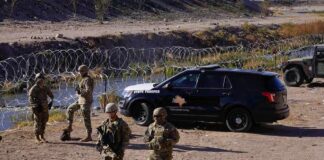
The same government that’s supposed to secure the border just used a military-grade laser to knock a U.S. border drone out of the sky—raising urgent questions about coordination, competence, and accountability.
Quick Take
- Lawmakers say a U.S. military laser system shot down a Customs and Border Protection drone near Fort Hancock, Texas, along the U.S.-Mexico border.
- The FAA responded by closing airspace around Fort Hancock, though officials said commercial flights were not affected.
- The incident follows an earlier February episode in the region involving a laser test and a reported misidentification of a party balloon as a threat.
- House Democrats argue the mishap reflects gaps in training and inter-agency coordination among DoD, DHS/CBP, and the FAA.
Laser Defense at the Border Hits a U.S. Asset
Officials and lawmakers described an incident Thursday evening, Feb. 26, 2026, in which the U.S. military used a laser-based counter-unmanned aircraft system near Fort Hancock, Texas, and a CBP drone ended up being shot down. The location sits south of El Paso along a heavily monitored stretch of the U.S.-Mexico border. The core fact pattern has been widely repeated, but public-facing details remain limited because the DoD and CBP have offered little immediate explanation.
The Federal Aviation Administration moved quickly after the report by expanding an airspace closure around Fort Hancock. Reporting indicated commercial operations were not disrupted this time, a key difference from earlier restrictions in the El Paso area. Still, when the FAA has to shut down airspace because agencies operating in the same corridor aren’t synchronized, it signals more than a simple “oops”—it shows how high-tech border tools can create new risks if the basics of communication fail.
FAA Airspace Closures Show How Mistakes Ripple Beyond the Border
The Fort Hancock restriction comes with recent regional precedent. Earlier in February, the FAA imposed restrictions around El Paso International Airport during a separate laser-related episode connected to operations near Fort Bliss. In that earlier case, reporting described an unsuccessful attempt to engage what was initially treated as a cartel drone but later identified as a party balloon. The FAA lifted the longer restriction the same day, but the disruption highlighted how rapidly these incidents can spill into civilian aviation concerns.
That context matters because border security is not just about fences and patrols anymore; it includes drones, counter-drones, and fast-moving decisions that can affect pilots, residents, and law enforcement in minutes. Laser-based C-UAS systems are often promoted as a way to neutralize drones without creating falling debris from bullets or missiles. But even “non-kinetic” tools can create consequences when they’re aimed at the wrong object—or, in this case, at a U.S. government drone operating in the same environment.
Democrats Cite Training Gaps, but Key Questions Remain Unanswered
Democratic lawmakers on the House Transportation and Infrastructure Committee, including Rep. Rick Larsen of Washington, said the episode reflected inadequate training and poor coordination among the Pentagon, DHS/CBP, and the FAA. They pointed to a claim that the White House rejected a bipartisan proposal aimed at training C-UAS operators and improving inter-agency coordination. Their statement underscores a real policy dispute: how to formalize procedures when multiple agencies operate drones and counter-drones in the same border airspace.
At the same time, the public record described in the reporting leaves significant gaps that matter for accountability. The reports did not provide a detailed operational timeline explaining why the laser system fired when it did, what identification steps were taken before engagement, or how a CBP drone ended up in the “threat” lane. DoD and CBP responses were described as minimal, with agencies deferring questions back toward the FAA, which primarily oversees airspace safety rather than military targeting decisions.
What This Means for Border Security and Constitutional Governance
Border hawks want technology that helps agents win the fight against cartels and foreign surveillance—especially as drones become cheaper and more capable. But conservatives also expect limited government to be competent government, with clear lines of authority and transparent after-action answers when federal tools take down federal assets. When Washington can’t coordinate basic operational deconfliction between agencies, it invites more closures, more mishaps, and more bureaucracy—none of which actually stops illegal crossings or hostile reconnaissance.
The clearest immediate takeaway is that the Fort Hancock incident is being treated as a serious enough event to trigger FAA airspace restrictions, but not yet serious enough—at least publicly—to produce a detailed explanation. That imbalance is exactly what frustrates voters who remember years of lectures about “competence” from the same institutions that struggled with border enforcement, inflation-era spending, and politicized priorities. Americans deserve border security that is effective, coordinated, and accountable—especially when the tools involved can reach beyond the border and into U.S. airspace.
Sources:
Texas Tribune: Texas closes airspace near El Paso after military laser reportedly downs CBP drone
KFOX14: Lawmakers say US military used laser to take down Border Protection drone