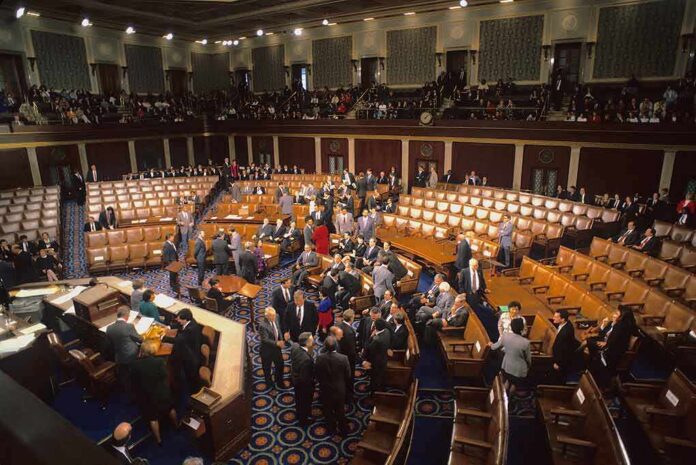
The House vote on the Stop Insider Trading Act is less a story about “swamp protection” than a revealing clash over what counts as real ethics reform versus a half-measure bundled with hardball voting rules.
Key Points
- The House passed the GOP-backed Stop Insider Trading Act 232–198; every “no” vote came from a Democrat, while 13 Democrats joined Republicans in support.
- The bill bans new purchases of individual stocks by members, spouses, and dependent children, but allows officials to keep and sell existing holdings with advance public notice.
- The measure’s enforcement relies on House and Senate ethics offices, with civil-style fines starting at $2,000 or 10% of the transaction value, not criminal sanctions or forced divestment.
- Democrats opposed the bill largely because it is narrower than stronger, bipartisan divestment proposals and is tied to a national voter ID requirement, which they view as an unrelated, partisan rider.
- The fight fits a long pattern: public outrage over congressional trading produces incremental reforms with weak enforcement while more sweeping bans and divestment mandates stall.
What the House Actually Passed
On its face, the Stop Insider Trading Act is a significant tightening of the rules that govern how members of Congress and their immediate families can trade stocks while in office. The bill, designated H.R. 7008, cleared the House by a vote of 232–198, with unified Republican support and a small group of 13 Democrats crossing over to back it. The entire bloc of “no” votes came from Democrats, which immediately fed a narrative that the party was defending its own financial privileges.
Substantively, the bill does three main things. First, it prohibits members of Congress, their spouses, and dependent children from purchasing new individual publicly traded stocks while the member is in office. Second, it permits those officials to retain the individual stocks they already own but requires them to disclose any intended sale publicly at least seven to fourteen days beforehand; those notices must specify the expected sale date, the nature of the transaction, and the number of shares and be posted on official House or Senate websites. Third, it creates a penalty structure: violators face fines of at least $2,000 or 10% of the transaction value, whichever is greater, plus surrendering any net gain from an unlawful purchase.
The bill expressly exempts diversified investment vehicles—mutual funds, index funds, ETFs—along with certain trusts, small business interests, and automatic dividend reinvestment plans. It also contains limited carve-outs for spouses or dependent children whose primary occupation involves trading securities, allowing them to continue that work under defined circumstances. The restrictions would take effect 180 days after enactment, giving lawmakers time to adjust their portfolios and compliance processes.
Why Nearly Every Democrat Voted No
To understand the Democratic opposition, you have to separate the ethics substance from the legislative vehicle. On ethics, key Democratic members and outside reform advocates argue that any credible fix must do more than block new purchases; it has to eliminate the conflict inherent in sitting lawmakers holding individual stocks in companies they oversee and regulate. In their view, the Stop Insider Trading Act is a partial, front-end restriction that still leaves significant room for conflicting incentives and potential abuse.
Critics emphasize several limits. The bill does not require lawmakers or their families to divest the individual stocks they already own. It does not bar selling existing holdings—so long as those sales are pre-announced—and it does not reach the President or Vice President, despite growing support for restricting trading across the entire top echelon of federal officeholders. Dependent children are defined narrowly as unmarried, under 21, living in the member’s household and claimed on their taxes; adult children with their own accounts and trading activity fall outside the bill’s scope.
Enforcement is another point of contention. Penalties are civil-style fines enforced by congressional ethics offices, not criminal sanctions backed by an agency with subpoena power. Given the STOCK Act’s history—where disclosure rules exist on paper but penalties are low, investigations are opaque, and enforcement has been described as “spotty at best”—many Democrats see the new regime as more of the same: a visible rule with limited deterrent effect.
Layered on top of these design critiques is the bill’s pairing with a nationwide voter ID requirement. The Stop Insider Trading Act is structured as a legislative package that both restricts congressional stock trading and mandates that voters present photo identification as a condition of casting a ballot. Democrats argue that combining a widely popular ethics measure with a contested voting rule is a classic “bait-and-switch”: it forces them to choose between supporting a trading curb they view as too weak or accepting election rules they consider likely to burden some eligible voters.
Those are not abstract objections. On the same day the House debated H.R. 7008, Democrats pointed to alternative proposals such as the Bipartisan Ban on Congressional Stock Ownership Act and the Senate’s PELOSI Act, which would prohibit lawmakers and their spouses from owning or trading individual stocks outright, often with divestment deadlines of 180 days after taking office. A group of House Democrats also introduced the No Getting Rich in Congress Act, which goes further by covering the President, Vice President, candidates, and banning trading in futures, commodities, and cryptocurrency, with stricter enforcement mechanisms. To supporters of these broader bills, H.R. 7008 looks incremental at best, and they see rejecting it as a way to keep pressure on for more sweeping divestment rather than settling for a limited restriction that may sap the political will for robust reform.
The Republican Case: A First Step on Ethics and Elections
Republican leaders, by contrast, cast the Stop Insider Trading Act as a concrete step toward restoring public trust in Congress. Speaker Mike Johnson has said he supports banning stock trading by lawmakers because “we shouldn’t have any appearance of impropriety” when officials legislate on matters that affect markets in which they personally invest. Sponsors such as House Administration Committee Chair Bryan Steil emphasize that the bill “does exactly what it says” by banning members and their families from purchasing individual stocks and requiring public notice before sales, with tangible penalties for violations.
From this perspective, the bill’s focus on new purchases is a pragmatic compromise. It avoids forcing immediate, potentially disruptive divestment while still closing off the most obvious avenue for exploiting inside information: buying shares in companies poised to benefit from upcoming legislative or regulatory activity. Requiring pre-announced sales and posting them publicly is meant to add an additional layer of transparency, making it easier for watchdogs and constituents to monitor whether lawmakers are timing their exits around nonpublic information or legislative events.
Republicans also defend the voter ID component as an overdue standardization of election rules across states, arguing that showing identification is a reasonable safeguard that many jurisdictions already employ. They present the package as a two-pronged effort: tighten ethics rules to address public anger over congressional trading and strengthen election integrity in one bill. From that vantage point, Democratic opposition appears less as a principled stand for stronger ethics than resistance to voter ID and a reluctance to accept constraints on long-standing financial practices.
How This Fits a Longer Pattern of Weak Ethics Enforcement
The conflict over H.R. 7008 sits squarely in a decades-long pattern in which Congress responds to scandal and public outrage with incremental reforms that narrow some behaviors but preserve core privileges. Congressional stock trading has been controversial since at least the early 2000s, when exposés about well-timed trades by lawmakers raised questions about insider access. The eventual response was the STOCK Act of 2012, which formally prohibited members from using nonpublic information for private profit and required disclosures of trades over $1,000 within a short window.
Yet the STOCK Act’s enforcement regime turned out to be weak. First-time violations carry a penalty of around $200, investigations are handled internally, and oversight bodies lack subpoena power; external watchdogs and scholars have described enforcement as inconsistent and opaque. No member of Congress has been successfully prosecuted under its insider trading provisions, despite multiple press reports documenting late disclosures and suspicious trading patterns. This history shapes lawmakers’ and advocates’ skepticism: they have seen how a high-profile ethics bill can, in practice, leave the status quo largely intact.
In response, more aggressive legislative ideas have circulated: requiring lawmakers to move assets into blind trusts managed independently, mandating full divestment from individual stocks and complex instruments, or imposing criminal penalties for violations tied to securities law. Multiple bipartisan divestment bills have been introduced in recent Congresses, including measures that would force members and spouses to sell individual stocks within 180 days and then limit them to diversified funds or blind trusts. In the Senate, the PELOSI Act cleared the Homeland Security and Governmental Affairs Committee despite opposition from most Republicans on that panel, showing that there is cross-party appetite for stronger action.
Against this backdrop, the Stop Insider Trading Act is best understood as part of a continuum: tougher than the STOCK Act’s disclosure-oriented framework, but not as far-reaching as outright divestment or blind trust mandates. That helps explain why some voices celebrate it as “real teeth” in ethics enforcement while others dismiss it as “a bandaid on a bullet hole.” The bill expands the rules, but it does not fundamentally change the model in which lawmakers can continue to hold and profit from individual stocks, subject to disclosure and modest fines.
Tell me again how well represented our nation is by the demsheviks
The Swamp Protects Its Own: 198 House Democrats Reject Congressional Stock-Trading Crackdown https://t.co/vqaZfEDFDf
— Kurt Bergstrom (@usalpinejager) July 24, 2026
What It Means Going Forward
The immediate political fallout of the House vote is predictable: Republicans will campaign on having passed a stock-trading crackdown and portray the 198 Democratic “no” votes as evidence that Democrats protect their own financial interests. Conservative media and social feeds have already framed the outcome as proof that “the swamp protects its own,” highlighting high-profile traders like former Speaker Nancy Pelosi as emblematic of the problem.
Democrats, meanwhile, are likely to answer that they opposed a weak, loophole-ridden bill tethered to voter ID and continue to push for stronger, cleaner proposals that mandate divestment, cover more offices, and separate ethics reform from election law fights. For voters trying to make sense of the noise, the key questions are simple: do you think members of Congress should be allowed to hold individual stocks at all while they write laws that affect those companies, and do you see voter ID as an appropriate add-on to an ethics package or a separate, more contentious issue that deserves its own debate?
Regardless of where one lands on those questions, the evidence from the past decade points to a structural reality: Congress has been slow to police its own financial conflicts, and when it acts, it tends to choose measures that adjust practices rather than eliminate them. The Stop Insider Trading Act fits that pattern. It narrows the avenues for potential abuse and adds transparency but stops short of requiring lawmakers to fully disentangle their personal portfolios from the companies they oversee. Whether the Senate and, eventually, the President accept this version or insist on more sweeping reform will determine whether this episode marks a turning point in congressional ethics—or simply the latest in a series of partial steps that leave the core controversy unresolved.
Sources:
redstate.com, cbsnews.com, youtube.com, cnbc.com, pbs.org, politico.com, time.com, finance.yahoo.com, brennancenter.org, congress.gov, facebook.com, businessinsider.com, npr.org, campaignlegal.org, britannica.com