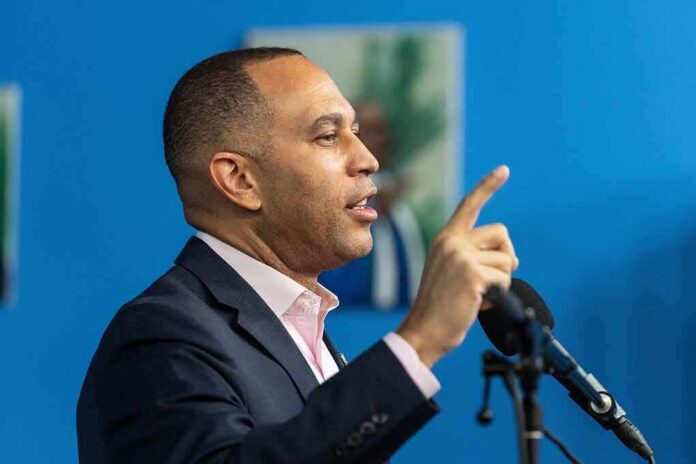
A brief, ambiguous head nod by House Democratic Leader Hakeem Jeffries is now driving a fierce fight over whether a future Democratic Congress would try to undo third-country deportations.
Story Snapshot
- Jeffries appeared to nod “yes” when asked if Democrats would bring back people deported to third countries.
- Democrats have criticized third-country deportations and opposed more enforcement funding.
- A federal appeals court questioned the policy’s due-process safeguards.
- Homeland Security officials defend the practice as a key public safety tool.
What Jeffries Was Asked And What He Signaled
The Gateway Pundit posted a clip on October 27 that shows a reporter asking Jeffries if a Democratic Congress would “bring back” people removed to third countries, including African nations. The site reports Jeffries nodded repeatedly and said, “We do.” The shared social post that boosted the clip admits he “never said YES out loud,” anchoring claims to body language rather than a clear statement. The exchange lacks a full, authenticated transcript or full-length video for added context.
Jeffries has criticized what he calls “extreme immigration enforcement” and urged a system that is “fair,” “just,” and “humane,” echoing broader Democratic language about due process and family impact. His office has opposed large new funding tranches for Immigration and Customs Enforcement and Customs and Border Protection, framing the Republican plan as reckless and harmful. That June stance committed Democrats to resist the package in Congress. None of the cited documents lays out a plan to fly deportees back to the United States.
What Third-Country Deportation Is And Why It Exists
Third-country deportation sends someone with a final removal order to a country that is not their homeland. The administration says this is used when the home country refuses return, when the person cannot be sent back there, or when logistics block removal to the country of origin. Officials argue the tool helps remove difficult cases, including some with serious criminal histories, and say the State Department seeks credible assurances about safety before transfers proceed.
Department of Homeland Security leaders and the department’s top lawyer describe the practice as an essential public safety tool. They argue that without it, people with final orders might remain in legal limbo inside the United States for years. They also say migrants receive notice and that the government obtains diplomatic assurances from the receiving country that the person will not face persecution or torture. Those assurances and notices are now central to ongoing legal challenges.
Why Courts And Advocates Are Pushing Back
Human rights groups and several news reports document cases where migrants say they lacked real notice, could not raise fears, or were later pushed onward to danger. A federal appeals court ruled in September that the process violated due process by not giving people enough notice or a meaningful chance to explain fear of transfer. The ruling pressures agencies to add stronger safeguards and more transparent steps before any third-country removal.
The Africa Report highlighted concerns about cost and oversight, citing a lawmaker calling the program “costly” and “poorly monitored,” and pegging total spending in the hundreds of millions of dollars. That claim feeds a bipartisan worry: large, opaque programs can grow without strong audits or clear results. Critics on both left and right see a system where officials protect their turf while taxpayers carry the bill.
What We Know Versus What Is Still Unclear
Two things are established: Jeffries criticized the policy and opposed more enforcement funding, and a court raised serious due-process problems. What remains unclear is whether Democrats plan to bring back people already sent abroad. The strongest evidence for that claim is an ambiguous nod and a short reply, not a policy paper, bill text, or caucus plan. No cited document sets funding, logistics, or criteria for any large-scale return program.
🔥🚨 JAW-DROPPING BETRAYAL! 🚨🔥
Hakeem Jeffries was asked POINT-BLANK if a Democrat-controlled House would BRING BACK the illegal aliens Trump already deported to third countries (like Africa):
Reporter: “Will the Congress under your leadership bring back the [illegal aliens]… pic.twitter.com/xFP1hE1nCc— Tironianae 🍊🍊 Z. – Ultra Verbum Vincet (@Tironianae) October 27, 2026
Homeland Security and the White House control removals day to day. Even if Democrats won both chambers in a future election, returning people already moved overseas would face legal, diplomatic, and budget hurdles. Receiving-country agreements, individual case files, and immigration-court orders all matter. Until leaders publish clear steps, voters are left with a viral clip, rival talking points, and a court order that targets process, not a blanket return mandate.
Sources:
thegatewaypundit.com, fatelephant.com, theafricareport.com, npr.org, jeffries.house.gov, abcnews.com, usatoday.com, apnews.com, congress.gov, washingtonpost.com