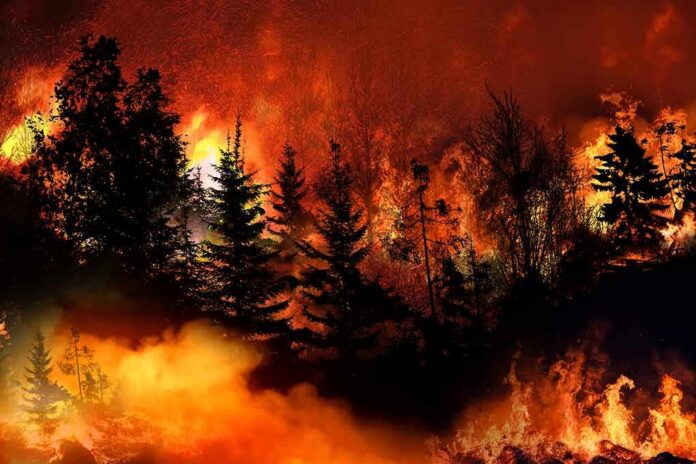
Europe’s own climate services now warn that wildfire danger is spreading beyond the Mediterranean into western, central, and northern regions as warming accelerates.
Story Snapshot
- European Union scientists project higher fire danger across most of Europe, with the biggest jump in the south.
- Copernicus says new wildfire‑prone areas may emerge in western, central, and northern Europe.
- A Nature study finds many areas could see at least a twofold rise in extreme‑fire probability.
- Researchers project far more land burned by century’s end, even under lower emissions.
What the Latest Assessments Say
European Commission analysts report that changing weather linked to global warming will raise wildfire danger across most of Europe, with the strongest increases in southern countries where fires already hit hard. Copernicus Climate Change Service adds that projections suggest new wildfire‑prone regions may emerge in western, central, and northern Europe as temperatures rise. This means communities that long saw big fires as a “Mediterranean problem” now face growing seasonal danger. The warning comes from official, science‑based services, not advocacy groups.
Peer‑reviewed research backs up these institutional findings. A 2024 Nature study reports that more than half of Europe could face at least a twofold jump in the chance of extreme fires, and that fire season length will extend in many places by late century. A 2026 study led by the Potsdam Institute for Climate Impact Research projects large growth in the area burned across Europe, including roughly 39 percent more per year under a low‑emissions path and near tripling under a higher path. These results point to a broader, long‑term shift.
Who Is Most Exposed and How That Changes
European Commission work quantifies what this means for people on the ground. The Joint Research Centre estimates that the number of citizens living near wildlands and facing at least 10 days of high to extreme fire danger each year could rise by millions with three degrees Celsius of global warming. While the largest absolute risk remains in southern Europe, the European Environment Agency also projects more high‑danger days in central Europe, expanding the map of exposure beyond traditional hotspots. That puts more towns, farms, and power lines in the path of risky weather windows.
Scientists also highlight key drivers that turn heat and drought into real disaster risk. The Joint Research Centre notes that climate change can stack the deck toward hot, dry, and windy conditions, while unmanaged fuels in forests and abandoned rural lands add to the threat. World Weather Attribution work linked severe fire‑weather episodes in Spain and France to human‑driven warming, finding those extremes are now far more likely than in a pre‑industrial climate. Together, these lines of evidence show both a climate signal and on‑the‑ground vulnerabilities.
Why This Matters for Everyday Life and the Economy
More dangerous fire weather in more places hits daily life and pocketbooks. Longer fire seasons mean higher costs for prevention, insurance, health care, and recovery. Tourism, farming, timber, and transport can all suffer when smoke and evacuations shut down regions. Power grids and water systems face higher stress. The Nature study’s finding of large increases in extreme‑fire probability implies more frequent, high‑impact weeks that strain emergency services and local budgets. Public safety plans and land management need to adjust before each hot spell arrives.
Many readers across the political spectrum share a deeper worry: institutions react after the damage, not before it. These European findings echo that concern. Agencies warn the danger map is shifting, yet fuel backlogs, slow permits for thinning, and a patchwork of local rules can delay action. The Joint Research Centre points to both climate and fuel management gaps. That mix invites a familiar failure mode—big reports, small follow‑through—until a bad season forces emergency spending that costs far more than steady prevention.
What Responsible Governance Would Do Next
Officials can act now with practical steps that respect tight budgets. First, target prescribed burns and thinning near towns and key infrastructure where risk is rising fastest. Second, harden homes and utilities with ember‑safe vents, cleared defensible space, and covered water storage. Third, upgrade early‑warning systems and cross‑border mutual aid for longer, earlier fire seasons. Fourth, align farm, forestry, and insurance incentives to reward year‑round fuel work, not only post‑fire aid. These actions match the science and cut risk regardless of future emissions paths.
Limits and What We Still Do Not Know
Models and scenarios drive many of these projections, and regional changes will not be uniform. Scientists emphasize that the largest increases appear in the south, and some areas will see smaller shifts. But the main conclusion is consistent across multiple top sources: danger is rising and spreading. For citizens, the practical takeaway is simple. Do not wait for smoky skies to start planning. Treat wildfire like floods or storms—predictable in trend, uncertain in timing, and manageable with smart steps taken early.
Sources:
newscientist.com, joint-research-centre.ec.europa.eu, climate.copernicus.eu, pik-potsdam.de, publications.jrc.ec.europa.eu, theguardian.com