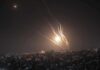
Israel’s widening campaign against Hezbollah has pushed Lebanon into a spiraling war-zone—leaving civilians to absorb the cost while evacuations, airstrikes, and ground moves expand by the day.
Quick Take
- Lebanon’s Health Ministry reported 217 killed and 798 wounded from Israeli strikes that began March 2, 2026, with attacks spanning Beirut’s southern suburbs and southern/eastern Lebanon.
- Israel says it is targeting Hezbollah-linked infrastructure as the Israel-Iran-US conflict spills across borders, while Hezbollah continues rocket and drone retaliation.
- Israel issued evacuation orders covering dozens of villages and later parts of Beirut’s southern suburbs, driving mass displacement reported at 800,000+ people.
- Ground activity increased near the border as UNIFIL reported Israeli movements into multiple locales, raising the risk of a deeper, longer fight.
Lebanon’s casualty numbers highlight the speed of the escalation
Lebanon’s Ministry of Health said Israeli strikes since Monday, March 2, killed 217 people and wounded 798, a sharp jump from earlier daily tallies reported at the start of the exchange. Israeli air and naval strikes aimed at Hezbollah-linked sites in Beirut’s southern suburbs and across southern and eastern Lebanon. The figures underscore how quickly tit-for-tat attacks can compound into a major regional emergency.
Israeli operations accelerated after Hezbollah launched attacks into Israel following reports tied to the killing of Iran’s Supreme Leader Ali Khamenei, an event cited as a trigger but described in some coverage as not fully confirmable. Lebanon’s reported death toll evolved as strikes continued, with early figures describing dozens killed before the cumulative count reached the hundreds. The pace of change makes real-time accounting difficult, but multiple sources align that the violence intensified rapidly after March 2.
Evacuation orders and strikes on communications show a broader target set
Israel issued evacuation orders for large areas—described as ranging from roughly 30 to 80 villages—and later expanded warnings to parts of Beirut’s southern suburbs, an area widely associated with Hezbollah. Strikes reportedly hit communications-related targets and media outlets tied to Hezbollah, including Al-Manar TV and other platforms. Those developments matter because they signal a push beyond isolated border exchanges toward sustained pressure on command, messaging, and logistics networks.
Mass displacement grew alongside the military campaign. Evacuation directives that affected hundreds of thousands, including an order impacting a large portion of south Beirut, and an overall displacement figure exceeding 800,000. UNIFIL reporting indicated Israeli entry or movement into multiple border-area locations as clashes flared near places such as Khiyam. Ground movement, even if limited, increases the likelihood of close combat and higher civilian disruption in fortified villages.
Hezbollah’s asymmetric retaliation keeps the conflict from staying “contained”
Hezbollah continued to respond with rockets, drones, and missiles aimed at Israeli bases and infrastructure. Israeli reporting emphasized strikes it described as “precise” counter-terror operations, while Lebanese reporting emphasized the civilian toll and the swelling number of wounded. The battlefield reality is that a heavily armed proxy force embedded near civilian areas makes “clean” conflict difficult, especially once evacuations and counterstrikes become routine.
Lebanon’s internal strain collides with a regional war dynamic
Lebanon’s government faces pressure from multiple directions: protecting civilians, addressing internal divisions over Hezbollah’s role, and navigating a region-wide conflict tied to Israel, Iran, and U.S. involvement. Lebanese detentions of suspected collaborators and statements condemning actions that pull the country deeper into war. Analysts warned that a ground invasion could produce intense clashes in fortified locations, suggesting the immediate humanitarian crisis could become a longer-term destabilization.
Lebanon says 217 killed, 798 wounded in Israeli strikes since Monday https://t.co/OuT3d1pUKh
— Naharnet (@Naharnet) March 6, 2026
For Americans watching from afar in 2026, one reality stands out: when terrorist-aligned militias operate as de facto armies, civilians get trapped between retaliation cycles and state-to-state escalation. Some key trigger claims and fast-moving casualty totals are difficult to independently verify in real time, and several sources caution that figures and battlefield claims can shift. What is clear is that the operational tempo—evacuations, airstrikes, and border moves—has increased rather than cooled.
Sources:
Israel’s Attacks on Lebanon March 2026
Lebanon conflict scenario (March 2026)
Regional war expands as Israel strikes Lebanon
Israel prepares ground invasion; Hezbollah formally joins war
Lebanon (Monthly Forecast, March 2026)
Israeli strikes targeting Hezbollah in Lebanon (map, March 3–4, 2026)