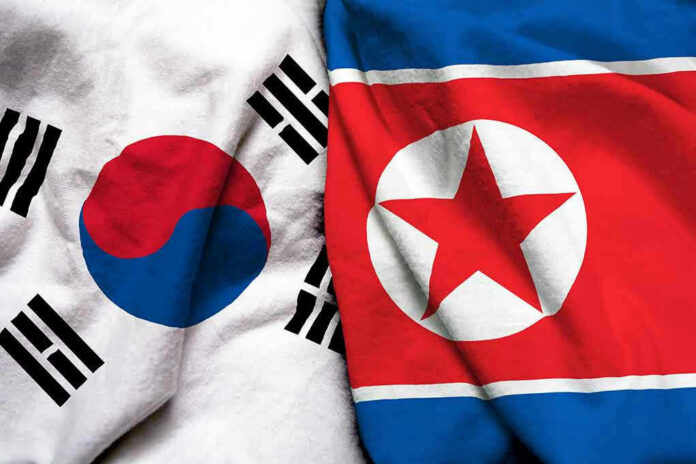
South Korea’s president publicly proposed direct talks to formally end the Korean War and discuss limits on North Korea’s nuclear program, reviving a long-stalled peace push as street protests warn against appeasing Pyongyang.
Story Snapshot
- President Lee Jae-myung urged four-party talks with North Korea, the United States, and China to replace the armistice with a peace regime.
- Seoul’s outreach comes as North Korea has dismissed recent proposals and shows little interest in dialogue.
- Conservatives in South Korea argue engagement is weak and push for a tougher military posture, even nuclear options.
- The debate follows the jailing of ex-President Yoon Suk Yeol over drone operations that courts said stoked tensions in 2024.
Lee’s Proposal: End the War and Curb Nuclear Risks
President Lee Jae-myung used a national address to call for direct talks among the two Koreas, the United States, and China. He said the goal is to replace the 1953 armistice with a formal peace framework and to explore ways to slow or halt North Korea’s nuclear advances. South Korean outlets reported that Lee framed this as a practical, step-by-step process focused on reducing chances of miscalculation. He tied the plan to easing daily military tensions near the border and at sea.
Lee’s government has floated a peace declaration as an early step to restart dialogue and create guardrails against crisis. That concept mirrors past research that described a peace regime as a set of agreements and institutions built over time, not a single event. Supporters say clear rules could reduce the risk of accidental clashes and give both sides incentives to keep talking. They argue that stability, not trust, is the first aim of talks.
Pushback at Home and a Cold Shoulder from Pyongyang
North Korea has recently rejected Seoul’s outreach and accused Lee of staying too close to Washington. Pyongyang has said it does not want talks under these terms, leaving Seoul to make its case to voters and allies while pressure remains high. Inside South Korea, conservatives call engagement “too weak” and prefer expanding deterrence. Some have urged discussions with Washington on redeploying United States tactical nuclear weapons or forming a nuclear-sharing plan.
Public protests in recent years have blasted engagement as appeasement, reflecting deep anger over security and sovereignty. Critics say aid or concessions reward bad behavior and could fund North Korea’s weapons. They argue that only stronger defenses and strict sanctions will change Pyongyang’s cost-benefit math. Lee’s team counters that stalemate without rules is riskier and that dialogue can proceed without weakening defenses.
Drone Legacy: Why Trust Is So Scarce
South Korea’s courts this year sentenced former President Yoon Suk Yeol to 30 years in prison, finding he authorized drone flights over Pyongyang in 2024 to raise tensions at home and justify martial law. The case hardened views about how leaders can manipulate crisis for power and why clear mechanisms to prevent escalation matter. The judgment also complicated Seoul’s politics, making any outreach to the North easy to attack as naïve or unsafe.
Reuters reporting in July said the current “peace first” shift does not drop denuclearization as a goal, but it does put risk reduction at the top of the agenda. That means building channels to manage incidents, setting guardrails near the Demilitarized Zone, and seeking phased steps that limit nuclear dangers. Advocates say even limited measures, like hotlines and no-fly rules, can save lives. Skeptics warn Pyongyang could pocket benefits and stall on real limits.
What It Means for Americans Watching Abroad
The United States remains central to any deal. Lee wants Washington at the table because American forces and guarantees shape the security balance on the peninsula. A calmer Korea lowers the chance of a crisis that could drag in U.S. troops and spike global markets. But a deal that loosens pressure without real checks could raise long-term risks. That trade-off echoes debates at home about strength, cost, and the gap between elite promises and results.
For readers tired of Washington’s gridlock and global drift, this moment hits familiar nerves. Leaders say they will reduce risk and defend the public, yet politics, secrecy, and spin often shape security choices. Lee’s proposal sets a clear test: can governments deliver basic safety steps both sides follow, with timelines and teeth, or will rival camps use fear to score points? Citizens on left and right, in both countries, will judge by outcomes, not slogans.
Sources:
apnews.com, koreaherald.com, koreatimes.co.kr, reuters.com, whbl.com, news.sbs.co.kr, upi.com