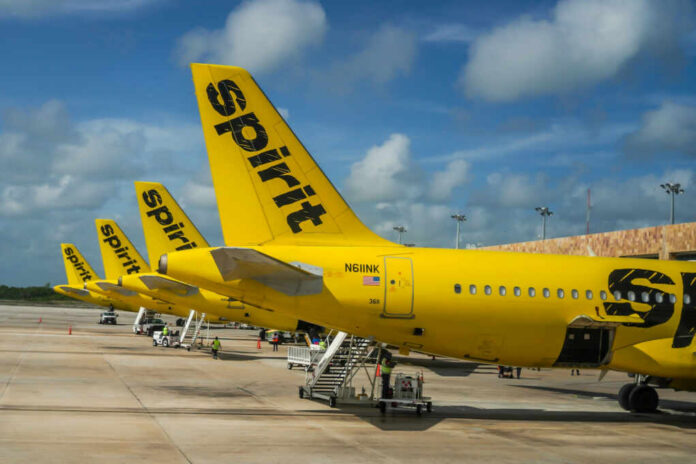
Spirit Airlines has shut down operations after Biden-era regulators blocked a merger that could have saved the carrier, forcing taxpayers to confront a controversial bailout that gives Washington control of a private airline.
Story Snapshot
- Biden DOJ blocked Spirit’s $3.8 billion JetBlue merger in 2024, eliminating the airline’s financial lifeline
- Spirit filed for bankruptcy twice, finally closing in May 2026 after fuel costs doubled and cash reserves evaporated
- Trump administration offered $500 million bailout requiring 90% government ownership, facing opposition from investors and Republicans
- 10,000 jobs hang in the balance as regulatory decisions force choice between taxpayer rescue or complete shutdown
Biden Regulators Block Merger Lifeline
The Biden Justice Department sued in March 2023 to stop Spirit Airlines’ proposed $3.8 billion merger with JetBlue Airways, winning a federal court decision in January 2024 that killed the deal. Spirit had sought the merger as a survival strategy after years of post-COVID financial struggles, having failed to turn a profit since 2019. The DOJ argued the combination would reduce competition and raise fares for budget travelers, despite Spirit’s deteriorating financial position making standalone survival increasingly unlikely. Both airlines abandoned the merger after the court ruling to avoid prolonged legal costs and uncertainty.
Whole-of-Government Anti-Merger Campaign
Biden appointees including FTC Chair Lina Khan and CFPB Director Rohit Chopra orchestrated what critics describe as coordinated anti-merger enforcement across federal agencies. The aggressive stance represented a sharp departure from traditional antitrust analysis focused on consumer welfare, instead prioritizing market structure theories favored by progressive activists. This “whole-of-government” approach, as characterized by conservative analysts, exemplified the administration’s willingness to use regulatory power to reshape industries according to ideological preferences rather than economic realities. The CFPB’s involvement particularly drew scrutiny, given questions about the agency’s constitutional structure and its traditional consumer finance mission having little connection to airline mergers.
Double Bankruptcy and Mounting Costs
Spirit filed its first Chapter 11 bankruptcy in 2024 following the merger collapse, then entered a second bankruptcy proceeding in August 2025 as conditions worsened. Jet fuel costs doubled amid escalating conflict involving Iran, draining Spirit’s cash reserves to $337 million against $360 million in fuel expenses alone. The airline projected $200 million in losses for 2026, making restructuring without external capital virtually impossible. Meanwhile, larger carriers like United, Delta, and American had improved their budget offerings, matching Spirit’s fares while providing superior products that eroded the ultra-low-cost carrier’s competitive advantage in an already consolidated market.
Taxpayer Bailout Faces Bipartisan Opposition
The Trump administration negotiated a $500 million rescue package in recent weeks that would give the federal government up to 90% ownership of Spirit, sparking fierce criticism from unexpected quarters. Investors objected to massive equity dilution that would essentially wipe out their holdings, while some Republicans warned against creating a precedent for government airline ownership. White House Press Secretary Karoline Leavitt publicly blamed the Biden merger block as the root cause, calling it “not a wise move” that forced taxpayers into an unwanted position. JPMorgan analysts cautioned the bailout would be “difficult to contain,” potentially triggering similar demands from struggling carriers like JetBlue and Frontier.
From CFPB Block to Bankruptcy: How Democrats, Biden Regulators Grounded Spirit Airlineshttps://t.co/QChPtJe4TM
— RedState (@RedState) May 2, 2026
The situation illustrates a familiar pattern where government intervention creates problems requiring further intervention, leaving ordinary Americans to foot the bill. Biden regulators prioritized their antitrust theories over market realities and worker livelihoods, blocking a private-sector solution that required no taxpayer money. Now 10,000 jobs depend on whether Washington becomes an airline operator, a role for which it has neither expertise nor constitutional authority. Whether one views this as regulatory overreach or necessary consumer protection, the outcome remains the same: bureaucrats in distant offices made decisions that grounded an airline, disrupted travel for millions, and stuck taxpayers with a rescue tab for an enterprise that hasn’t been profitable in seven years.
Sources:
From CFPB Block to Bankruptcy: How Regulators Grounded Spirit – RedState
Spirit Airlines Didn’t Die Because Biden Blocked the JetBlue Merger – View from the Wing
Biden Policy Forcing Trump Spirit Airlines Bailout – Washington Examiner
Struggling Airline Offered Smooth Landing From Trump Administration – NewsChannel 9