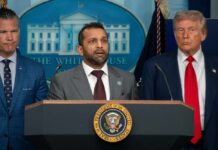
A DHS scandal that mixed aggressive immigration enforcement with allegations of blocked investigations has now forced a rare shakeup inside President Trump’s Cabinet.
Story Snapshot
- President Trump removed DHS Secretary Kristi Noem on March 5, 2026, after intensifying scrutiny over DHS operations in Minnesota and allegations of obstructed investigations.
- Congressional Democrats and Minnesota officials cited fatal shootings involving federal agents and claimed the federal government hindered state-level investigative efforts.
- Lawmakers also raised alarms about administrative subpoenas used to seek information from tech companies about Americans, including concerns tied to political expression.
- Trump named Sen. Markwayne Mullin as the next DHS leader, effective March 31, 2026, while reassigning Noem to a new Western Hemisphere security role.
Why Noem Was Removed: Minnesota Operations Put DHS Under a Microscope
President Trump announced Kristi Noem’s removal as Secretary of Homeland Security on March 5, 2026, after weeks of congressional scrutiny focused on DHS actions in Minnesota. The controversy centered on a major enforcement push tied to what DHS described as “unprecedented” fraud concerns, alongside allegations that federal agencies interfered with state oversight. The available records describe a breakdown of trust between federal operations and state authorities investigating serious incidents involving American citizens.
Trump also reassigned Noem as “Special Envoy for the ‘Shield of the Americas,’” a Western Hemisphere security initiative teased for a March 8 announcement in Florida. That move signaled an attempt to keep the administration’s border-and-security agenda moving while acknowledging that Noem’s tenure had become politically and operationally difficult to defend. Markwayne Mullin was named as her successor, with an effective date of March 31, 2026.
Operation Metro Surge: From Fraud Messaging to an Immigration Enforcement Flashpoint
The timeline in Minnesota began escalating in late 2025, when Noem publicly posted about rooting out fraud in Minneapolis and other cities. On December 6, 2025, she announced “Operation Metro Surge,” initially deploying at least 100 ICE and Homeland Security Investigations agents to the Twin Cities. Minnesota’s attorney general later described the deployment as expanding dramatically, suggesting it grew to as many as 2,000 DHS personnel in the area.
Critics described the operation as an immigration enforcement surge rather than a narrowly tailored fraud probe, a distinction that matters because it shapes which authorities are invoked and what guardrails apply. It aslo notes community-level effects attributed to the surge, including reduced cooperation with law enforcement and economic disruption for local businesses. Those claims largely appear in congressional correspondence and state filings, meaning readers should treat them as documented allegations and policy critiques rather than adjudicated findings.
Fatal Shootings and the Core Claim: State Investigations Were Thwarted
Two shootings became central to the political blowback. In one case, Renee Good was shot by ICE agents; in another, Alex Pretti was shot at point-blank range by a Border Patrol agent. Minnesota officials and congressional Democrats argued that federal agencies blocked or limited state investigative efforts. Leading to Minnesota Bureau of Criminal Apprehension being prevented from fully investigating, and it describes the Department of Justice and DHS as obstructing cooperation in at least one case.
Those obstruction claims matter beyond Minnesota because they raise a constitutional and accountability question conservatives should care about: whether any federal agency can insulate itself from legitimate scrutiny when a U.S. citizen is killed. It does not include a final adjudication of wrongdoing by agents, nor does it include a full federal response on the merits. What it does show is that the political system treated the allegations as serious enough to trigger hearings, letters, and ultimately a leadership change.
Administrative Subpoenas and Civil Liberties: Oversight Expands Beyond Minnesota
Congressional scrutiny widened to include DHS use of administrative subpoenas to obtain personal information from technology companies. Lawmakers raised concerns that such tools could be used to identify Americans based on political expression and even rally attendance—an issue that crosses ideological lines but hits especially hard for conservatives wary of bureaucratic overreach. Rep. Kelly pursued impeachment-related pressure tied to these subpoena practices, underscoring how quickly immigration enforcement debates can spill into broader civil liberties fights.
What Changes Under Mullin—and What We Still Don’t Know
Markwayne Mullin’s appointment creates an immediate test: can DHS keep a firm enforcement posture while avoiding the kind of operational and oversight conflict that drove this controversy? The status of “Operation Metro Surge” under new leadership remains unclear, and it flags gaps, including limited detail about an Inspector General accusation referenced in the topic framing and an unexplained “Butler” investigation reference. Until those details are documented in primary records or final findings, conclusions should remain cautious.
Noem Saga Grows More Bizarre as IG Accuses DHS of Blocking Investigations, Including One Involving Butlerhttps://t.co/0PLjVbEyEf
— RedState (@RedState) March 6, 2026
For conservative voters who support border enforcement but also demand constitutional restraint, this episode is a reminder that outcomes matter as much as intentions. The record provided describes serious allegations: U.S. citizens detained despite limits on civil immigration authority, designated cells for citizens, and tactics criticized as reckless. The political consequence—Noem’s removal—suggests the administration is signaling that enforcement must be aggressive, but also disciplined, accountable, and able to withstand scrutiny.
Sources:
MN Follow-up Letter (January 29, 2026) – Rep. Pramila Jayapal office PDF
Congress: DHS administrative subpoenas used on tech companies
Minnesota Attorney General complaint regarding DHS operations (January 12, 2026) – PDF