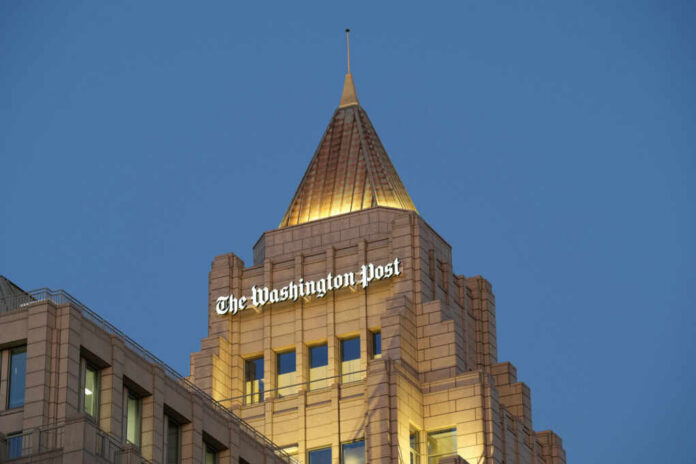
When Jeff Bezos told CNBC the Washington Post must be profitable and “not a non-profit,” he drew a sharp line that spotlights a deeper fight over who sets the rules for American journalism and who pays the price when the math does not work.
Story Snapshot
- Bezos defended layoffs as necessary to make the Washington Post financially self-sustaining [1].
- He said decisions should follow audience and performance data, with investigative reporting as a protected exception [1].
- Coverage summaries say cuts reached roughly 30 percent of staff, raising fears of weakened capacity [2].
- The available record relies on interview recaps and clips, not full financials or the complete transcript [1][2].
Bezos’s Profitability Case and Data-First Rationale
Jeff Bezos argued on CNBC that the Washington Post must be profitable and relevant to readers on its own merits, saying wealth from other ventures would not indefinitely subsidize the newsroom [1]. He said he directed managers to use performance metrics to determine where to reduce costs, framing layoffs as a structural business response rather than a preference for smaller journalism [1]. He pointed to reader willingness to pay as the definitive test of value, asserting that weak demand signals an insufficient product-market fit for coverage [1].
Bezos contrasted the Washington Post with the New York Times, noting that a legacy outlet can be editorially strong and financially successful if it offers services people will pay for [1]. He also claimed the Post’s newsroom remains large by historical standards even after cuts, invoking past eras like Watergate to argue capacity persists [1]. He cited recent high-impact work and awards as evidence the core mission endures, though awards validate quality rather than prove financial necessity for staff reductions [1].
The Protected Core: Investigative Reporting Exemption
Bezos said investigative journalism should be exempt from data-driven cuts, calling it “the heart of the Post,” a stance that implicitly concedes metrics can misprice long-horizon reporting with diffuse benefits [1]. This carveout addresses a central fear across the political spectrum: that algorithms and short-term engagement measures will shrink the watchdog function that exposes waste, fraud, and abuse in powerful institutions. The claim, however, is not backed here by department-level headcount data or internal staffing plans quantifying the protection [1].
Coverage summaries report layoffs affected roughly 30 percent of staff, a scale that naturally raises concerns about beat depth, institutional memory, and the ability to track complex stories over time [2]. Critics argue that preserving marquee investigations while thinning everyday coverage risks eroding the connective tissue that makes major scoops possible. The record provided does not include the selection matrix, performance criteria, or post-layoff outcomes needed to evaluate that trade-off empirically [1][2].
Evidence Gaps and Why They Matter for Public Trust
The currently surfaced evidence relies on secondary summaries and short-form clips rather than the full CNBC transcript, unedited video, or internal financial documents, limiting verification of exact phrasing and context [1][2]. No audited revenue figures, loss statements, or operating-margin disclosures accompany the profitability claim, leaving the core “business necessity” rationale dependent on owner assertions instead of documentary support [1][2]. Absent the layoff decision rubric and department headcounts, it remains unclear how consistently data-guided criteria were applied across desks [1].
Audiences on the right and left, already wary of elite control and opaque decision-making, will find these gaps consequential. Conservatives see another institution failing to live within its means, while liberals see corporate-style triage threatening public-interest reporting. Both sides share a baseline suspicion of billionaire-owned media. That climate makes transparency a strategic imperative: releasing staffing charts, performance rubrics, and before-and-after subscription and advertising trends would let readers judge whether painful cuts improved sustainability or simply normalized austerity.
The Larger Stakes for Journalism and Democratic Accountability
The debate sits within a long industry contraction as advertising shifted to technology platforms and legacy outlets chased digital subscriptions with mixed success. Bezos’s profit-and-relevance framing matches a market discipline view that many voters, frustrated with failing institutions, apply across government and media alike. Yet watchdog reporting often delivers delayed, systemic benefits that pure metrics can undervalue, creating a tension between cash-flow targets and civic obligations—a tension that grows when trust in institutions is already low [1][2].
🇺🇸 Bezos draws line on WaPo subsidies
What happened:
Jeff Bezos responded to direct questions about Washington Post layoffs by stating the paper must reach profitability on its own without ongoing support from his personal wealth.✅ Confirmed: Bezos was publicly confronted… pic.twitter.com/0DSspLIXYW
— The States Brief (@TheStatesBriefX) May 21, 2026
For readers who believe the federal government and entrenched elites protect themselves first, the risk is clear: if newsrooms narrow to what sells week to week, fewer resources remain to follow the money, scrutinize policy failures, and hold power to account. Bezos’s pledge to shield investigative work acknowledges that risk. Substantiating the pledge with documents—and publishing post-layoff outcome data—would test whether a leaner Post can still meet the public’s need for rigorous, independent oversight.
Sources:
[1] Web – The Post needs to be a profitable enterprise: Jeff Bezos defends …
[2] Web – Washington Post owner Jeff Bezos confronted on major layoffs at …