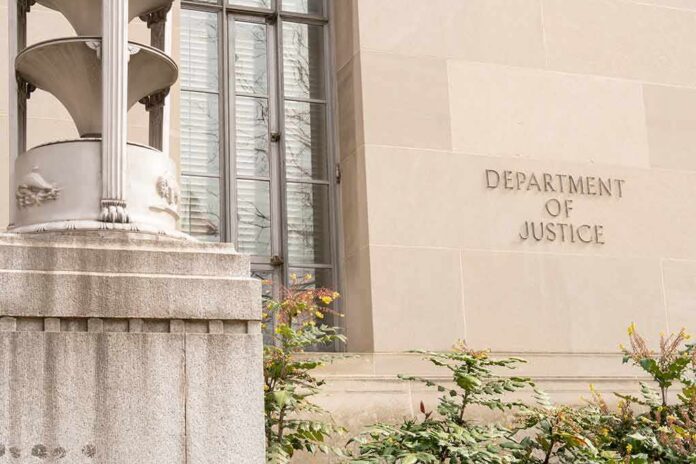
President Trump’s Justice Department is moving fast on denaturalization, and the scale is now hard to ignore.
Quick Take
- The Justice Department has filed new denaturalization actions against 25 naturalized citizens accused of serious crimes and fraud.
- The department says the cases involve concealment, false statements, identity fraud, and other disqualifying conduct.
- Government reporting shows the Trump administration is treating denaturalization as a top enforcement priority.
- Legal experts note that denaturalization still requires a federal court case and a high proof standard.
Justice Department Expands the Campaign
The Justice Department announced that it filed denaturalization actions against 25 naturalized citizens between July 20 and August 3. Officials said the cases involve crimes and conduct including attempted murder, child sexual abuse, identity fraud, marriage fraud, passport fraud, bank fraud, drug trafficking, and practicing medicine without a license. The department also said the complaints are part of what it called the largest denaturalization effort ever.
The new filings add to a broader push that has accelerated under President Trump. The Justice Department said its denaturalization total has reached 88 since January 20, 2025, while a separate report said the administration is aiming for at least 250 cases by October. U.S. Citizenship and Immigration Services also said it helped with several recent cases, and the agency said the complaints were filed in federal district courts across multiple states.
Why the Administration Says It Is Acting
Administration officials say citizenship must be protected from fraud and criminal abuse. Acting Attorney General Todd Blanche said the complaints allege that the defendants secured naturalization through fraud, concealment, or other unlawful conduct. A Justice Department memo from 2025 made denaturalization one of the Civil Division’s top enforcement priorities and listed cases involving war crimes, gangs, drug cartels, government corruption, and fraud.
The legal basis is not new. Federal law allows the government to seek revocation if naturalization was illegally obtained or gained through concealment of a material fact or willful misrepresentation. The Justice Department and U.S. Citizenship and Immigration Services both stressed that the cases are filed in court, which means the government still has to prove its claims before any citizenship is stripped.
What the Surge Means for Citizens and Courts
This is where the fight gets bigger than the headline. Denaturalization is rare, but the current pace shows the Trump administration is using an old legal tool with new force. Legal and immigration groups say the government must meet a strong evidentiary burden, and the complaints alone do not equal proof. That matters because citizenship is one of the most serious rights in American law.
The Department of Justice (DOJ) has filed a record 25 denaturalization cases over a two-week period between July 20 and Aug. 3, marking the “largest denaturalization effort ever,” according to the department.
The denaturalization complaints were filed in multiple district courts…— the sentinal (@youseethisguy) August 5, 2026
The public record also shows why this issue is drawing attention. A Trump administration official told reporters the government has filed nearly 90 denaturalization cases since early 2025, and one report said officials are targeting hundreds of foreign-born citizens for review. Supporters see that as overdue enforcement. Critics warn that any broad campaign must stay tied to clear evidence, not just broad suspicion.
Sources:
thegatewaypundit.com, justice.gov, npr.org, cnn.com, youtube.com, theconversation.com, cbsnews.com, immpolicytracking.org, congress.gov, forumtogether.org