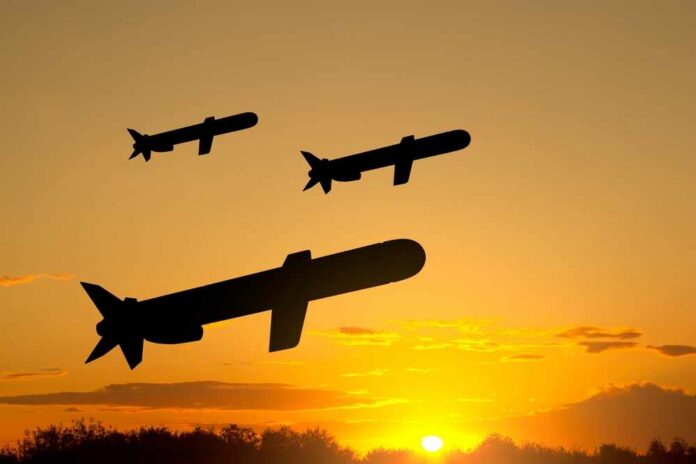
America’s critical Tomahawk missile stockpile faces catastrophic depletion after Operation Epic Fury against Iran consumed what could take half a decade to replace, leaving our forces dangerously exposed if China moves on Taiwan.
Story Snapshot
- U.S. Navy fired up to 400 Tomahawk missiles at Iran in just 72-96 hours during Operation Epic Fury—equivalent to five years of current production rates
- Production bottlenecks limit output to just 57-72 missiles annually, with each taking up to two years to manufacture due to supply chain constraints and single-source suppliers
- Pentagon war games predict massive Tomahawk requirements for a China-Taiwan conflict, but current Middle East operations drain stockpiles needed for Indo-Pacific deterrence
- Navy maintains a goal of 3,992 missiles in inventory, but recent strikes may have depleted roughly 10% of ready stocks when Pacific readiness should be the priority
Operation Epic Fury Drains Critical Stockpile
The U.S. Navy launched between 100 and 400 Tomahawk cruise missiles against Iranian targets during the opening phase of Operation Epic Fury in late February 2026. Thirteen destroyers and submarines participated in the “shock and awe” campaign targeting Iranian air defenses and military installations. The USS Thomas Hudner fired Tomahawks on March 4, with CENTCOM releasing video documentation of the strikes. This rapid expenditure represents an unprecedented drain on America’s precision strike capability, consuming in days what the defense industrial base needs years to replenish.
Production Cannot Keep Pace With Combat Usage
RTX Corporation, the sole manufacturer of Tomahawk missiles, produced only 72 units in fiscal year 2025 and 57 in fiscal year 2026. Each missile requires approximately 24 months to manufacture due to bottlenecks in rocket motor production and reliance on single-source suppliers for critical components. Former Chief of Naval Operations Admiral James Kilby testified in 2025 about the urgent need to increase production or develop alternatives. Even with Pentagon deals to ramp production toward 1,000 missiles annually, the “cold” production lines and supply chain vulnerabilities mean years will pass before inventory recovers to pre-strike levels.
China Threat Exposes Strategic Miscalculation
Defense analysts warn that diverting Tomahawks to Middle East operations undermines deterrence against China in the Indo-Pacific. The Center for Strategic and International Studies conducted war games in 2023 demonstrating that a conflict over Taiwan would require massive numbers of precision missiles to destroy Chinese missile batteries at range. Mackenzie Eaglen of the American Enterprise Institute noted that a China conflict would demand far more munitions than the 2003 Iraq invasion, which consumed 800 Tomahawks and took a decade to replace at previous production rates. The current situation creates dangerous “empty rack” scenarios if Beijing decides to exploit America’s depleted arsenal.
Industrial Base Weakness Threatens National Security
The Tomahawk shortage reveals fundamental weaknesses in America’s defense industrial base that decades of post-Cold War drawdowns created. Unlike past conflicts where stockpiles could absorb temporary depletion, current production capacity cannot sustain high-intensity operations against peer adversaries. Japan and Australia, both purchasing Tomahawks for their own defenses, now compete for limited output. The Army’s new Typhon ground-launched program adds additional demand on the same constrained production pipeline. This exposes how years of complacency and inadequate investment left America vulnerable precisely when strength matters most against adversaries like China who monitor our sustainment capabilities closely.
Over 2,000 Tomahawk Missiles Will Vanish and the U.S. Navy Has Almost No Way To Replace Themhttps://t.co/rL8KAXNu79
— 19FortyFive (@19_forty_five) March 9, 2026
RTX Corporation has begun ramping up production facilities, but the 24-month lead times for critical components mean recovery will extend well into 2028. The Navy maintains its stated goal of 3,992 missiles in inventory, though actual stockpile numbers remain classified. This situation demonstrates the consequences of allowing defense readiness to atrophy while threats multiplied. American military superiority depends on magazine depth—the ability to sustain combat operations over time—not just initial strike capability. As China watches America expend irreplaceable precision weapons on Middle East operations, the window for opportunistic aggression against Taiwan potentially widens, undermining the very deterrence these weapons exist to provide.
Sources:
EPIC FURY – U.S. Central Command