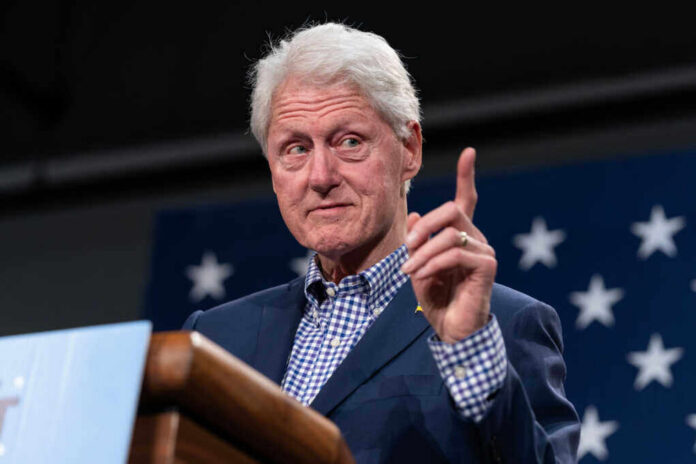
A headline claiming Nancy Mace “shocked” Bill Clinton may be clickbait, but the real story is more serious: Congress is testing whether powerful political families can simply dodge subpoenas without consequence.
Story Snapshot
- Mace trapped or “shocked” Bill Clinton with a specific provocative allegation during a deposition.
- House Oversight pursued depositions tied to Jeffrey Epstein; Bill Clinton initially did not appear for scheduled dates before later footage showed hours of questioning.
- Hillary Clinton did appear, and accounts of her demeanor sharply conflict between Mace and Clinton’s spokesperson.
- The probe expanded to include scrutiny of Commerce Secretary Howard Lutnick after new photos and emails resurfaced about Epstein ties.
- The broader stakes center on congressional oversight authority, public transparency, and whether elites face the same accountability as everyone else.
What We Can and Cannot Verify About the Viral “Shock” Claim
Rep. Nancy Mace (R-SC) “left Bill Clinton shocked” or lured him into a “clever trap” during an Epstein-related deposition. What is documented is narrower and more concrete: the House Oversight Committee pursued testimony from Bill and Hillary Clinton as part of a wider Epstein investigation, and later released footage indicating each sat for more than four hours of questioning.
This matters for readers who are tired of media games. The conservative takeaway is not a made-for-social clip; it is whether oversight institutions can force answers when the subject is politically connected. Without a verified transcript segment showing a “provocative allegation” or “trap,” responsible reporting has to focus on the official timeline, the committee’s actions, and what witnesses did or did not do under subpoena pressure.
Oversight Timeline: Subpoenas, Missed Dates, and a Contempt Track
House Oversight’s investigation addressed alleged federal mishandling around Epstein and Ghislaine Maxwell, questions surrounding Epstein’s 2019 death, and potential ethics concerns involving public officials. According to the research summary, Bill Clinton was scheduled for a deposition in December 2025 and then again in mid-January 2026, and he did not appear for either date. The committee later moved forward on contempt-related action and set another deposition date with negotiated terms.
The committee’s posture highlights an institutional issue conservatives have flagged for years: when government power is used aggressively against regular Americans, compliance is demanded immediately, but when elites are called to account, the system suddenly moves slowly. Congressional subpoenas are not optional suggestions, and the practical question for voters is whether the House can enforce its investigative authority evenly, regardless of party or pedigree.
Hillary Clinton Deposition: Disputed Conduct and Competing Narratives
Hillary Clinton’s deposition produced one of the most contested pieces of this story: what happened in the room. Mace publicly described Clinton as “screaming” and “combative” when Epstein and Maxwell came up, while Clinton’s spokesperson disputed that portrayal and argued Clinton was being prevented from answering a question tied to her Senate work after 9/11. Rep. Anna Paulina Luna backed Mace’s description and suggested audio would be released.
With only the research provided, the strongest conclusion is limited: there are conflicting accounts from partisan actors, and the public is being asked to choose whom to believe. For constitutional-minded voters, that is precisely why transparent procedures matter. If depositions are video recorded and released in full, Americans do not have to rely on curated clips, selective quotes, or spokesperson spin to understand how witnesses responded to direct questions.
Bill Clinton’s Testimony: Hours of Questioning and a Narrow Claim
Footage and transcript indicate Bill Clinton ultimately faced more than four hours of questioning. Within those materials, Clinton reportedly characterized his relationship with Epstein as limited, stating he had only one meeting with him. That narrow claim will continue to draw scrutiny because Epstein’s network and access are at the heart of what Congress is trying to map, and short, definitive answers invite follow-up questions.
The key point is procedural, not theatrical. If Congress is investigating how a notorious trafficking operation intersected with influential circles, then answers need to be specific, testable, and recorded. Conservatives who watched years of “two-tier” accountability debates will view this as a basic fairness issue: ordinary citizens would not be granted endless benefit-of-the-doubt when timelines and relationships are under investigation.
Lutnick Angle Expands the Probe Beyond the Clintons
The investigation broadened when Commerce Secretary Howard Lutnick came under renewed scrutiny. The research summary cites DOJ-released emails and the emergence of a restored photograph placing Lutnick with Epstein on Little Saint James. Lutnick has acknowledged visiting Epstein’s island in 2012 during a family vacation and testified he spent about an hour there with his wife, nannies, and children. Mace urged his testimony, and Chairman James Comer reportedly signaled he may be summoned.
WATCH: Nancy Mace Leaves Bill Clinton SHOCKED During Epstein Deposition After Bringing Up a Very Provocative Allegation Epstein Made About Him – Then Clinton Falls into a Clever Trap Set By Mace | The Gateway Pundit | by Cullen Linebarger
— GuitarMan (@palumb61466) March 8, 2026
Politically, this creates a reality both parties can understand: once Congress opens the Epstein file, the blast radius can widen fast. For voters exhausted by institutional distrust, the most credible path forward is consistent standards—subpoenas enforced, testimony recorded, and evidence evaluated on the record. If the viral “shock” narrative fades, the underlying accountability question remains: will Washington apply the same rules to the connected that it applies to everyone else?
Sources:
https://evrimagaci.org/gpt/nancy-mace-sparks-firestorm-over-clinton-and-epstein-testimony-531986
https://www.rev.com/transcripts/bill-clintons-deposition-in-epstein-investigation