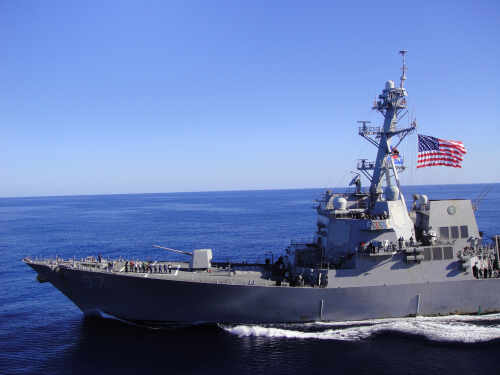
Iran issued a 30-minute countdown threat to sink a US Navy destroyer approaching the Strait of Hormuz on April 11, 2026, forcing the vessel to retreat just as fragile ceasefire talks unfolded in Pakistan—exposing how asymmetric warfare tactics now dictate terms in a conflict where both superpowers and ordinary Americans pay the price in blood and treasure.
Story Snapshot
- Iranian forces warned a US destroyer it would be targeted and sunk within 30 minutes if it entered the Strait of Hormuz, prompting a reported retreat on April 11, 2026
- The threat coincided with indirect US-Iran ceasefire negotiations mediated by Pakistan in Islamabad, raising fears the standoff could derail diplomacy
- Since February 28, 2026, the US has sunk over 60 Iranian vessels, yet Iran’s Revolutionary Guard continues to effectively close the strait using speedboats, drones, and mines
- Approximately 400 merchant ships remain queued as the closure of this critical chokepoint—through which 20% of global oil flows—drives energy prices higher and strains an already overstretched US Navy
Escalating Brinkmanship at Critical Chokepoint
Iran’s Revolutionary Guard Corps (IRGC) delivered the stark ultimatum via state-linked Taznim news agency as a US Navy destroyer departed Fujairah port en route to the Strait of Hormuz. Iranian officials notified Pakistani mediators that any American vessel entering the waterway would be targeted within 30 minutes, directly linking the military threat to ongoing ceasefire discussions in Islamabad. The destroyer reportedly reversed course, though US officials later claimed multiple warships had passed through unhindered—a contradiction that underscores the fog of war and conflicting narratives emanating from Tehran and Washington. This incident represents a dangerous convergence of military brinkmanship and diplomatic efforts to de-escalate a conflict that threatens global energy security.
Asymmetric Warfare Trumps Conventional Superiority
Despite the US military’s overwhelming conventional advantage—having decimated Iran’s Navy with the sinking of approximately 60 frigates and over 20 warships since late February—the IRGC’s asymmetric tactics have proven remarkably effective at denying American naval dominance. The Iranian strategy mirrors Ukraine’s successful Black Sea campaign against Russia, deploying swarms of fast-attack speedboats, drones, and mines to harass shipping and threaten US warships. Defense analysts note this approach exploits a critical American vulnerability: the US Navy has only eight destroyers available to escort merchant convoys through the strait, limiting protection to just four or five commercial vessels per convoy. This calculus favors Iran, whose inexpensive, expendable assets can overwhelm sophisticated American defenses through sheer numbers and unpredictability.
The human and economic toll of this standoff continues mounting on all sides. Over 130 Iranian sailors perished aboard the IRIS Dena alone when US forces sank the vessel off Sri Lanka in March, while merchant shipping faces unprecedented delays with 400-plus vessels awaiting passage through the strait. Maritime insurance rates have skyrocketed, and global oil markets remain volatile as 20% of the world’s petroleum supply sits bottlenecked. Expert analysis from Jane’s Defense reveals the harsh operational reality: each US destroyer escort mission ties up precious naval resources for extended periods, while Iran can deploy mine-laying capabilities from virtually any small craft. This imbalance raises fundamental questions about whether America’s advanced military technology can effectively counter low-cost harassment tactics in confined waterways.
Diplomatic Efforts Undermined by Military Posturing
The April 11 confrontation occurred precisely as Pakistani mediators worked to facilitate indirect ceasefire negotiations between Washington and Tehran—timing that Iranian officials explicitly acknowledged when delivering their threat. Supreme Leader Ayatollah Khamenei and Foreign Minister Abbas Araghchi have issued repeated warnings that the US will “bitterly regret” continued naval operations, while President Trump has claimed victory in the conflict while simultaneously acknowledging Iranian officials desire peace. This disconnect between military actions and diplomatic rhetoric creates a treacherous environment where a single miscalculation could ignite wider regional war. Pakistan’s mediation efforts face enormous pressure as both sides demonstrate unwillingness to back down from maximalist positions, with Iran demanding recognition of its sovereignty over Gulf waters and the US insisting on freedom of navigation through international chokepoints.
Americans Left Holding the Bag
While Washington and Tehran engage in this high-stakes game of chicken, ordinary Americans face the consequences through higher energy costs and the specter of expanded military commitments. The strain on US Navy resources raises uncomfortable questions about strategic overextension—the same pattern that has characterized decades of Middle Eastern interventions producing questionable returns on massive investments of blood and treasure. With only limited destroyer escorts available and global oil supplies disrupted, this conflict exemplifies how elite decision-makers in both capitals pursue policies that ordinary citizens ultimately finance. The fundamental disconnect between government actions and public interests becomes stark when merchant sailors risk their lives navigating war zones while politicians in air-conditioned offices negotiate positions that seem designed more to save face than achieve practical solutions benefiting working families struggling with inflation and economic uncertainty.
The Strait of Hormuz crisis exposes a harsh reality about modern asymmetric conflict: technological superiority and conventional military victories do not guarantee strategic success when adversaries adopt unconventional approaches. As ceasefire talks continue in Islamabad, the American people deserve honest answers about endgame strategies, realistic costs, and whether this confrontation serves genuine national interests or simply perpetuates the cycle of Middle Eastern entanglements that have drained resources and credibility for generations. Until Washington’s decision-makers demonstrate they value practical outcomes over posturing, Americans will continue bearing the burden of policies that seem increasingly disconnected from the founding principles of limited government and prudent foreign engagement.
Sources:
Iran challenges the powerful US Navy in an asymmetric naval battle in the Gulf – El Pais
Iran warns United States as conflict escalates with struck warship – Time
Iran Navy destroyed by IRGC asymmetric tactics against US – Radio Free Europe
Iran threatens US Navy in Middle East – Jerusalem Post
Iran threatening to sink US aircraft carrier – can it? – National Interest