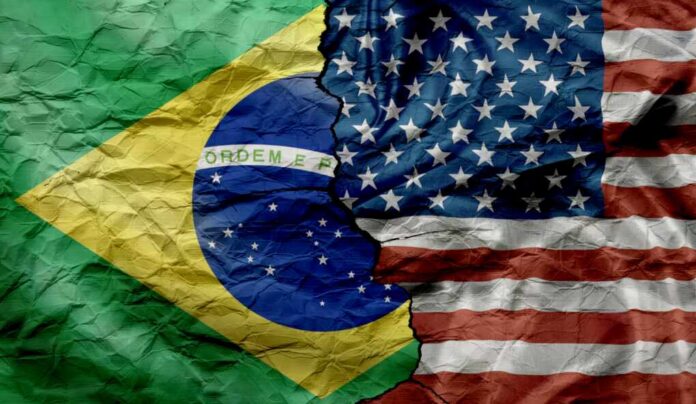
Washington’s new “narco‑terrorist” label on Brazil’s biggest gangs may hit cartel money, but it also hands the U.S. government sweeping leverage over Brazil’s economy and exposes House Democrats’ earlier warnings about abuse of terror laws.
Story Snapshot
- The Trump administration and Secretary of State Marco Rubio have formally labeled Brazil’s PCC and Comando Vermelho as foreign terrorist organizations and “specially designated global terrorists.”[1][6]
- The move lets U.S. authorities freeze assets, pursue “material support” cases, and pressure banks and companies worldwide that touch dollar transactions linked to these groups.[3][5][6]
- Brazil’s government calls the step a threat to its sovereignty and argues the gangs are brutal criminals, not political terrorists under Brazilian law.[1][4]
- House Democrats previously warned that stretching terrorism tools against cartels could be weaponized and politicized, a concern now colliding with voters’ anger over crime, drugs, and border chaos.[3][5][6]
What Trump and Rubio Just Did – And Why It Matters
The Trump administration has now completed what it has been signaling for months: Secretary of State Marco Rubio announced that Brazil’s Primeiro Comando da Capital (PCC) and Comando Vermelho (CV) are being designated both as Foreign Terrorist Organizations and as “specially designated global terrorists,” with the measures taking effect in early June.[1][6] The U.S. State Department describes terrorist designations as a “critical” tool to cut off financing and support networks for targeted groups worldwide.[6]
Rubio argues these Brazilian factions are among the most violent criminal organizations in Brazil, commanding thousands of members and directing brutal attacks on police, public officials, and civilians.[1] He also says their reach now extends beyond Brazil’s borders across Latin America and into the United States, making them a direct threat to U.S. national security.[1][4] The administration frames the move as part of a broader effort to dismantle “narcoterrorist” networks fueling drug flows, gang violence, and border instability in the hemisphere.[3][6]
How Terror Labels Change the Legal and Financial Battlefield
Once a group is listed as a Foreign Terrorist Organization under U.S. law, providing “material support” becomes a federal crime, assets in the American financial system can be frozen, and immigration restrictions can be imposed on members and associates.[3][5] The State Department notes that these designations are designed to curtail funding and logistical backing, not just punish violence after the fact, by cutting into financial lifelines and deterring third parties from doing business with designated entities.[6]
Americas Quarterly and other analysts explain that the practical impact extends far beyond gunmen in Rio’s favelas: because most international trade and finance touches U.S. dollars at some stage, banks and companies in Brazil and elsewhere now face sanctions risk or investigations if U.S. authorities later claim that a client, supplier, or intermediary was tied to PCC or CV.[2][3] Similar terror and sanctions tools have already been used against several Mexican cartels and Venezuela’s so‑called Cartel de los Soles, gradually stretching terrorism law into a general enforcement weapon against organized crime in the Americas.[3][5][6]
Brazil’s Backlash: Sovereignty, Law, and Fear of Mission Creep
Brazil’s government is pushing back hard, launching a diplomatic offensive to stop or roll back the designations, and warning that Washington is crossing a line from cooperation into unilateral intervention.[1][5] Brazilian officials note that their own Anti‑Terrorism Law defines terrorism as acts intended to cause “social or generalized terror,” emphasizing political or terror‑inducing intent rather than the profit‑driven violence typical of drug gangs.[1] They argue PCC and CV are extremely dangerous criminal enterprises, but not “terrorist” groups in a legal sense under Brazilian standards.[1]
Diplomats in Brasília worry that once the terrorism label is in place, it could set precedents for future U.S. actions, including financial operations or even limited security measures justified as counterterrorism.[4][5] Some Brazilian voices see echoes of earlier U.S. moves against Venezuela’s drug trafficking networks and fear that a terrorism framework, rather than a pure organized‑crime framework, makes it easier for Washington to claim exceptional powers.[4][5] At the same time, some Brazilian conservatives, such as Flávio Bolsonaro, publicly praise the classification as a way to squeeze cartel finances and “do more for Brazil’s security” than prior left‑leaning governments.[6]
House Democrats’ Concerns and the Deepening Terror-Label Debate
Even before this Brazil decision, House Democrats like Representative Jim McGovern had warned the administration that overusing terrorism designations against criminal groups risked politicizing a serious national‑security tool.[5] They questioned whether the legal threshold for “terrorism” was truly met and urged the White House to provide clear evidence before slapping the label on foreign gangs.[5] Critics framed the trend as a possible “weaponization” of Foreign Terrorist Organization authority, turning it into a flexible sanctioning device rather than a narrowly targeted measure against clearly ideological terrorism.[3][5]
For Americans watching violent crime, fentanyl overdoses, and border breakdowns, the appeal of hitting cartels as “terrorists” is obvious: it sounds tough, decisive, and long overdue. Yet both the left and right increasingly suspect that Washington’s power tools rarely stay within their original guardrails. Once the terrorism label expands from jihadist networks to profit‑driven gangs, nothing stops future administrations from redefining “terror” again, whether to chase foreign enemies, pressure trading partners, or even intimidate domestic opponents.[2][3][5][6]
What This Signals About Power, Security, and a Fraying System
The PCC and Comando Vermelho designations illustrate a broader pattern: when elected leaders in both parties fail to control crime, drugs, and borders through ordinary law enforcement, they reach for extraordinary tools that centralize more power in the federal executive branch.[2][3][6] The Trump administration says it is simply using every lawful instrument to protect Americans from narcoterrorists who now operate across the hemisphere.[1][6] Critics respond that a government that cannot fix basic security problems is now rewriting the definition of “terrorism” on the fly.[2][3][5]
For conservatives angry at open borders and cartel violence, and for liberals angry at creeping executive power and financial overreach, this fight over Brazilian gangs confirms the same uneasy reality: Washington’s political class is far quicker to expand its own authority than to address the deeper corruption, demand for drugs, and broken immigration and policing systems that let these gangs thrive.[2][3][5][6] Whether this new terror label truly weakens Brazil’s narco‑empires—or mainly extends the reach of an already unaccountable security and financial apparatus—will be the test that follows.
Thank you very much, Mr. Secretary. Strong action against PCC and Comando Vermelho shows a real commitment to security and the fight against narco-terrorism.
— Jayme Eduardo Leone (@JaymeL32078) May 29, 2026
Sources:
[1] Web – Trump and Rubio Finally Go After Brazil’s Narco-Terrorists. House Dems …
[2] Web – Brazil Scrambles to Block U.S. Terror Label for Its Gangs
[3] Web – Brazil’s Gangs in Trump’s Crosshairs – Americas Quarterly
[4] Web – Brazil’s Gangs in Trump’s Crosshairs – AS/COA
[5] YouTube – Marco Rubio says US is designating 2 more gangs as …
[6] Web – Press Releases – Congressman Jim McGovern – House.gov