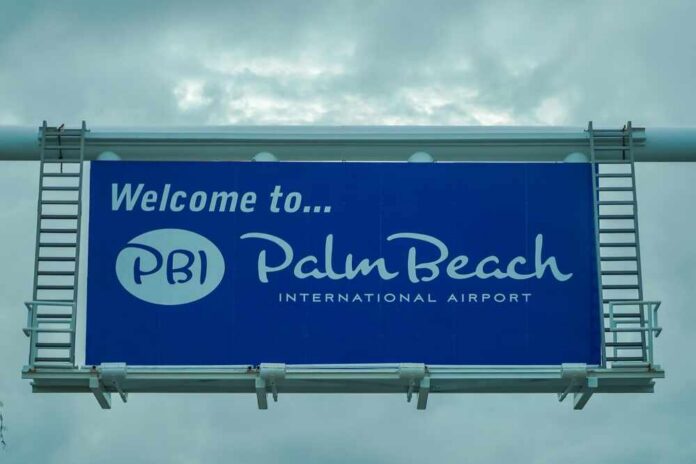
Florida approved millions of dollars for renaming Palm Beach International Airport after President Donald Trump, sparking debate over public spending, local control, and political symbolism.
Story Snapshot
- Florida passed a law forcing Palm Beach International Airport to be renamed President Donald J. Trump International Airport, pending federal approval.
- Lawmakers set aside about $2.75 million in state money for new signs, uniforms, and rebranding tied to the name change.
- Palm Beach County commissioners narrowly approved a licensing deal that gives Trump strong control over how his name and image appear at the public airport.
- Lawsuits and public backlash say the state is overriding local control and using public funds for a political stunt rather than real public needs.
What Florida’s New Airport Law Actually Does
Florida Governor Ron DeSantis signed House Bill 919, a law that orders Palm Beach International Airport to be renamed “President Donald J. Trump International Airport.” The airport is owned by Palm Beach County but sits just a few miles from Trump’s Mar-a-Lago club, which he uses often when flying to and from South Florida. The law takes effect July 1 but the change still depends on approval from the Federal Aviation Administration, which must update charts and databases before the new name is official.
The same law also blocks local governments from changing the names of several other major Florida airports, including those in Orlando, Miami, Fort Lauderdale, Tampa, Southwest Florida, and Jacksonville. That means state leaders, not local communities, now hold final power over the branding of key transportation hubs used by millions of travelers each year. Supporters frame this as honoring a sitting president, while critics see it as Tallahassee tightening its grip on local assets for political reasons.
Taxpayer Money and Trump’s Control Over a Public Asset
To pay for the name change, the Florida Senate’s budget sets aside about $2.75 million to cover new road and terminal signs, rebranding consultants, equipment, vehicles, marketing materials, and uniforms. The airport had earlier estimated the full cost of rebranding at around $5.5 million, so the state funding covers only about half of the projected total. Any gap will likely be paid from airport revenues or local funds, raising questions for residents about whether their money should plug a shortfall for a political naming project.
Palm Beach County commissioners voted 4–3 to approve a naming rights and license agreement with Trump’s company that lets the county legally use his name for airport operations. Reporting by the Miami Herald says the deal gives Trump veto power over how his image is used in the rebranding, creating unusual private control over a public facility’s look and merchandise. The agreement grants the county a “royalty-free” right to use the name, but critics argue it still opens the door for Trump-linked trademark and branding benefits on airport goods.
Local Backlash, Lawsuits, and the Bigger Pattern of Political Branding
The narrow 4–3 vote, with Democrat Maria Sachs casting the deciding vote, shows how divided local leaders are. One Palm Beach County pilot has sued to stop the name change, arguing that the state is overriding local authority over a county-owned airport. Released records and local coverage describe strong anger among residents, some of whom say honoring Trump this way misuses public space and deepens the sense that political elites treat shared infrastructure like personal billboards.
Major news outlets and commentators have called the renaming a “political stunt,” pointing to the cost, the timing while Trump is still in office, and the lack of clear economic evidence that a new name will boost tourism or revenue. A Florida Phoenix analysis notes that, if finalized, Palm Beach would become the ninth U.S. commercial airport named after a president, and the first large hub renamed for a president while still serving in the White House. That break with past norms feeds wider worries—shared by many conservatives and liberals—that government is busy trading symbolism and favors while everyday problems like inflation, wages, and housing stay unsolved.
Why This Fight Resonates Beyond Palm Beach
This airport battle highlights the deeper complaint that the system serves the powerful first. Many conservatives see the move as more proof that political insiders spend public money on branding instead of fixing borders, energy costs, and debt. Many liberals see it as another “America First” gesture that celebrates one man while cutting social support and ignoring the growing gap between rich and poor. Both sides can look at the $2.75 million in rebranding funds and ask why leaders move faster on names than on real solutions.
MASSIVE 🔥 — In a STUNNING development, Florida Governor Ron DeSantis signed HB919, officially renaming Palm Beach International Airport to "PRESIDENT DONALD J. TRUMP INTERNATIONAL AIRPORT". It will take effect on July 1.
FOLLOW ME, THE NEXT DROP WILL BE SHOCKING. pic.twitter.com/yQCK4kQQnD
— John f Kennedy JR (@Amelia_Davilzc) June 28, 2026
The Trump Organization says it does not plan to charge royalties for the airport’s use of his name, claiming it only seeks to protect the brand from abuse. Still, the mix of state power, private trademark control, and taxpayer funding at a local airport fits a larger pattern of political branding of public assets. Whether courts block the change or the Federal Aviation Administration signs off, the fight over President Donald J. Trump International Airport is really about who owns the public square—and whether the people who pay for it still have a meaningful say.
Sources:
independent.co.uk, pbs.org, youtube.com, facebook.com, thehill.com, flsenate.gov, x.com, cbs12.com, miamiherald.com, wfmd.com