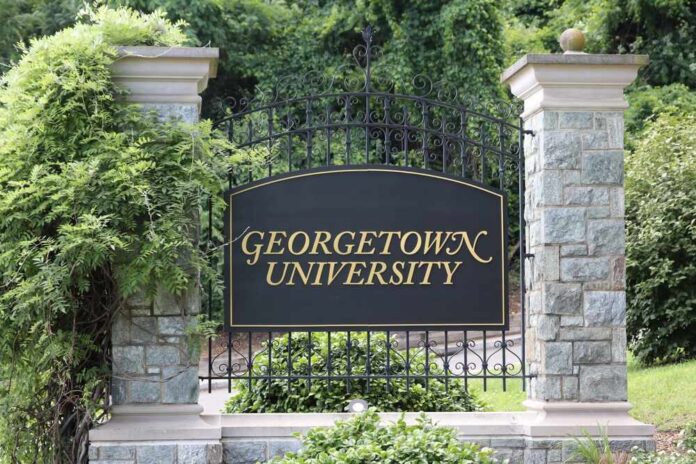
Georgetown’s China initiative is under fire because the money behind it, and the access it created, now sit at the center of a foreign influence fight.
Quick Take
- Georgetown launched its U.S.-China initiative in 2016 with a $10 million gift from the Spring Breeze Foundation.
- The Department of Education later alleged that Georgetown failed to properly report some foreign gifts tied to the foundation and the Central Committee of the Communist Party of China.
- Critics say the program built a pipeline of student fellows, workshops, and public events that could reach future policymakers.
- Georgetown says the initiative is independent, transparent, and often critical of the Chinese government.
How the Initiative Began
Georgetown said the Initiative for U.S.-China Dialogue on Global Issues began in 2016 with a $10 million gift from the Hong Kong-based Spring Breeze Foundation. The university described the foundation as supported by CP Group, a Thai multinational agribusiness company. That origin matters because the current dispute is not about a small research grant. It is about whether a major foreign-backed gift helped shape a program meant to train and connect future leaders.
By 2019, the initiative had launched five research groups, supported 43 student fellows, organized 16 U.S.-China workshops, produced 23 podcasts, funded graduate study tours in China, and hosted 35 public events. Supporters view that as ordinary academic exchange. Critics see something else: a steady channel for foreign-linked groups to build relationships with students who may later work in government. The evidence in the reporting shows broad outreach, but it does not prove direct political control over the program’s content.
What the Government Report Said
The strongest pushback came from the Department of Education, which alleged Georgetown did not fully disclose some foreign gifts. Georgetown Voice reported that the agency cited the Spring Breeze Foundation and the Central Committee of the Communist Party of China, and said Georgetown derived $2,360,807 through what the report called “significant intermingling” with the People’s Republic of China. Georgetown denied the allegations and said it had met its reporting duties and kept academic freedom intact.
That clash leaves two separate issues on the table. One is compliance with federal reporting rules. The other is influence. The reporting shows a real dispute over transparency, but it does not give public proof that Chinese officials dictated research or student selection. Still, the lack of a full public gift agreement leaves room for suspicion, especially when foreign money reaches programs tied to policy training and international dialogue.
Why Critics Say the Stakes Are Bigger Than One Campus Program
Representative Mike Gallagher argued that a donation from a foreign entity with ties to the Chinese Communist Party deserved close review by the Department of Education. In the same public debate, he warned that the Chinese Communist Party could use proxies to exploit the “revolving door” between public service and private life. That charge resonates far beyond Georgetown because it touches a broad national fear: that elite institutions can become soft entry points for outside influence while calling the arrangement academic exchange.
Georgetown’s China initiative gives CCP-linked groups access to future US policymakers: ANALYSIS
Link in bio or click the link below at https://t.co/XjbnKs3zuo#georgetown #china #ccp #policy
— Campus Reform (@campusreform) July 11, 2026
Georgetown’s defenders say the initiative is not a front for Beijing. The university says it operates under independence, transparency, balance, and academic excellence. Georgetown spokesperson Meghan Dubyak also said the program has often produced work critical of the Chinese government and the Communist Party. Those claims matter because they show the university is not offering silence. But they also depend on the university’s own word, not on a public audit of the donor agreement or a full independent review of program outputs.
The Broader Foreign-Funding Problem
This fight fits a much larger pattern in American higher education. Congress and the Department of Education have spent years warning that universities often fail to report foreign gifts the way federal law requires. That broader problem helps explain why this case draws attention. Even when a school is not proven to be controlled by a foreign power, hidden or poorly explained funding can erode trust fast. For readers across the political spectrum, that looks less like scholarship and more like a system that protects elites first.
The sharper claim in the headline, that the initiative gave “CCP-linked groups access to future U.S. policymakers,” goes further than the available reporting can firmly prove. The record here shows a donor dispute, a transparency dispute, and a program that reached many students and public events. It does not name policymakers who were recruited or show direct political indoctrination. What it does show is why foreign money at elite schools keeps triggering public suspicion, especially when the paperwork stays out of view.
Sources:
thegatewaypundit.com, georgetown.edu, washingtonpost.com, thehoya.com, sfs.georgetown.edu, uschinadialogue.georgetown.edu, meforum.org