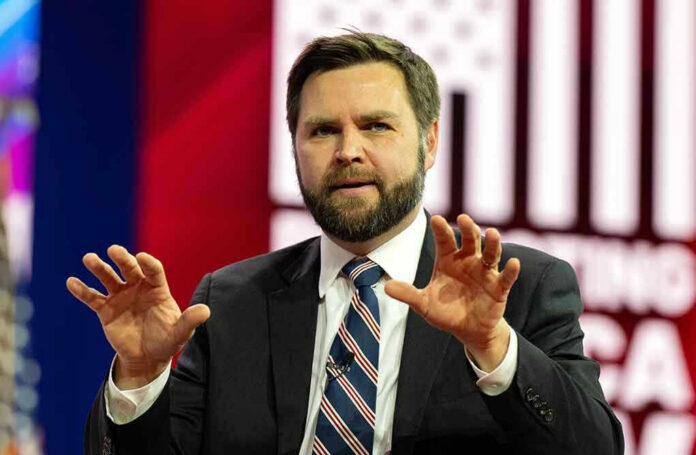
Vice President JD Vance said he has not decided on a 2028 presidential run, even as allies signal he is a frontrunner and likely to seek the job.
Story Snapshot
- Vance told a CBS News town hall he has not decided whether to run in 2028.
- Vance said he believes President Trump would back him if he runs.
- Republican midterm losses reshaped the 2028 field and sparked new speculation.
- Early polling buzz is common but rarely predictive this far out.
What Vance Said On The Record
Vice President JD Vance told viewers at a CBS News town hall in Michigan on October 17 that he has not decided whether to run for president in 2028. When asked if there was any chance he would not run, he said, “Of course there’s a chance”. Two days later, Vance said during an interview aboard Air Force Two that he has not made up his mind and has not focused on 2028. He added that, if he runs, he thinks President Trump will endorse him.
Vance also said he had not discussed a 2028 bid directly with President Trump. He framed his comments as keeping options open while he continues his work as vice president. This approach matches how many potential candidates talk years before an election. It keeps donors, activists, and media engaged without triggering a formal campaign or early attacks. It also avoids signaling disloyalty while serving in office. Vance’s language fits that pattern clearly.
How Midterm Losses Shaped 2028 Talk
Republican setbacks in the midterm elections triggered new debate inside the party over who should lead in 2028. Coverage described a reshaped landscape for Vance and other Republicans, with some in the party looking for alternatives while others see Vance as the early favorite. Vance blamed the losses in part on the Iran war, which he opposed inside the administration, a stance that set him apart from some colleagues. That split added to the public contrast among potential contenders.
Speculation about endorsements also grew after the midterms. Reporting said Vance believes Trump would back him if he enters the race. Trump, for his part, has pushed back on claims that he has already anointed a successor, saying it is too early to focus on 2028. That dynamic matters to both conservatives and liberals who worry that party elites, donors, and insiders often decide races long before voters do. Clear statements from both men suggest no final decision has been made.
Why Early Polls And Buzz Can Mislead
Public polls and media attention often jump ahead of real decisions. Political scientists have shown that early polls are weak guides to final results, with predictive value rising much closer to voting. Early polling can still shape donor behavior and media coverage, which helps explain why potential candidates keep options open. For readers frustrated by power plays in Washington, this is a feature of the system, not a bug: attention often flows to those who play the long game.
Donald Trump suggested this week that he might not endorse J. D. Vance for president in 2028. @GrahamDavidA explores whether that would be good or bad news for Vance: https://t.co/ycgzFbybRp
— The Atlantic (@TheAtlantic) November 13, 2026
The next formal steps, if Vance takes them, could include an exploratory committee, travel to early states, and policy rollouts. Those moves let a would-be candidate test the waters and raise money without a formal launch. For now, Vance says he is not there yet, and he has left the door open to staying out. That clarity helps cut through rumor. The 2028 Republican field remains fluid, and voter priorities, not just elite backing, will decide what comes next.
Sources:
mediaite.com, thehill.com, politico.com, independent.co.uk, washingtonexaminer.com, cjr.org