

A Georgia pastor now admits she pulled up a rival candidate’s campaign signs after Apple AirTags hidden inside them led police straight to her front door.
Story Snapshot
- Stolen signs for Georgia House candidate Stephen Acorn were tracked using hidden AirTags to a home in Columbus.
- Police bodycam video shows officers questioning the resident and pulling signs out of the trash.
- The homeowner’s wife, a pastor, says she removed the signs believing they sat on public land, not private property.
- No formal charges have been confirmed, and police treated the case as a possible misdemeanor theft matter.
AirTags Point Officers To A Quiet Neighborhood
Stephen Acorn, a Republican running for a Georgia House seat, got an alert that two of his campaign signs were moving. He had slipped tracking devices inside them after earlier signs went missing. Within 24 hours, the trackers led Acorn and police to a home in Columbus, Georgia, according to reports on the incident.
Officers arrived at the residence and found four of Acorn’s signs sitting in the trash. Bodycam footage shows police questioning the man who lives there, retired Columbus State University professor Spencer Garrard, before recovering the signs and returning them to the candidate.
Removing a political sign without the owner’s permission counts as theft under Georgia law, a misdemeanor charge. Police reportedly told the household that pressing charges remained on the table, even after the signs came back.
Pastor Wife Owns Up, But Disputes The Theft Label
Garrard’s wife, Cindy Cox Garrard, a reverend, later spoke up. She said she took the signs herself and that her husband had nothing to do with it. Her stated reason: she believed the signs had been planted illegally in a public right-of-way, not on someone’s private lawn.
In her own words, shared publicly, Garrard wrote that she thought “the signs were illegally placed on public right of way and removed them,” adding that “the signs have been returned.” She also stressed, “‘They’ is me, not my husband. I never removed a sign from private property.”
That distinction matters legally. Property owners in many places can remove unwanted signs from their own yard, including strips of land near the street. But pulling signs that sit legally on someone else’s property or in an allowed public space is a different matter, one that can trigger a theft charge.
A Familiar Fight Over Yard Signs Nationwide
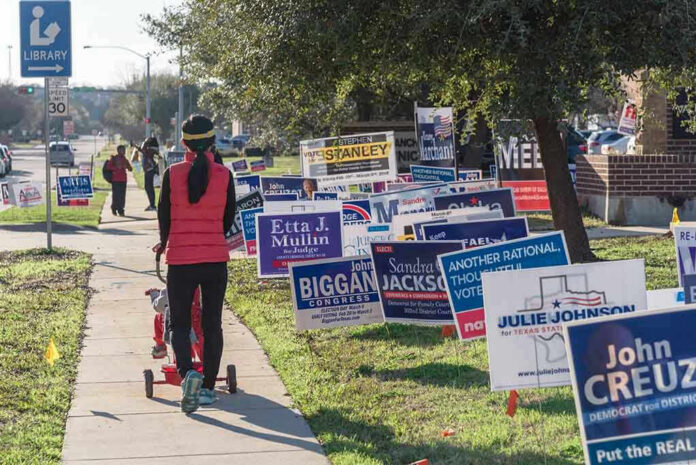
This is not an isolated dispute. Yard sign theft happens often enough that police departments across the country regularly issue public reminders that taking a political sign is a crime in all fifty states. A Reuters analysis found roughly one in ten Americans display a presidential yard sign, which helps explain why these cheap plastic markers spark outsized fights every election cycle.
Voters have increasingly turned to AirTags and home cameras to catch sign thieves red-handed. Similar tracker-led recoveries have played out in Missouri, Michigan, and Tennessee in recent years, sometimes ending in criminal charges and even court-ordered restitution for the cost of the sign and the tracking device itself.
BUSTED:🚨RETIRED PROFESSOR QUESTIONED AFTER STOLEN CAMPAIGN SIGNS TRACED TO HIS HOME
Police were called after stolen campaign signs belonging to Georgia House candidate Stephen Acorn were reportedly traced to the home of retired Columbus State University Professor Spencer… pic.twitter.com/6G7xUo36tK
— Sergeant News Network (@sgtnewsnetwork) September 8, 2026
The Georgia case has since spread across conservative social media accounts, framed as proof of hypocrisy from a retired academic and a pastor. That framing runs ahead of any court record. No police report, incident number, or charging document has surfaced publicly, and the full, unedited bodycam video has not been released. What is confirmed is narrower: signs went missing, AirTags led to a home, a pastor admitted removing them, and the signs came back. Whether that removal was theft or a legitimate response to improperly placed signs remains an open legal question, one that a right-of-way survey or a prosecutor’s decision could ultimately settle.
Sources:
twitchy.com, thegatewaypundit.com, spotongeorgia.com