A Baton Rouge man is accused of shooting his wife dead in a public park, then driving her body five hours across state lines to Memphis before a routine traffic stop exposed the crime — a case that also fits one of the best-documented and most dangerous patterns in domestic violence: the moment a victim decides to leave.
Key Points
- Tyronne Brazille, 50, is accused of shooting his wife, Lanessa Bradford, 50, at Independence Community Park in Baton Rouge after an argument.
- Police allege he then drove roughly five hours to Memphis with Bradford’s body propped in the passenger seat, where he was arrested during a traffic stop.
- A friend says Bradford had been quietly preparing to leave the marriage — saving money and coordinating an escape with out-of-town family.
- Brazille is being held in Shelby County, Tennessee, pending extradition to Louisiana to face a murder charge.
- Research on intimate-partner homicide consistently identifies the separation period as the highest-risk window for lethal violence, particularly when firearms are accessible.
What Happened in Baton Rouge
According to the Baton Rouge Police Department, Tyronne Brazille and his wife, Lanessa Bradford, were together at Independence Community Park when a verbal argument turned deadly. Investigators believe Brazille shot Bradford at the park, then left with her body still in the vehicle. Louisiana First News reported the same account, noting that BRPD investigators point to the argument at the park as the immediate trigger for the shooting. Bradford, also 50, worked at an elementary school in Baton Rouge, and her absence from work over several days reportedly prompted colleagues to request a welfare check — one of the threads that helped investigators piece together her disappearance before her death was confirmed.
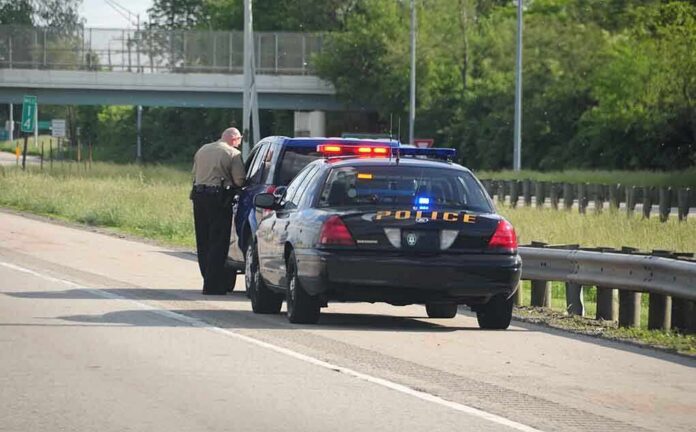
What makes this case unusual, even within the grim catalog of domestic homicides, is what happened next. Rather than reporting the shooting or fleeing on foot, Brazille allegedly propped Bradford’s body in the passenger seat of his vehicle and drove north out of Louisiana, through Mississippi, and into Tennessee — a trip of roughly five hours. He was still driving with her body when a Memphis officer pulled him over for what appears to have been a routine traffic stop. That stop, not any investigative breakthrough in Louisiana, is what ended the drive and led to his arrest.
The Traffic Stop and Arrest
Memphis officers who approached the vehicle Thursday night found Bradford dead in the passenger seat, according to jail records cited in coverage of the arrest. Local reporting on the stop described officers discovering the body immediately upon making contact with Brazille, who was taken into custody on the spot. He is currently being held by the Shelby County Sheriff’s Office on a hold for Baton Rouge authorities and is awaiting extradition back to Louisiana, where he will face a murder charge. The mechanics of extradition — the formal process by which one state transfers a custody hold to another for prosecution — typically take days to weeks depending on whether the suspect contests the transfer, though nothing in the public record here suggests Brazille is fighting it.
She Was Planning to Leave
Perhaps the most consequential detail to emerge since the arrest came from Shellica Decker, a longtime friend of Bradford’s, who said Bradford had been quietly preparing to leave the marriage. Decker described a methodical exit plan: Bradford had been saving money and coordinating with out-of-town family members to disappear from the relationship safely. Decker also said Brazille had a history of threatening to harm himself or Bradford whenever the subject of leaving came up, and that he had recently become physically abusive — though Decker told reporters she never believed he would actually kill her. That combination of details — a documented pattern of threats tied specifically to separation, escalating physical abuse, and a victim actively planning her exit — is not incidental color. It maps directly onto the risk architecture that domestic-violence researchers have spent decades documenting.
Why Separation Is the Deadliest Phase of an Abusive Relationship
Intimate-partner homicide research is remarkably consistent on one point: the period surrounding separation, not the relationship’s ongoing conflict, is when lethal violence is most likely. An Australian federal dataset found that in roughly 58 percent of cases where a man killed a female partner, the couple had either already separated or one partner intended to separate — 34 percent already apart, another 24 percent in the process of leaving. A parallel study of intimate-partner homicides in England and Wales found that 40 percent of victims had separated from their partner or were about to, with a notable share also reporting stalking and harassment from the perpetrator beforehand. Canadian government research on spousal violence after marital separation reached a similar conclusion: women face their highest homicide risk in the first several months after leaving, not before.
Criminologists who study estrangement homicide describe this dynamic as a loss-of-control response — an abuser who has relied on coercion to keep a partner in the relationship reacts to the partner’s attempt at autonomy not with acceptance but with escalating, sometimes lethal, violence. Comparative data across multiple countries has shown that the female-biased pattern of spousal homicide grows significantly more pronounced when couples are estranged rather than still living together, a finding that has held up across separate national datasets. Firearm access compounds the danger considerably; researchers at Penn State’s Social Science Research Institute have identified firearm access, separation, prior nonfatal strangulation, and threats to kill as the clearest warning signs preceding intimate-partner homicide. A 2004 study on separation as a distinct risk factor concluded that the danger is not merely elevated but qualitatively different in kind, extending beyond the immediate risk of injury into sustained, long-term threat.
What the Pattern Means for This Case — and Beyond It
None of this research determines Brazille’s guilt or innocence in a court of law; that remains a matter for Louisiana prosecutors and, eventually, a jury. But the broader pattern helps explain why advocates and researchers treat “she was planning to leave” as more than a poignant biographical detail. It is, statistically, one of the most reliable predictors that a controlling partner may resort to violence — and it is precisely the kind of information that domestic-violence hotlines, family courts, and law enforcement are trained to treat as an urgent red flag rather than a private matter. Cases like this one, where an alleged killing is followed by an cross-state flight with the victim’s body, are rare in their particulars but depressingly familiar in their setup: a woman quietly building an exit, a partner unwilling to accept it, and a firearm within reach.
For readers trying to make sense of how a case moves from a park argument to a Memphis traffic stop to a murder charge awaiting extradition, the throughline is straightforward and well-supported by the reporting to date. What remains for the courts is the legal question of intent and degree; what the research adds is the sobering context that this sequence — escalating control, a partner’s attempt to leave, and lethal violence — is one investigators and advocates have seen described, in aggregate, thousands of times over.
Sources:
nypost.com, wafb.com, yahoo.com, newsbreak.com, local12.com, crimewatch.net, courttv.com, katv.com, courts.wa.gov, x.com, podcasts.apple.com