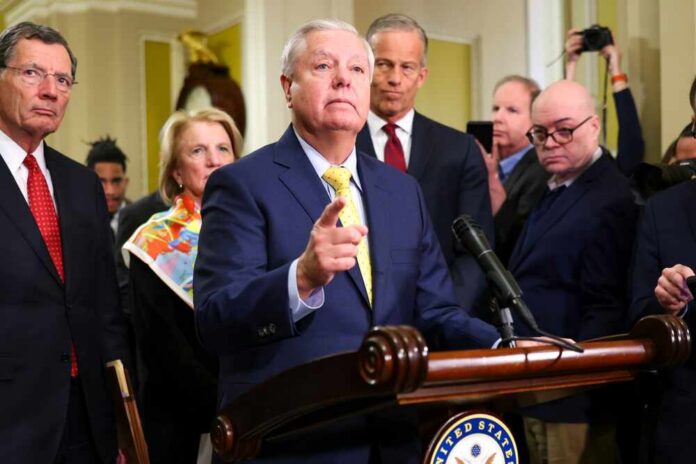
Senator Lindsey Graham of South Carolina died suddenly on July 11, 2026, at age 71 — just days after meeting with Ukraine’s president in Kyiv — and world leaders rushed to honor a man who spent decades shaping American foreign policy.
Story Snapshot
- Graham died at 71 from a “brief and sudden illness,” his office confirmed on July 11, 2026.
- President Trump called Graham “one of the greatest people and senators” he had ever known and a “true American patriot.”
- Graham had just returned from Kyiv, where he met with Ukraine’s President Volodymyr Zelensky the day before his death.
- NATO allies, Ukraine, and Israel all issued tributes, reflecting Graham’s deep ties to U.S. foreign policy abroad.
A Sudden Death Shocks Washington
Senator Lindsey Graham died on the evening of July 11, 2026, following what his office described as a “brief and sudden illness.” He was 71 years old. Graham had represented South Carolina in the U.S. Senate for more than two decades and was one of the most recognizable figures in American politics. His death came as a shock — he had been scheduled to appear on Sunday morning political talk shows just hours after he passed.
Graham had returned just the day before from Kyiv, Ukraine, where he met with President Volodymyr Zelensky. That trip underscored how active Graham remained on the world stage right up until the end. He was a vocal supporter of American military aid to Ukraine and had long pushed for stronger ties between the U.S. and its European allies. His death leaves a significant gap in the Senate’s foreign policy debate.
Trump and World Leaders Pay Their Respects
President Trump posted a tribute on Truth Social, calling Graham “one of the greatest people and senators” he had ever known. Trump described him as “always working” and “a true American patriot.” The two men had a complicated history — Graham was once a sharp Trump critic — but in recent years he became one of Trump’s closest Senate allies. Graham even thanked Trump publicly after winning his GOP primary earlier in 2026.
The tributes did not stop at the U.S. border. NATO allies, Ukraine, and Israel all honored Graham as a friend and champion of trans-Atlantic ties. Israeli Prime Minister Benjamin Netanyahu was reportedly considering flying to the United States to attend Graham’s funeral. Graham had been one of Israel’s strongest supporters in the Senate for years, and his death drew an outpouring of grief from foreign governments who had counted on his backing.
A Polarizing Figure Who Crossed Lines
Graham was never easy to define. Early in his career, he worked across the aisle with Democrats on immigration reform and military policy. He was a close friend of the late Senator John McCain. Then he became one of Trump’s most loyal defenders. That journey made him both admired and criticized, depending on who you asked. The New York Times described him as “an outsize and often divisive figure in U.S. foreign policy” whose death drew a wave of tributes.
Inside Lindsey Graham and Donald Trump’s Complicated Relationship Over the Years as Trump Pays Tribute to ‘True American Patriot’ https://t.co/UuTTOe1sTL
— People (@people) July 12, 2026
Graham’s passing also reflects a broader truth about American politics today. Deaths of major public figures rarely bring people together the way they once did. Analysts have noted that public tragedies now tend to deepen political divides rather than bridge them. Graham himself was a symbol of that tension — a man who angered both sides at different points in his career. Whether his legacy unites or divides will likely depend on which chapter of his life people choose to remember.
Sources:
thegatewaypundit.com, youtube.com, instagram.com, cbsnews.com, facebook.com, bbc.com, nytimes.com, scdp.org, c-span.org, edition.cnn.com, wgnradio.com, aol.com, cas.lehigh.edu, scrippsnews.com, pmc.ncbi.nlm.nih.gov, aoc.gov, lailluminator.com, bunkhistory.org, millercenter.org