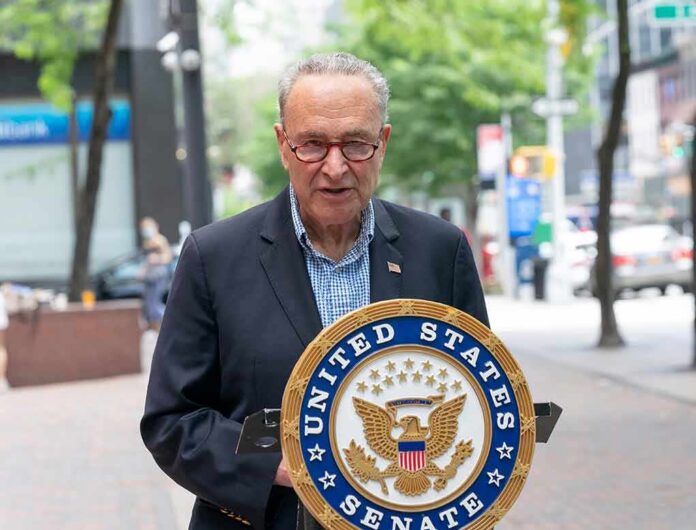
Senate Democratic Leader Chuck Schumer says Congress will use its control of money to force an end to the eight-month-old U.S. military campaign against Iran, even though lawmakers already passed a resolution demanding troop withdrawal and President Trump kept fighting anyway.
Quick Take
- Schumer vowed on November 4 to “end the war” with Iran, pointing to Congress’s constitutional power over military spending.
- Four Republican senators joined Democrats earlier this year on a war-powers resolution demanding withdrawal.
- Both chambers passed that resolution in June, but it did not need Trump’s signature and he has continued military action.
- Trump, House Speaker Mike Johnson, and other Republicans say the strikes stopped Iran’s nuclear program and were lawful.
- History shows funding cutoffs are hard to pull off — only 5 of 21 such proposals have become law since the Vietnam era.
Schumer’s Pledge and the Power of the Purse
Standing at Democratic Senatorial Campaign Committee headquarters on November 4, Schumer told reporters, “We are going to end the war.” He said the Founding Fathers gave Congress the power of the purse specifically to stop a president from waging war without the public’s consent. Schumer argued that cutting off funding is the clearest tool lawmakers have to force the administration’s hand.
The fight is not purely partisan. Four Republican senators — Rand Paul, Susan Collins, Bill Cassidy, and Lisa Murkowski — crossed party lines earlier this year to back a war-powers resolution ordering troops out of hostilities with Iran. That bipartisan breakaway gives Schumer’s push some weight beyond the usual Democrat-versus-Republican script that dominates Washington.
A Resolution Without Teeth?
In June, Senate Democratic leadership announced that both the House and Senate had passed a War Powers Resolution demanding President Trump withdraw U.S. forces, noting the measure did not require his signature to take effect. Despite that vote, the record does not show the administration complying, and military action against Iran has continued for months since the resolution passed.
That gap between a congressional vote and real-world withdrawal is the central problem for Schumer’s pledge. Congress can pass resolutions and even write funding restrictions into law, but turning those words into an actual halt to military operations depends on the executive branch choosing to follow them — or a legal fight to force the issue.
The Administration’s Case for Continuing
Trump and his allies reject the idea that the war should end now. Trump has said strikes targeted an Iranian anti-aircraft facility and that U.S. forces remain “locked and loaded” if more action is needed. House Speaker Mike Johnson called the strikes “necessary, lawful, and effective”, while the administration’s formal notification to Congress described the campaign as limited action meant to destroy Iran’s nuclear program and defend Israel.
Senator Lindsey Graham went further, arguing that ending Iran’s government is “necessary and more than justified” and predicting the campaign would be “violent, extensive, and… successful”. Vice President JD Vance said Iran must make a “meaningful” cut to its uranium enrichment before U.S. pressure eases. That split — Congress demanding withdrawal, the administration insisting the mission isn’t finished — leaves ordinary Americans caught between competing claims about what counts as victory.
🚨🇺🇲 Hebrew Live | Breaking News:
Chuck Schumer, Senate Democratic leader: “I pledge to end the war in Iran with the help of the new Democratic majority in the Senate.” pic.twitter.com/JM94g9sWYc— The Daily Brief (@TheDailyBriefX) November 4, 2026
A Familiar Fight With Uncertain Odds
This standoff echoes a pattern going back to Vietnam. Congress has tried repeatedly to restrict money for military operations it opposes, but research from the Congressional Research Service found only 5 of 21 such funding-cutoff proposals since 1970 actually became law. Most efforts to defund a war in progress have failed, even when resolutions passed with bipartisan votes.
That history matters for voters watching this fight unfold. Schumer’s promise gives Democrats a rallying point heading into the new Congress, and the Republican defectors show real discomfort with an open-ended war. But unless Democrats can translate floor speeches and resolutions into enforceable spending law — and get the administration to actually follow it — the war is likely to continue on the executive branch’s timeline, not Congress’s.
For Americans frustrated with endless conflicts and a government that seems to talk past itself on basic questions like who controls war and peace, this clash is a stark reminder. Lawmakers on both sides can claim constitutional authority, pass resolutions, and hold press conferences, but actually stopping a war in progress has proven far harder than declaring one should end.
Sources:
democrats.senate.gov, congress.gov, thehill.com, washingtonpost.com, commondreams.org, blumenthal.senate.gov, c-span.org