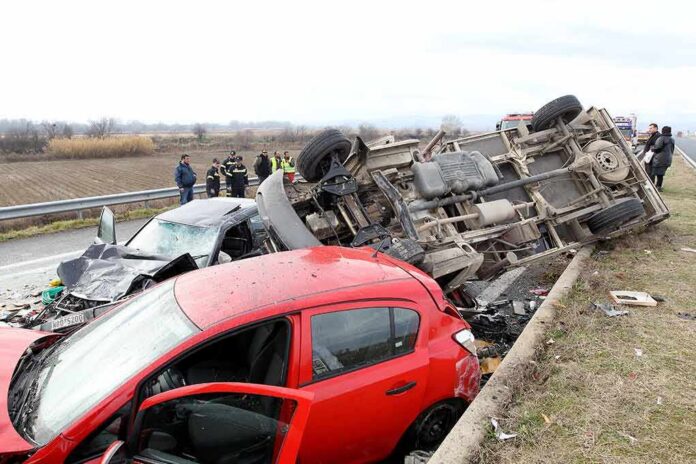
Police say a driver swatted at a bug, crossed the center line, and killed two motorcyclists in a crash that now carries homicide-by-vehicle charges.
Story Snapshot
- Police say a New Jersey driver crossed into oncoming traffic after “freaking out” over a bug, killing two riders.
- Officials charged the driver with homicide by vehicle and related offenses under Pennsylvania law.
- The victims were riding a motorcycle that was hit head-on in Clearfield County, Pennsylvania.
- National data show distraction contributes to about 8 percent of fatal crashes each year.
Police Account of the Fatal Crash
Pennsylvania State Police said a 55-year-old driver from Brick, New Jersey, told investigators a bug flew into her sport utility vehicle on a Clearfield County highway. Officers said she “freaked out,” swatted at the insect, and then veered across the center line into oncoming traffic. Police reported her Nissan Rogue struck a motorcycle head-on, killing both riders at the scene. Troopers identified the crash location near Luthersburg in Brady Township on Route 219 and Route 322.
Officials and local outlets reported the driver, identified as Bernadette A. Cobb, now faces two counts of homicide by vehicle and related charges. Police statements say her own account about being distracted by the insect preceded the lane crossing that led to the impact. The crash killed the motorcycle’s driver, identified as Anthony M. Sones, 34, and a passenger identified as Miranda, according to reporting that cited state police details from the scene and follow-up charging documents.
Charges and How Pennsylvania Law Applies
Pennsylvania’s homicide-by-vehicle statute covers an unintentional death caused while a driver violates a law related to vehicle operation, when reckless or grossly negligent conduct causes the fatality. Prosecutors often use improper lane travel or careless driving as the underlying traffic offense. The charge does not require alcohol or drugs. It does require proof that the driver’s violation was a direct and substantial cause of death under the state’s causation test applied by the courts.
Appellate decisions explain that “but for” the unlawful driving, the death would not have occurred, and the driver’s conduct must be a substantial factor in the outcome. Courts have upheld liability even when other factors existed, so long as the defendant’s driving remained a direct cause. That framework helps explain why a moment of distraction can lead to criminal charges when it crosses into reckless or grossly negligent behavior that ends in death on the roadway.
Distraction Is a Documented Driver Risk
Federal safety data show distraction is a recurring factor in fatal crashes nationwide. The National Highway Traffic Safety Administration reported that distraction was involved in about 8 percent of fatal crashes in 2024, with 3,208 people killed that year. These figures include many causes beyond phones, such as objects inside the car, eating, or reacting to events around the vehicle. The common thread is the lost attention window that raises crash risk at highway speeds.
NEW DETAILS | Police say the driver charged in yesterday's double-fatal crash near Luthersburg claimed that she was distracted by a bug that flew into her SUV just before she collided with a motorcycle.https://t.co/WJoGOFCEt9 https://t.co/5XEWqFp7xx
— 6 News (@WJACTV) August 13, 2026
Motorcycle riders face higher danger in these scenarios. Riders have less protection and less margin for error when a larger vehicle crosses the center line. A head-on strike often leaves little time to brake or swerve, especially on two-lane roads with limited shoulders. Federal research has long found that other-vehicle driver attention failures are a frequent factor when motorcycles are involved in severe and fatal crashes.
Why This Case Hits a National Nerve
This crash blends a simple cause with the worst outcome. A brief distraction led to two lost lives and felony charges. People on the left and right both see a system that talks about safety but struggles to prevent basic, deadly mistakes on everyday roads. Families pay the highest price while officials debate budgets, enforcement, and design fixes. The facts do not suggest a complex plot here; they point to attention, responsibility, and the real stakes of a moment’s lapse.
Lawmakers and transportation agencies can act on known risks. Steps include centerline rumble stripes, clearer lane markings, targeted patrols on high-risk corridors, and strong public messaging on distraction of any kind. These moves cost less than major rebuilds and can save lives fast. The law will sort out criminal blame in this case. The public question is whether leaders will treat routine distraction like the fatal hazard the data shows it is, not as a one-off oddity.
Sources:
nypost.com, nj.com, lightnercommunications.com, nj1015.com, northjersey.com, rlsmedia.com, newjersey.news12.com, wjactv.com