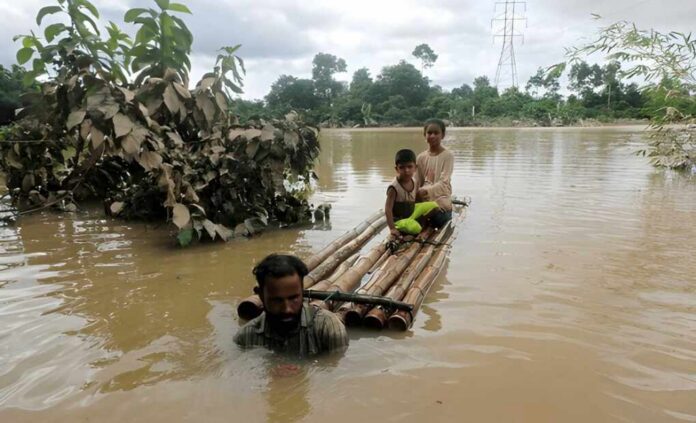
Bangladesh’s monsoon disaster has already killed at least 51 people, and the toll may rise as more rain moves in.
Quick Take
- Officials say the disaster has killed at least 51 people across seven districts.
- More than one million people are stranded, and 267,000 families are affected.
- Authorities have opened 1,131 shelters for 44,457 displaced people.
- Heavy rain and landslides are also hitting Rohingya refugee camps in Cox’s Bazar.
Death Toll Rises as Rescue Work Continues
The Ministry of Disaster Management and Relief says the disaster has so far claimed 51 lives, with 39 people injured across the flood-hit region. Reuters also reported that more than one million people were stranded as flooding spread across seven districts. The gap between 44 and 51 deaths in different reports shows how fast the human toll is changing while rescue teams still work.
That uncertainty matters because families, local officials, and aid groups need the clearest possible count to plan food, shelter, and medical help. TBS News reported that more than 267,000 families have been affected in Chattogram, Cox’s Bazar, and nearby districts. The latest figures also show that 1,131 shelters have been opened, but they cover only a fraction of the people now cut off by floodwater.
Floodwater Pushes Hardest on Coastal and Hill Areas
Heavy monsoon rain and landslides have hit southeastern Bangladesh hardest, especially Chattogram and Cox’s Bazar. The flooding has left roads, homes, and whole neighborhoods under water, while hill slopes have become dangerous in the rain-soaked districts. Reuters and local reporting both show that the disaster is not limited to one city or one river basin.
Brussels Morning reported that the crisis is also raising risks inside the Rohingya refugee camps in Cox’s Bazar, where landslides have damaged temporary shelters. That detail matters because the camps are already crowded and fragile. The same report said health workers are watching for waterborne disease as clean drinking water becomes harder to find. Those risks can turn a flood emergency into a wider public health problem.
Why the Conflicting Numbers Matter
Different outlets have reported different death tolls, with some saying 44 and others saying 51. That kind of split can confuse the public and weaken trust at the exact moment people need clear facts. It can also hide how fast the situation is worsening as fresh rain keeps falling and landslide zones stay unstable.
Floods, landslides push Bangladesh monsoon death toll to 51
Heavy monsoon rains have killed at least 51 people across Bangladesh, triggering widespread flooding and landslides that have displaced tens of thousands, authorities said Sunday. More than 38,400 people have taken… pic.twitter.com/XgAyoleKAE
— The CBIJ (@TheCBIJ) July 12, 2026
The broader picture is still clear even with the uneven figures. More than one million people are stranded, hundreds of thousands of families are affected, and the government says rescue and shelter work is still underway. For many readers, this will feel like a familiar failure of state capacity: disaster hits, numbers lag, and ordinary people are left waiting for help while official statements catch up.
Sources:
youtube.com, tbsnews.net, aa.com.tr, reuters.com