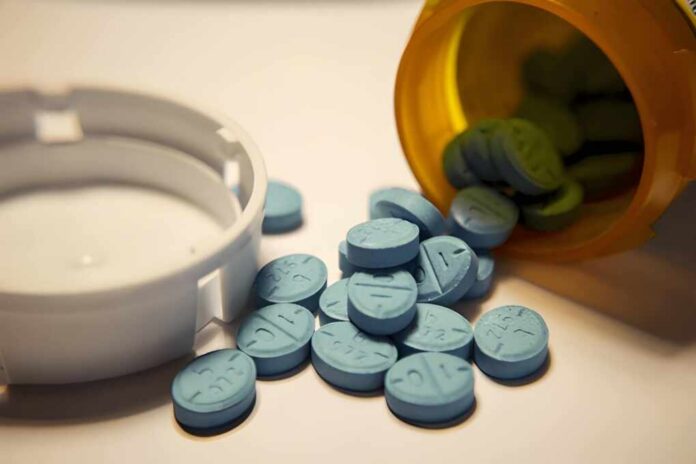
A Silicon Valley telehealth startup turned into a massive Adderall pill mill, and its founder is now heading to prison while Washington scrambles to prove it can still police digital-age drug dealing.
Story Snapshot
- Founder Ruthia He was sentenced to six years in prison and fined $1 million for a scheme that pushed over 37 million Adderall pills through a telehealth platform.
- Federal prosecutors say the company’s technology, pay system, and clinical rules encouraged “assembly line” prescribing and $12 million in insurance fraud.
- Clinical president David Brody wrote nearly 400,000 stimulant prescriptions for patients he never evaluated and received a two-year sentence.
- The case is part of a wider post-pandemic crackdown on telehealth fraud, raising fears of both digital pill mills and overreach by a struggling federal system.
Executives Sentenced for Massive Adderall Distribution Scheme
Federal officials say Done Global Inc., a San Francisco telehealth startup, became the engine of a sprawling Adderall distribution scheme instead of a trusted mental health service. The United States Department of Justice reports that founder and former chief executive officer Ruthia He was sentenced to six years in prison and fined $1 million after a jury found she used the company’s systems to unlawfully distribute more than 37 million Adderall pills. The scheme also defrauded Medicare, Medicaid, and private insurers of about $12 million through false prescription claims.
Clinical president David Brody, a psychiatrist who oversaw prescribing, received a two-year prison sentence and a $1 million fine for his role. According to the Justice Department, both He and Brody were convicted in November 2025 of conspiracy to distribute controlled substances, multiple counts of illegal Adderall distribution, and conspiracy to commit health care fraud. He alone was also convicted of conspiracy to obstruct justice, signaling that investigators believed she tried to interfere with the federal probe into her company.
How a Telehealth Platform Became a Pill Mill
Prosecutors say this was not a few bad decisions but a business model built around high-speed, high-volume prescribing. Done Global’s platform connected patients to prescribers through quick online visits, then used software and strict clinical rules that pushed clinicians to renew and increase stimulant prescriptions with little real evaluation. Reports indicate some clinicians issued Adderall prescriptions every 30 seconds, turning what should be careful psychiatric care into what looks like an assembly line.
The Justice Department says Brody personally prescribed 394,324 stimulant pills to patients he never assessed, often relying on brief digital forms instead of full exams. Investigators describe automatic refills of Adderall even for people who were under forced psychiatric care or had died. They say the company dispensed stimulants to people whose mental health conditions, such as psychosis or bipolar disorder, could be made worse by the drugs, suggesting profits were placed ahead of basic medical safety.
Deceptive Marketing and Insurance Fraud
The case goes beyond reckless prescribing and into the way the company attracted paying customers. An Internal Revenue Service Criminal Investigation release states that He and Done Global spent more than $40 million on social media ads designed to convince struggling Americans they had attention deficit hyperactivity disorder and needed Adderall. These ads targeted people working from home during the pandemic and older adults dealing with normal aging and stress, blurring the line between real illness and everyday life problems.
Once people signed up and paid subscription fees, the company allegedly turned those signups into streams of billings to public programs and private insurers. The Department of Justice estimates that Medicare, Medicaid, and commercial insurers paid at least $12.3 million for these prescriptions. Officials say those claims were fraudulent because many prescriptions had no legitimate medical purpose, making this not only a drug case but a health care fraud case that shifts costs onto taxpayers and raises premiums for everyone.
A Symbol of Telehealth Crackdown and Deeper System Distrust
This prosecution is part of a nationwide push to police telehealth after emergency pandemic rules made it easier to prescribe controlled substances online. The Department of Justice has framed Done Global as one of several “telehealth pill mills” that used relaxed rules and fast technology to move industrial volumes of drugs while billing public programs. Agencies like the Office of Inspector General and Internal Revenue Service say such schemes have cost the system billions, and they are now aggressively pursuing digital health companies.
Psychiatrist David Brody gets two years prison for Adderall distribution scheme
Former Done Global Clinical President Dr. David Brody has been sentenced to two years in federal prison and fined $1 million for his role in a multimillion-dollar telehealth scheme that illegally…
— PsychCrime (@psychcrime) July 9, 2026
For many Americans on both the right and the left, this case hits old nerves about a federal system that feels both heavy-handed and strangely absent. People frustrated with addiction, wasted tax money, and corporate greed see a tech founder turning mental health care into drug dealing and insurance fraud. Others worry that Washington helped create this mess by rushing telehealth rules, then moved slowly while millions of pills flooded homes. The result is a story that seems to confirm a shared fear: powerful players can twist new technology faster than government can protect ordinary citizens.
Sources:
townhall.com, wsj.com, justice.gov, fiercehealthcare.com, instagram.com, irs.gov, swlaw.com