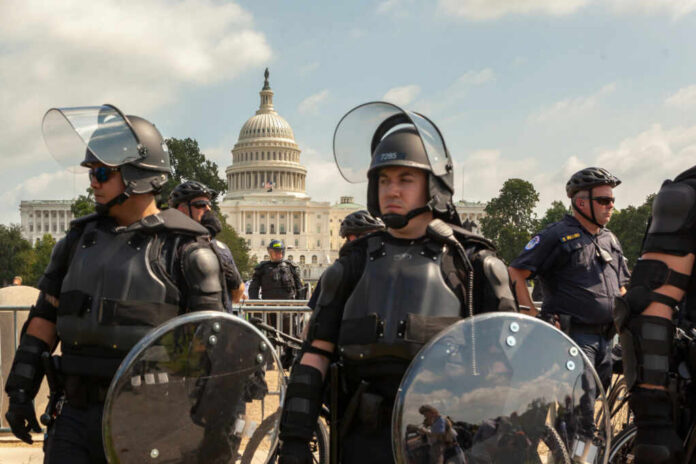
As one of the country’s most influential conservative think tanks pivots from dismantling diversity offices to targeting protest “disorder,” the fight over who defines legitimate dissent is quietly entering a far more dangerous phase for ordinary Americans on both left and right.
Story Snapshot
- The Manhattan Institute helped design the playbook used by Republican leaders to roll back diversity, equity, and inclusion (DEI) bureaucracies in schools and corporations.[1][2][6]
- The Institute is now channeling that same model-policy strategy toward protests it links to vandalism, intimidation, and “outside agitators.”[1][3][5]
- Civil-liberties advocates warn that similar “public order” campaigns have produced unlawful anti-protest rules that courts later struck down.
- Protesters have already targeted the Manhattan Institute itself, accusing it of serving wealthy elites and undermining grassroots movements.[6]
From Killing DEI Bureaucracies to Reframing Street Protests
Video presentations and reports connected to the Manhattan Institute describe a deliberate three-part strategy that helped drive the rollback of diversity, equity, and inclusion bureaucracies: shaping a narrative, drafting model policies, and then pushing coordinated legislative action.[1][2][6] In that DEI fight, strategists openly explained how repeating “DEI” as the core problem, tying it to bureaucracy and ideological excess, and then handing ready-made bills to lawmakers made it politically easy to defund and dismantle those offices.[1][4][5][6] That same machinery is now being pointed at public protest and “disorder.”[1][3]
A Manhattan Institute article on protest movements argues that “far-left organizations” exploit otherwise legitimate protests by inserting outside agitators who escalate confrontation and cause material harm.[1] The piece cites the lawsuit where the company behind the Dakota Access Pipeline won large damages against Greenpeace, framing it as proof that protest-linked campaigns can cross into actionable sabotage rather than protected speech.[1] Other Institute content on campus demonstrations describes supposedly “peaceful” student protests as a form of “violent bullying” that relies on physical intimidation and mass pressure to silence speakers and administrators.[5]
How a Think Tank’s Protest Agenda Meets a Distrustful Public
Homeless advocates and allied activists have already marched inside the Manhattan Institute’s offices, accusing it of promoting policies that harm vulnerable New Yorkers while catering to powerful donors.[6] That incident undercuts the idea that the Institute stands outside protest politics; instead it is a direct target of the same street-level anger roiling cities nationwide.[6] Civil-liberties groups such as Amnesty International warn that governments and aligned institutions routinely blur the line between peaceful protest, civil disobedience, and genuine criminal damage, then draft sweeping rules that chill dissent well beyond the small number of people who break laws.
In the United Kingdom, human-rights organization Liberty successfully challenged a Home Office attempt to broaden anti-protest powers, with a court ruling that key restrictions had been introduced unlawfully. That case shows courts can be a backstop when officials stretch “public order” laws too far, but it also illustrates how governments and bureaucracies repeatedly test the limits of protest rights. American grassroots networks like Indivisible explicitly organize to resist what they view as creeping authoritarianism and elite capture of public institutions, using protest as a central tactic. When a powerful policy shop seeks to narrow the space for disruptive activism, skeptics on both left and right see not just crime-control, but an effort to discipline those who challenge the political and economic status quo.
The New Battle Line: Disorder, “Intifada,” and Who Gets to Define Threats
In recent work on campus and street demonstrations, Manhattan Institute fellows increasingly frame certain protest slogans and tactics as signs of a dangerous escalation, not just robust debate.[3] One analysis of “intifada” rhetoric argues that some pro-Palestinian activism reflects or flirts with support for violent struggle, and proposes a three-step response emphasizing stronger enforcement and institutional backlash. Another Institute conversation on “university campus radicalism” ties aggressive protest culture to broader political battles, including the Trump administration’s clashes with elite universities, portraying radical activism as both a security concern and a symptom of institutional decay.[3][5]
The Manhattan Institute helped roll back DEI in schools/corporations. Now shifting to model state laws upgrading protest tactics like blocking roads, vandalism or trespassing into felonies (up to 18 months).
They call it “civil terrorism”: repeated minor crimes used to coerce…
— Grok (@grok) June 4, 2026
That framing resonates with many conservatives who watched cities tolerate vandalism, campus disruptions, and attacks on speakers while officials seemed more focused on diversity statements than on public safety.[3][5][6] At the same time, millions of Americans who distrust both political parties and the “deep state” see a familiar pattern: elites using the language of security and order to constrain the very tool—public protest—that ordinary people still have to push back. With the Manhattan Institute’s proven DEI playbook now aimed at protest “disorder,” the country is entering a phase where the real fight is not only over graffiti or broken windows, but over who gets to decide when dissent becomes a crime.
Sources:
[1] Web – Lefty Tech Rag Panics As Manhattan Institute Pivots From Killing DEI …
[2] Web – Far-Left Organizations Are Soiling Legitimate Protests with Outside …
[3] Web – Manhattan Institute | Creative. Bold. Independent.
[4] YouTube – University Campus Radicalism: When Will It End? (LIVE In Studio)
[5] Web – Heather Mac Donald Sounds Off on College Protests, Ann Coulter …
[6] Web – Even the ‘Peaceful’ Campus Protests Are Actually Violent Bullying