When a congresswoman storms out of a hearing accusing the administration of hiding Venezuelan oil money, but the secretary insists every dollar is in an audited blocked account, it exposes just how little ordinary Americans are allowed to see about who really profits from foreign deals.
Story Snapshot
- Rep. Sydney Kamlager-Dove accused Secretary of State Marco Rubio of “zero transparency” over Venezuelan oil revenues and then walked out of the hearing.[2][3][1]
- Rubio responded that all funds go into a blocked Treasury account at a major bank and are audited by accounting firm KPMG, with spending limited to a jointly agreed list.[2]
- The clash highlights a deeper fight over who controls records and receipts when billions flow through opaque foreign accounts.
- Both sides talk about transparency, but neither has yet put full contracts or audits in front of the public.[1][2][3]
How A Routine Oversight Hearing Turned Into A Walkout Moment
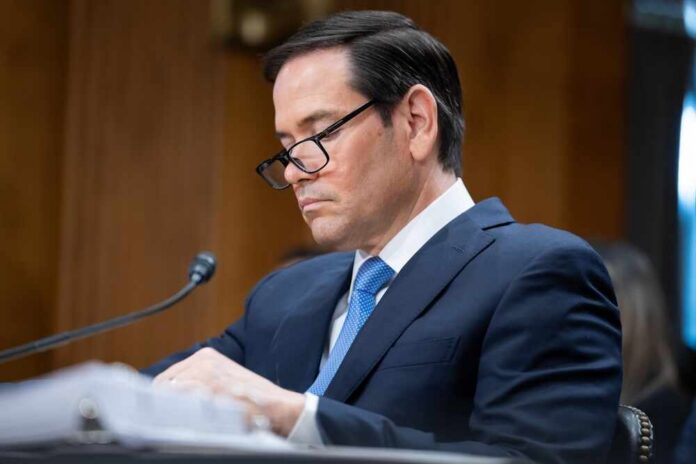
During a House Foreign Affairs Committee hearing, Democratic Representative Sydney Kamlager-Dove confronted Secretary of State Marco Rubio over his role in managing Venezuelan oil revenues under the Trump administration’s sanctions and licensing policy.[2][3] Kamlager-Dove said that five months earlier Rubio had “essentially become the new overlord of Venezuela,” claiming he now helped decide which companies gained access to the country’s oil and minerals.[2][3] Video of the exchange shows her repeatedly pressing him, then leaving as Rubio tried to answer, prompting him to ask, “Why is she leaving?”[1][2]
Kamlager-Dove argued that the administration had provided “no real transparency about where the money is going and who is benefiting from this arrangement.”[2][3] She said it “looks unseemly” that Venezuelan oil money was being routed through “a network of campaign donors, corrupt politicians, lobbyists,” while Congress could not obtain documentation.[2][3] She added, “We can’t get any documentation on that. We don’t have any receipts,” and complained that lawmakers had “zero visibility into the contracts that are awarded.”[2][3] After the back‑and‑forth, she exited the hearing room as the chair moved to the next member.[1][2]
Rubio’s Defense: Blocked Accounts, Big Auditors, And Allowable Uses
Rubio responded that Kamlager-Dove was “absolutely wrong about the way the money flows” and rejected the corruption framing.[2] He explained that proceeds from Venezuelan oil sales are deposited “in a treasury blocked account at City Bank,” rather than moving freely through private channels.[2] According to Rubio, that account “is audited by KPMG,” and the Venezuelan government pays the firm from those funds “to audit every single expenditure.”[2] He said there is a list “agreed to by both sides” that limits what the money can be spent on, and insisted it “doesn’t go to the individual benefit of anybody.”[2]
Rubio’s description, if accurate, suggests a formal structure with third‑party oversight, which undercuts the most extreme version of the claim that there is no accounting system at all.[2] However, the public record so far shows only his assertion about KPMG and the blocked account, not the audits themselves.[2] The hearing excerpt does not include any engagement letters, audit reports, or contract files that would let Congress or the public verify how comprehensive the oversight really is.[2][3] That gap fuels continued suspicion from critics while supporters point to the auditor’s name as proof that concerns are overblown.[2][3]
Transparency, Documentation, And A Government Most Americans Do Not Trust
Kamlager-Dove’s criticism in the hearing matches a broader statement from her office accusing Rubio’s State Department restructuring plan of being developed with “zero input from Congress,” reinforcing her narrative that major decisions are being made without meaningful legislative oversight.[1] Her line of questioning framed talking points about audits as a substitute for hard evidence, telling Rubio that “talking points are never a replacement for transparency and documentation.”[3] She demanded commitments to return with the people monitoring oil sales and with the underlying data, emphasizing that “the onus is on you to prove that there is no corruption happening.”[3]
The clash taps into frustrations shared by many on the right and left who see a federal government that hides the details when big money and foreign policy intersect. Americans who worry about “globalist” deals, offshore accounts, and entrenched elites hear a lawmaker say “no audits” and “no receipts” and see their fears reflected.[2][3] Others who distrust corporate power and foreign influence hear about a secretary acting like a “kingmaker” in Venezuela and question whether any party in Washington is really on the side of ordinary citizens.[2][3] So far, neither side in this dispute has fully opened the books, leaving the public once again asked to choose between competing talking points instead of hard documents.[1][2][3]
Call me crazy but I like both Marco Rubio and Democrat Rep. Sydney Kamlager-Dove who wouldn't let him speak. https://t.co/df689z54Jq
— Moral Politics 🖋️ Malloy (@Moral_Politics) June 4, 2026
Sources:
[1] YouTube – Rep. Kamlager-Dove storms out of House hearing with Marco Rubio after …
[2] Web – Kamlager-Dove Statement on Rubio’s State Department …
[3] YouTube – ‘WHY IS SHE LEAVING?’: Rubio mocks Kamlager-Dove’s …