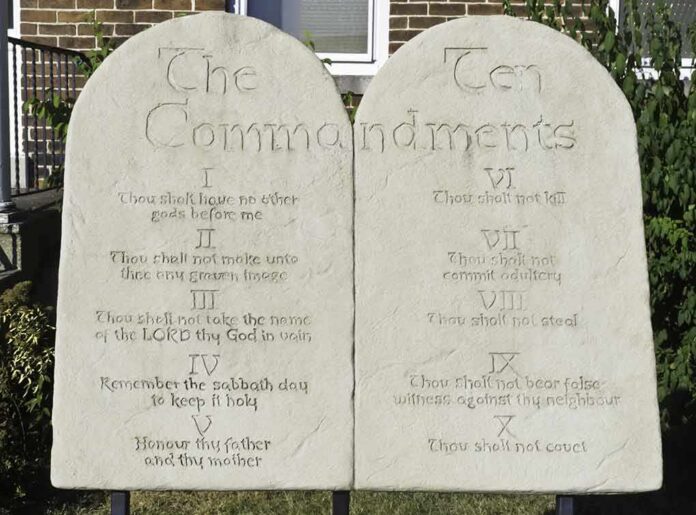
A razor-thin federal appeals court let Texas require Ten Commandments posters in every public school classroom, and now the American Civil Liberties Union wants the Supreme Court to step in.
Story Snapshot
- The Fifth Circuit, by a 9-8 vote, upheld Texas’s classroom Ten Commandments law and reversed a lower court block.
- Texas families represented by the American Civil Liberties Union filed a Supreme Court petition challenging the law.
- Texas’s attorney general told districts not covered by injunctions to display the posters under Senate Bill 10.
- The fight centers on whether classroom displays coerce students or reflect history and tradition.
What the Fifth Circuit Decided and Why It Matters
The United States Court of Appeals for the Fifth Circuit ruled 9-8 that Texas’s Senate Bill 10 does not violate the First Amendment. The court reversed a federal district court order that had blocked the law, and it dismissed the families’ claims. The opinion concluded that the displays fit within a history-and-tradition approach and are not an establishment of religion. The narrow margin signals legal uncertainty and invites higher review, which often follows close, high-profile splits.
Texas Attorney General Ken Paxton instructed school districts not under court orders to comply and display the posters once the law took effect. He argued the Ten Commandments are part of America’s legal and moral heritage. He also said districts must accept qualifying donated posters if offered, reducing costs while keeping the mandate in place. Supporters frame the display as passive and historical, not a sermon or required exercise.
Why the Families Are Seeking Supreme Court Review
Texas families represented by the American Civil Liberties Union, the American Civil Liberties Union of Texas, Americans United for Separation of Church and State, and the Freedom From Religion Foundation asked the Supreme Court to take the case. Their petition argues that Supreme Court precedent in Stone v. Graham struck down a similar classroom posting law and that public schools are a uniquely coercive setting for children. They say the Texas mandate pressures religious minorities and nonreligious students.
Earlier in the case, a federal district court temporarily blocked the law, finding likely constitutional problems under the Establishment Clause. That block was short-lived after the Fifth Circuit’s en banc ruling. The shift from a temporary block to a final dismissal shows how much the outcome depends on which legal test applies and how judges read the Court’s newer history-and-tradition approach. The families now seek clarity from the Supreme Court on which rule controls.
The Legal Test at the Heart of the Dispute
Supporters of the law lean on recent Supreme Court rulings that favor historical practice when judging religion cases. They point to decisions that protected religious expression and monuments on public land, and they argue that classroom posters are a passive display with civic value. Critics respond that Stone v. Graham condemned classroom postings as lacking a secular purpose and that schools differ from other public spaces because students are a captive audience. The conflict turns on which line of cases the Court applies.
Supreme Court asked to hear case on Texas law requiring Ten Commandments in schools https://t.co/zNngNHW91r
— On Line English (@OLE_Marjory) August 18, 2026
The stakes reach beyond Texas. Other states have tested religious displays and school prayer rules, and lower courts have split on how to apply the newer approach. A clear Supreme Court ruling would guide school boards, teachers, and parents nationwide. Without it, districts face lawsuits from both sides. Many families, left and right, already doubt that officials put students first. A confused rulebook adds cost, fuels division, and erodes trust in basic governance.
Sources:
foxnews.com, cbsnews.com, aclu.org, texastribune.org, nytimes.com, scotusblog.com