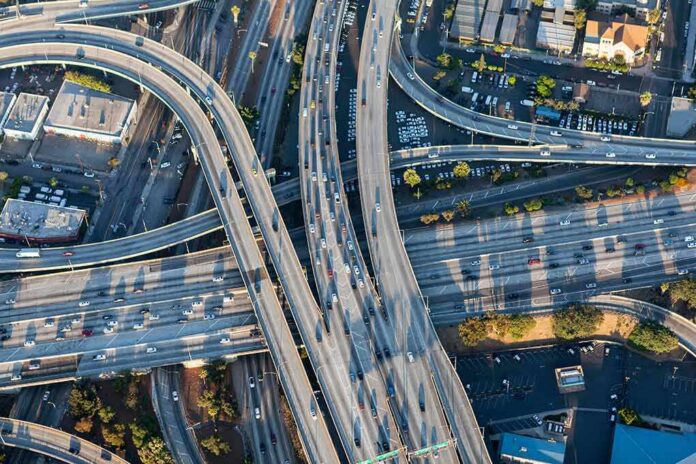
The fury over a key 101 Freeway ramp closing for months in suburban Los Angeles is really a clash between daily commuter pain and a long-running effort to keep the region’s wildlife — especially its embattled mountain lions — from disappearing altogether.
Key Points
- The northbound US‑101 on‑ramp at Liberty Canyon Road in Calabasas/Agoura Hills is scheduled for a long-term closure tied directly to final construction on the $114 million Wallis Annenberg Wildlife Crossing.
- The crossing is designed to reconnect fragmented habitat across the 10‑lane 101 and adjacent Agoura Road, allowing safe wildlife movement between the Santa Monica Mountains and ranges to the north.
- Research by the National Park Service and project partners shows mountain lions in the Santa Monica Mountains face genetic collapse and possible local extinction without new connectivity.
- Like many major infrastructure and conservation projects, the crossing delivers long-term ecological and safety benefits but imposes short-term traffic disruption and frustration on nearby residents and commuters.
What the Ramp Closure Is Really For
The controversy centers on Caltrans’ decision to shut down the northbound 101 on‑ramp at Liberty Canyon Road around the clock for roughly two months, a closure that local cities and media have flagged as a serious inconvenience for drivers moving between the western San Fernando Valley, Calabasas and Malibu. This is not a generic roadwork job; Caltrans’ own project notice states explicitly that the closure is to allow crews to place rock and landscape materials on the Wallis Annenberg Wildlife Crossing, which is being built immediately west of the ramp. In parallel, Agoura Road — the frontage and detour route parallel to the freeway — has faced waves of full daytime closures as crews pour concrete, build abutment walls, and install “false work” supporting the crossing’s structural elements.
For drivers, those details may feel academic; what they experience are detours, overnight freeway shutdowns, and weeks of lane restrictions. But technically, this ramp closure is one of the last pieces of a tightly choreographed construction sequence. The crossing has already spanned the freeway itself; the current phase focuses on tying the structure into surrounding hillsides, completing habitat on the deck, and building the secondary span over Agoura Road so animals never have to drop down to pavement. That work requires space, safety margins, and uninterrupted access for heavy equipment — conditions that are difficult to guarantee with live traffic flowing just feet away.
Inside the Wallis Annenberg Wildlife Crossing
To understand why transportation agencies and conservation groups are willing to absorb political heat over closures, you have to look at what the crossing is designed to do. The Wallis Annenberg Wildlife Crossing at Liberty Canyon will be the largest vegetated wildlife bridge in the world, spanning ten lanes of the Ventura Freeway plus Agoura Road and connecting protected open space on both sides. The project occupies the last viable passage point in the central Santa Monica Mountains where public lands face each other across the highway, about 1,600 feet of corridor that decades of scientific work identified as the region’s best chance to restore connectivity.
Biologists from the National Park Service and partner institutions have documented for more than twenty years how US‑101 functions as a hard barrier for wildlife, especially for wide-ranging carnivores like mountain lions and bobcats. Male mountain lions dispersing from their natal ranges rarely make it across; many die attempting to cross the freeway, and those that remain in the isolated Santa Monica range increasingly breed with close relatives, driving genetic diversity to alarmingly low levels. The crossing is engineered as green infrastructure rather than a simple concrete flyover: its deck will carry nearly a dozen acres of restored chaparral, coastal sage scrub and oak savannah, planted with roughly 50,000 native plants to mimic the surrounding mountains. Hydrology is being reconnected as well, with ephemeral creek corridors and ridgeline restorations that match the routes animals already use on either side of the road.
How a Wildlife Bridge Ends Up Closing Ramps
Bridges of this type are not just sculptural landmarks; structurally they are complex, multi-phase undertakings. Caltrans’ project description notes that the Liberty Canyon crossing not only spans the freeway but must interface with existing bridge structures, accommodate buried utilities and maintain freeway operations during construction. The construction sequence has therefore unfolded in layers: nighttime directional freeway closures to lift massive beams into place, extended daytime closures on Agoura Road to pour deck concrete and build abutments, and now ramp closures to safely truck in rock, soil and habitat materials.
The Liberty Canyon on‑ramp functions as both an access point and a construction margin, sitting directly adjacent to the crossing’s western abutment. Closing it 24/7 allows crews to stage materials, maneuver cranes and earthmoving equipment, and build out the vegetated shoulders that will guide animals up and over the freeway. Caltrans has tried to limit freeway-wide impacts by keeping most closures at night, holding to directional shutdowns where possible, and providing signed detours via other ramps and surface roads. Still, for regular commuters, the cumulative effect — weeks of overnight freeway closures, repeated daytime shutdowns on Agoura Road, and now a long ramp closure — feels substantial, especially in a corridor that already carries hundreds of thousands of vehicles per day.
The Science Behind “Reconnecting Fragmented Habitat”
Supporters of the crossing, including the National Wildlife Federation, the Santa Monica Mountains Conservancy and the Wildlife Crossing Fund, frame the project as a direct response to a well-characterized conservation crisis. When large carnivores are confined to small, isolated habitats, inbreeding accumulates quickly; over time, that genetic erosion manifests in physical abnormalities, lower reproductive success and heightened vulnerability to disease. Studies in the Santa Monica Mountains have already recorded signs of such genetic collapse in mountain lions, prompting warnings that the population could wink out within decades if isolation persists.
Wildlife crossings — overpasses, underpasses and associated fencing — are one of the few interventions that have shown measurable success in reversing these trends. In Colorado, for example, a major wildlife overpass and underpass system along I‑25, paired with fencing, cut wildlife‑vehicle collisions by about 91% within a year of completion. Similar projects in Utah, Wyoming and Canada have dramatically reduced crash rates while allowing elk, deer, carnivores and smaller animals to move across highways. The Wallis Annenberg crossing applies those lessons in an unusually urban setting: rather than linking rural habitats, it connects a fragmented mountain ecosystem hemmed in by one of the busiest freeways in the country.
Public-Private Partnership and the $114 Million Price Tag
The ramp closure has reignited debate over cost as well as inconvenience. The Wallis Annenberg Wildlife Crossing is a public‑private partnership, funded by a combination of state transportation money, conservation grants and philanthropy, anchored by a major gift from Wallis Annenberg. Early estimates placed the project around $92–95 million; subsequent inflation, tariffs and construction market pressures have pushed that figure above $110 million, with some recent official and media sources citing totals near $140 million as work nears completion.
Supporters argue that, given the crossing’s anticipated lifespan and ecological role, these are one‑time capital costs analogous to a major bridge replacement or interchange redesign, justified by decades of future benefit. The design team emphasizes that the project is not simply a wildlife “bridge” but a full habitat restoration and climate resilience intervention, including the undergrounding of key utility lines, fire‑hardening infrastructure, and landscape features meant to buffer nearby communities from noise and ecological degradation. Critics, by contrast, point to overruns and ask why scarce transportation dollars are going to animals rather than congestion relief. That tension is visible in social media posts labeling the crossing a “bridge to nowhere” and complaining that a “key road” is being sacrificed for an initiative they see as symbolic rather than practical.
$114M Wildlife Crossing Forces Freeway Ramp Closure in Southern California
A major 101 Freeway on-ramp in Calabasas is closed this week for final work on the Wallis Annenberg Wildlife Crossing. Construction began in April 2022 and has now stretched past four years.
The… pic.twitter.com/uzxMeX9FYA
— Paul A. Szypula 🇺🇸 (@Bubblebathgirl) August 4, 2026
Short-Term Fury vs. Long-Term Gains
The anger around the Liberty Canyon ramp closure follows a pattern familiar from many long-term infrastructure projects. Road users encounter an immediate, tangible loss — a closed ramp, a longer detour, a missed connection — while the promised gains are abstract, delayed and often non-human: fewer collisions in some future year, healthier mountain lions deep in the backcountry, a more resilient ecosystem for species people rarely see. For policymakers, the challenge is to manage that asymmetry without dismissing legitimate commuter frustration.
Caltrans and local cities have tried to strike that balance by sequencing most freeway closures overnight, publishing detailed detour maps, and emphasizing that daytime mainline traffic will remain open through much of the construction window. Conservation leaders, meanwhile, highlight the project’s global profile, its role as a “conservation legacy of the century,” and the public’s own role in funding it — thousands of small donors alongside large institutional gifts. As the crossing enters its final stage, with a public opening planned and research teams preparing to monitor which species cross first, the ramp closure is best understood not as an isolated bureaucratic decision, but as the last disruptive step in a decades-long attempt to keep a corner of metropolitan Los Angeles wild enough for mountain lions to survive.
Sources:
nypost.com, agourahillscity.org, dot.ca.gov, nbclosangeles.com, cbsnews.com, latimes.com, vcstar.com, secretlosangeles.com, cnn.com, laist.com